Postcard From Hardwick: September 1

After an intense week of work and family — of wondering where is this heading? — my daughter locks her keys in her car and texts me. Can I bring my keys? And there’s a sketchy stranger near her, too.

When I arrive, she’s leaning against her car, looking up at the sky, and the sketchy somebody is a dad in the high school parking lot, teaching his kid to drive, in that jerking, slow way my daughter and I both recognize.

I mention that my brother can teach my second daughter to drive.

From a soggy patch in the weeds, a bullfrog croaks.

September 1 today, the anniversary of the fateful day Hitler rolled his tanks into Poland, beginning the war that destroyed so many lives.

September 1, the anniversary of my former inlaws.

This morning, all’s quiet on this green patch of Vermont, overcast, with cricket songs and bird calls, a day that begs reflection.

All I have is a voice
To undo the folded lie...
There is no such thing as the State
And no one exists alone;
Hunger allows no choice
To the citizen or the police;
We must love one another or die.

— W. H. Auden, September 1, 1939


IMG_3115

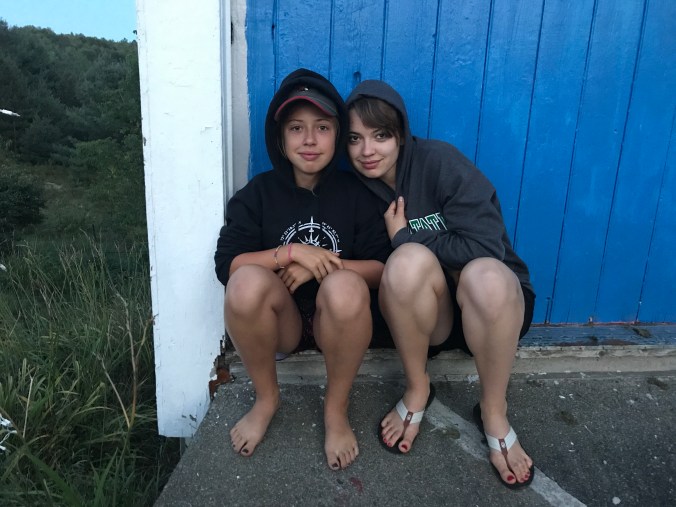
Being 13, Hardwick, Vermont

Turtle Visitor

A wildlife biologist smitten with wood turtles makes an evening presentation at my library, turtle in tow.

The room fills with people I know, and some I don’t know — a little girl from Montpelier with her grandfather whose family has owned a lakeside camp in Woodbury for 100 years. The trustees bring homemade desserts; there’s cold cider; we borrow chairs from the elementary school’s second floor gymnasium. In the humidity, I wipe sweat from my forehead with the school’s paper towels.

An older couple brings their dog, who otherwise would have cowered alone at home, if thunderstorms moved in.

These evenings are a microcosm of small town Vermont: one woman quietly counsels another about obtaining a medical referral. The kids pile a paper plate with brownies. Another woman raids my book sale, asks for a box, and says she’ll drop a check by later.

In the end, I lock up, saying goodnight to the silent 100-year-old schoolhouse. So many people have gone through these doors; so much living has happened here.

In my library, next door, I glance around at a bit of chaos — a pile of old buttons in a pie plate the children have strung into necklaces, picture books on the floor.

Enough for one day. I turn off the light, lock the door, and walk out into the cooling-down rain-sweet night.

And over the grass at the roadside a land turtle crawled, turning aside for nothing, dragging his high-domed shell over the grass: His hard legs and yellow-nailed feet threshed slowly through the grass, not really walking, but boosting and dragging his shell along.

— John Steinbeck, The Grapes of Wrath, 1939

IMG_3110


Ode to the Miraculous Melon

And then there’s this: at the very end of Vermont’s summer months — August 27th, a day of jumbled work and bruised adult egos, a day of existential pondering, after a moonlit night when I consider my very genuine failings as a parent to my oldest child, a day of humidity that ends with my daughters sitting on the bank of the pond while I swim with my friend, in all that cool water, its glassine surface broken in circular ripples with biting fish, and I long to keep swimming, swimming, we drive the 30 seconds home with a garden-grown cantaloupe cradled in my hands.

The melon had already split at its oblong end, vaguely skull- and exposed-brain-esque. As I carry the melon into the kitchen, the girls eye it skeptically. Already, that cracked end is clustered with fruit flies — where did they come from? — and I brush them away quickly with my hand and open the melon with a cleaver. The orange flesh bleeds juice.

With the cleaver, I slice off irregular squares, and then I’m eating it — famished not for the fruit, not for the sugar, not for the sticky liquid — but for the sheer miracle of a hard-shelled seed turned into such sweetness from soil and rain and sunlight, for all that this summer has been — both amazing beauty and clustering flies and ugliness of split rinds and quickly — hush, wait, yes — how just momentarily — we’ll all disintegrate back into that dust.

But not yet. Not this evening, with its creamy, rising nearly-full moon, two girls and two cats, a handful of chickens, and the crickets all night long, their songs still soldiering solidly.

IMG_3092


Omen

Running on the trails behind the high school today, a owl swoops through the woods, heads along the path, and then veers rapidly into the canopy. I run after him, but he’s gone.

Omen, clearly. But of what?

My luck to see this winged beauty?

Or a warning to keep my eyes open? Or just an owl searching for supper? I can look back on my life now and see all kinds of omens I missed — or blatantly ignored — but maybe, I keep thinking, those were merely owls, then, too….

Then, sometime during the fourth year, the omens will abandon you, because you’ve stopped listening to them.

— Paulo Coelho, The Alchemist

IMG_3074


Family Lore

My father, visiting, tells the story of his parents driving from Michigan to California, in the fall of 1941. I imagine my father, 4-years-old in the backseat with his much older sister, his parents driving an American-made car on innumerable two-lane highways, in the time when cars were made with tank-quality metal.

Decades before blue jeans and seatbelts, his parents — both Romanian immigrants — must have been on the immigrant road again, traveling not for leisure but to size up the Golden State: could they make a living in this land of sunshine?

They returned with the intention to sell their business and property and move. That early winter, however, the Japanese bombed Pearl Harbor. With the country at war, moving was no longer an option.

In the blue predawn, I lie awake, thinking of the journey of these people, a grandfather I never met, my grandmother and aunt, now long dead. How this terrible war ended the California dream of my grandparents, but made their grocery business; how my dad enrolled in the University of Michigan in Ann Arbor, where he met my mother; and that his sister lived her adult life in southern California.

All a mystery, perhaps, that journey cloaked in the murky past — and yet not, the consequences of those years still unwinding in my life — and my daughters’ lives.

I saw in their eyes something I was to see over and over in every part of the nation — a burning desire to go, to move, to get under way, anyplace, away from any Here… Nearly every American hungers to move.

— John Steinbeck, Travels with Charley: In Search of America

IMG_3067

Postcard from Hardwick, swimming, 2018

Kidness

I’m at a restaurant in town with my parents, expecting to meet my daughters. My older daughter walks in alone, and I ask, What’s up? Where’s your sister?

She’s busy apparently, in a kid kind of way, hiding in the back of her friend’s car, so she and the friend can surprise the friend’s mother.

Well, I think, good luck to the mother.

In a few minutes my daughter appears, in soccer practice shorts, her face tanned and glowing. That, she says, was so fun. She assures me the mother wasn’t angry, preoccupied with a math homework assignment, instead.

In the early morning dark, I lie awake, listening to the crickets’ low sizzle. Like the lilacs, the mating songbirds have finished for this year. On the grass beside my garden lies a swimming floatie that needs to head back into the barn.

End of August, turn of seasons. Except, perhaps, if you’re in the season of being 13: keep on being 13 for a while yet.

Here’s an unrelated quote from what I’m reading: Lauren Markham’s The Faraway Brothers: Two Young Migrants and the Making of an American Life:

The United States cannot at once be isolationist — build a wall, kill the trade deals — and global, selectively reaping the benefits of an international economy, like lower-cost imports, cut-rate outsourced workforce, and cheap labor in our fields here at home. We have played a major part in creating the problem of what has become of Central America, and we must play a major part in solving it.

IMG_3055