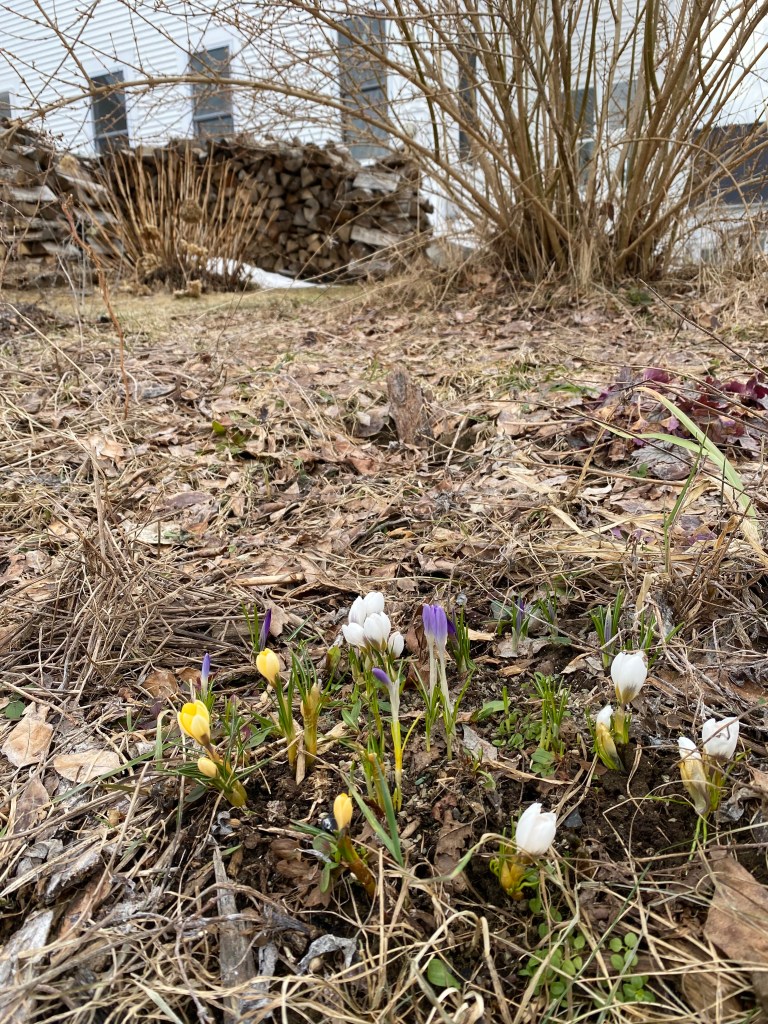
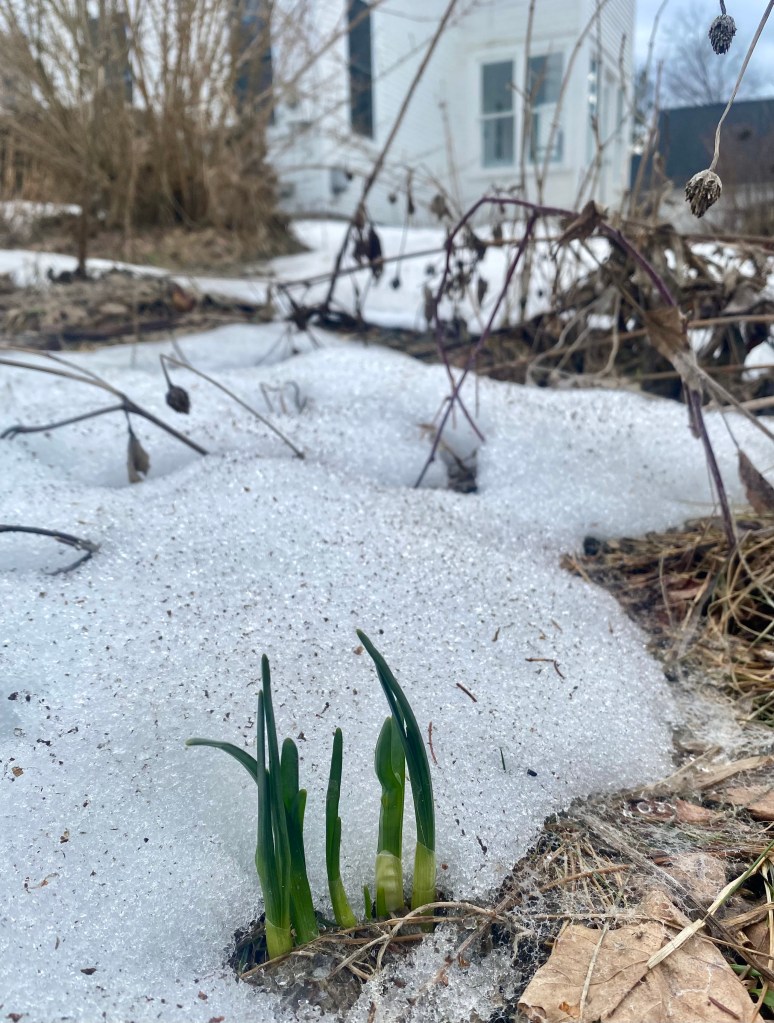
Beyond words.

A few days of streaming sunlight. I wander around outside, over the crusty remains of snow, the thawing grass. The garden yet lies covered. A junco picks at seed scattered beneath the feeder. This far along in the chemo, staring at the end, I’m hard used up, muscles withered, fat trimmed near to my bones. But here, here, alive.

My life – physically, mentally, economically, spiritually – has been crumpled up by disease. Now, ahead, lies the unfolding, the remapping. A friend visiting with her three-year-old, with daffodils and chocolate, points out what I’ve recently reckoned with: that my fierce independence, my raving insistence to live my life, on my own terms and never shaped to the pattern of any man (as Tillie Olsen wrote), has long been my lifeline, the way through lean times, betrayal, uncertainty. But cancer, that mighty devil, flipped that in my face and revealed it as my hollow weakness, too.

Day by day here, determined to remain free from the hospital, to finish to the final drop this course of so-called treatment, glean back what I can salvage. Four months ago, I didn’t think I would live to see this season’s Chionodoxa blue flowers. This afternoon, my daughter and I remarked that the walnut tree I planted seven years ago as a mere twig has plump buds on its lengthy branches. Buds, blossoms, leaves. Beyond words.

“Why do you want to shut out of your life any uneasiness, any misery, any depression, since after all you don’t know what work these conditions are doing inside you? Why do you want to persecute yourself with the question of where all this is coming from and where it is going? Since you know, after all, that you are in the midst of transitions and you wished for nothing so much as to change. If there is anything unhealthy in your reactions, just bear in mind that sickness is the means by which an organism frees itself from what is alien; so one must simply help it to be sick, to have its whole sickness and to break out with it, since that is the way it gets better.” ~ Rilke

Calendar (and actual) spring…

In my rinse-and-repeat pattern of this long winter, driving back from Dartmouth in the late morning, sunlight sprawling over the brown fields, the tree limbers along the interstate beginning the season’s cutting, I notice the Connecticut River has thawed. Unmutable sign the back of this mighty winter has cracked.

Home, my yard half-buried yet in twig-strewn snow, the ash buckets mark their winter resting place, a chaos of cinders that touch the edge of the quartz-pebbled rose garden my youngest and I made, years ago.

Later, a friend stops by with good cheer and belated and welcome Christmas presents. The sun is yet bright. We walk, slowly, slowly, on the short stretch of dead-end road before my house. I point to a robin perched in a pin cherry. She spies last summer’s hornet nest spun into the lilacs, a nest on the neighbor’s windowsill.

We were once neighbors ourselves. In mud season, we walked with our little kids up and down our back road, taking our time as the kids searched for frog eggs in the roadside ditches and tender green folds pushing up through matted brown leaves in the forest: the first spring beauties and trout lilies, bloodroot. Now, during my last hospitalization, her son repaired my daughter’s car, stayed for dinner and conversation.

Too snowy and wet to sit down, I lean against my car’s bumper. A robin chirps in the neighbors’ sugar maple, an expanse of curved trunk and branch and twig. Such a meager peep peep this rust-bellied hand-sized creature makes, prying winter away, thrusting our world towards nest building, egg laying, song.

“Against Panic” by Molly Fisk

You recall those times, I know you do, when the sun  

lifted its weight over a small rise to warm your face,   

when a parched day finally broke open, real rain   

sluicing down the sidewalk, rattling city maples   

and you so sure the end was here, life a house of cards   

tipped over, falling, hope’s last breath extinguished   

in a bitter wind. Oh, friend, search your memory again —   

beauty and relief are still there, only sleeping. 

A cup of tea, surrounded by ice, broken boards.

In the pale blue dawn, I wake with the taste of wild mushrooms in my mouth. In my dream, I’m eating tender stems from a soft paper bag. In the non-dreaming chemo world, I’m temporarily forbidden from dining on fresh anything from the produce world, but in this nubbly dream I munch on, relishing the residual taste of dirt, the forest itself.

I open my eyes. Day 4 – oh, I am counting these 21 days until the sixth of these six chemo sessions – Day 4, and through my window, geese wing across the sky. These past few days, spring blew in, fierce sun. On my back deck, broken by ice, a friend stopped by yesterday. I made tea, and we talked about this and that, kids and disease and politics, when we might plant spring peas. On my desk waits a cardboard box of wildflower seeds, a gift for this summer.

Spring is radiant light and also brokenness. The ash buckets trailing coals, the deck joists smashed by the roof’s ice, the barn still desperately in need of paint. Me, too, broken, with my few hours of clarity in the mornings, the stumbling way I’m heading towards this final treatment. Around me, too, the remains of this winter: people who have helped me more than I could have imagined, others who have distanced themselves, the disease itself, perhaps, too much, the leer of mortality a shivering thing. All that is neither here nor there. The cancer has stolen a share of my vitality, my economic steadiness, a winter of my life. And yet, all these pinwheeling days and nights as I’ve traversed this tunnel – what an infinitely rich journey, one I never would have booked a ticket to join.

My daughter sends word of singing redwing blackbirds. Spring, mightier than winter’s brawn. The season of planning, putting things back together, rearranging and cleaning, of tipping our eyes up to the sun, relishing the light.

…. Ariel Gore repeatedly quotes Audre Lorde’s The Cancer Journals in her Rehearsals for Dying. In these lines, I was reminded how we each respond to crisis in others’ lives, too, from the soil of our lives.

Each woman responds to the crisis that breast cancer brings to her life out of a whole pattern, which is the design of who she is and how her life has been lived.

After an absence, return.

Photo by Molly S.

A long while away from this space after a day last week that began easily enough in our kitchen with my daughter and transpired into another Dartmouth ER visit and a prolonged stay. Days and nights chopped into mosaic pieces. MDs and RNs, the revolving cast of the Dartmouth surgical team, my daughters, pain meds, ice chips, me sitting up and begging for a patch-up to get me to my next chemo appointment… Get me out of this chronic patient repeat.

Now, five of the six chemo treatments completed, I am in the final haul. While my in-box filled up (thank you for your patience), and I was moved from room to room by kind people, I kept thinking of this cancer in a narrative arc. I had hit the section of story where the impossible commences. Before, things looked grim. But now, as protagonist in my own story, the arc swerves sharply, the longed-for light-at-the-end of the tunnel snuffs out, the path is hidden.

I’m not a writer for naught, for make-believe or play. I’m a writer because I know our lives tread meaningful albeit sometimes horribly hard paths. Lean in, I counseled myself, my shoulders far skinnier now but just as fierce. Use math. Get to the fifth infusion. Get to the sixth. Count down the finite days to the end of this treatment, which is, thankfully, eradicating the cancer. In the mosaic: my two daughters, the plastic IV tubing, the doctors in their masks, the ER nurse who stayed long past his shift in the middle of the night, holding my hand and assuring me that, yes, indeed, I would endure.

This is my story, but also the human story, in all our infinite variations of human desire, choice, the immutability of fate.

Sunny morning in our kitchen, birdsong, the fierce thrust towards spring.

Go for a walk around the block?

March 7, my father’s 88th birthday today in what is doubtlessly sunny New Mexico. So much for my plans, months ago, to visit him on this day.

Here’s the thing about living such a long life — I could pick countless numbers of things to write about, but what I woke up thinking about this morning was how my dad would often say, “Let’s go for a walk around the block.” At any time of day, we’d set off. Sometimes just up the street and actually around the block, or other afternoons on hours-long rambles through the woods behind our neighborhood. We walked in sunny days, through sleet, through knee-deep snow, in the sweet spring rain. It’s a habit all three of his children have continued our whole lives, and his four grandchildren, too.

Sunny, here, in northern Vermont, too, a day of such optimism that the blue sky choruses the inevitable promise of spring. And for my father, one of our favorite poems from the unmatchable Hayden Carruth.

Birthday Cake

For breakfast I have eaten the last of your birthday cake that you
had left uneaten for five days
and would have left five more before throwing it away.
It is early March now. The winter of illness
is ending. Across the valley
patches of remaining snow make patterns among the hill farms,
among fields and knolls and woodlots,
like forms in a painting, as sure and significant as forms
in a painting. The cake was stale.
But I like stale cake, I even prefer it, which you don’t
understand, as I don’t understand how you can open
a new box of cereal when the old one is still unfinished.
So many differences. You a woman, I a man,
you still young at forty-two and I growing old at seventy.
Yet how much we love one another.
It seems a miracle. Not mystical, nothing occult,
just the ordinary improbability that occurs
over and over, the stupendousness
of life. Out on the highway on the pavement wet
with snow-melt, cars go whistling past. 
And our poetry, yours short-lined and sounding
beautifully vulgar and bluesy
in your woman’s bitterness, and mine almost 
anything, unpredictable, though people say
too ready a harkening back
to the useless expressiveness and ardor of another
era. But how lovely it was, that time
in my restless memory.
This is the season of mud and thrash, broken limbs and crushed briers
from the winter storms, wetness and rust,
the season of differences, articulable differences that signify
deeper and inarticulable and almost paleolithic
perplexities in our lives, and still
we love one another. We love this house
and this hillside by the highway in upstate New York.
I am too old to write love songs now. I no longer
assert that I love you, but that you love me,
confident in my amazement. The spring
will come soon. We will have more birthdays
with cakes and wine. This valley
will be full of flowers and birds.

Finding Jesus with the star sunglasses…

Home again and somewhat shocked to see an ice floe leering off my back roof, not exactly the size of A23a Iceberg, but approximating it….

I’m under strict orders to drink broth, eat saltines, lie on the couch and read — the last two I’ve been perfecting for months now. As for the rest of the order (this is the only thing you should be doing, Brett), I’ve been quietly breaking rules for years. Now, intimate with cancer and my mortality, I push myself to obey the orders, stick with the plan, follow the course precisely.

The winter thaws. The iceberg chips, shifts. I step outside and lean against my house in my down jacket that is now limp and beaten down, a sad thing that, this quarantined winter, I’ve used so little. How will my thousand words a day fit into these orders? A grant deadline looms. When will I put on my clean shoes and that linen sweater I knitted and return to work? A cardinal perches on the railing.

In those 48 hours I spent in the Dartmouth ER, in a beige isolation room, an upbeat nurse with amazing eyelashes occasionally stopped in to cheer me and whoever of my daughters was there. On the TV, which we never turned on, she pointed out a tiny orange plastic duck, and told us someone had placed small figurines all over the hospital. “I found Jesus,” she said. “I know that’s weird, to go around a hospital saying I’ve found the Man, but really…” She reached in her pocket and pulled out an inch-high plastic Jesus in a long robe, black curls, gold star sunglasses. He smiled so widely his teeth gleamed.

In that same room, I spied a second duck, brought the ducks home with me and lined them up on the bathroom mirror beside the wooden blue elephant from the Metropolitan Museum my daughter gave me. Two tiny things that arrived in my pocket, after a week of manifold things, after months of many manifold more. All day, it will rain, the warmth softening that iceberg on my roof, falling on the deck and breaking the wood, or not. If it’s broken, we’ll repair it this summer. If not, we’ll move on to the next thing.

And utterly seasonally inappropriate, here’s a Galway Kinnell poem I’ve been loving:

Blackberry Eating

I love to go out in late September
among the fat, overripe, icy, black blackberries
to eat blackberries for breakfast,
the stalks very prickly, a penalty
they earn for knowing the black art
of blackberry-making; and as I stand among them
lifting the stalks to my mouth, the ripest berries
fall almost unbidden to my tongue,
as words sometimes do, certain peculiar words
like strengths or squinched,
many-lettered, one-syllabled lumps,
which I squeeze, squinch open, and splurge well
in the silent, startled, icy, black language
of blackberry-eating in late September.