Vermont Day.

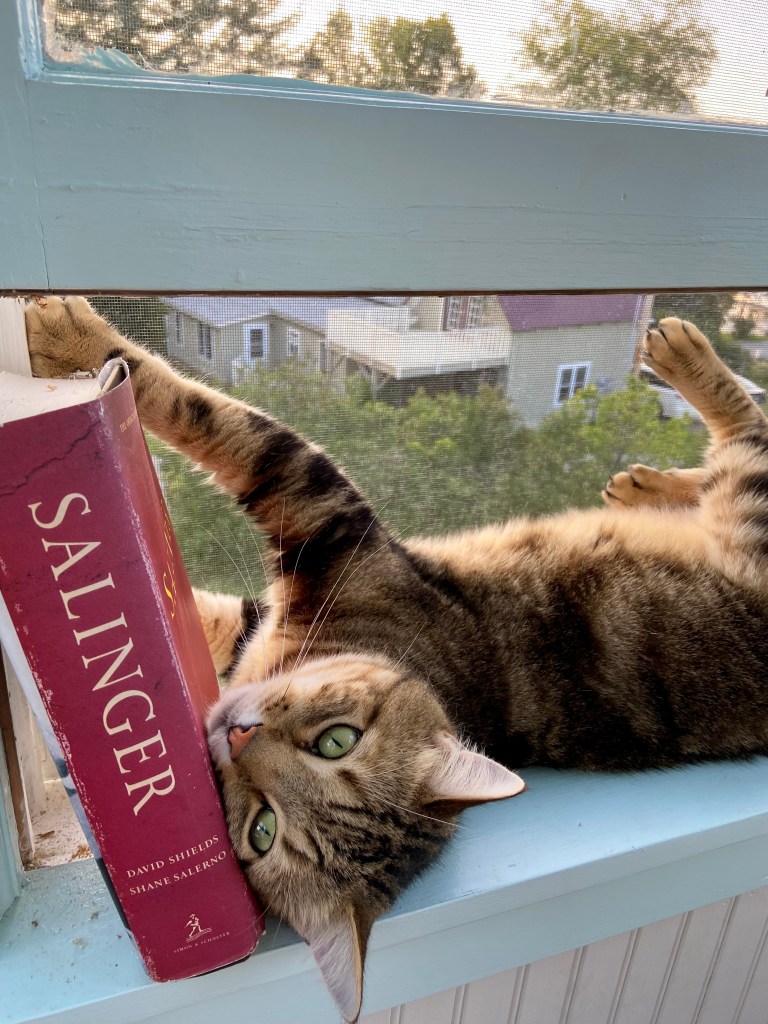
Soccer practice begins. School looms. In the night, I wake and wonder what does any of that mean anymore? What is this strange time? Sleepless, I read The Farm with a cat on my feet. Through the open window, the humid night swallows sound, the crickets’ nighttime singing almost a whimper. Unlike the raucous spring mating season, late summer sounds dwindle.

But the season is fat, full. I dream of delicata squash lying on the ground, beneath their wide leaves.

*

My youngest sits on the couch beside me, with a bag full of pens and paper that her uncle bought her for school. She snaps open her binder and replaces last year’s ragged dividers with unmarked manila pages for this year. On the tags, she writes CALC, then APUSH, outlining her junior year courses.

I pick up my knitting — yarn I’ve unraveled from a previous sweater I never finished. Maybe this project will remain on the needles forever, too.

*

Sebastian Junger, one of my favorite writers, collaborated on a documentary, The Last Patrol. Combat veterans take a long foot journey, searching for what’s good about America — particularly relevant these days.

“The public is often accused of being disconnected from its military, but frankly it’s disconnected from just about everything. Farming, mineral extraction, gas and oil production, bulk cargo transport, logging, fishing, infrastructure construction—all the industries that keep the nation going are mostly unacknowledged by the people who depend on them most.” 

― Sebastian Junger
One Word.

Yesterday, I kept remembering when we took our youngest camping beside a pond when she was two. She pointed to a purple flower growing in the water and learned to say pickerel. For days, she practiced that word, pick-er-el, saying it slowly and carefully, over and over.

Fourteen years later, she’s mastered that name and much more, working for days last spring at what appeared to me to be pages of math. She won’t remember one bit of that trip, but it’s in her, still.

In the evening, my daughters disappear to go running. I wash up dishes, then sit outside near the garden and where the wilderness edges up behind our world, with milkweed and raspberry brambles. As the dusk filters in, I read. The late summer crickets chirp their songs, and the world keeps moving on and on at what it does.

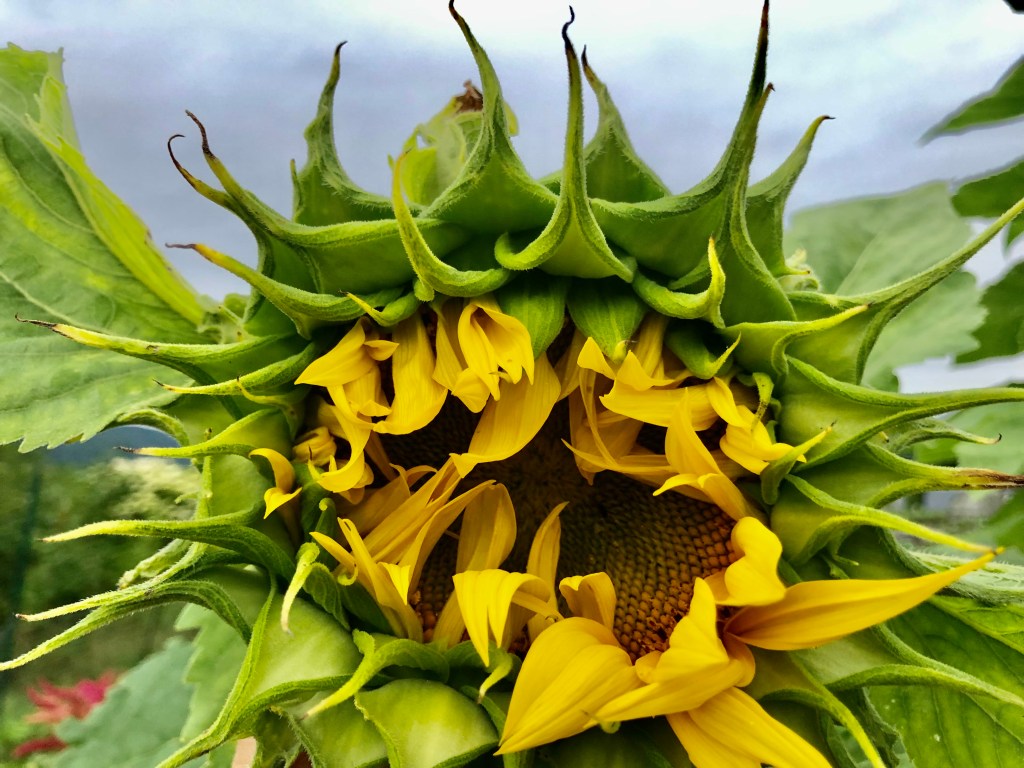
Sunflowers. Japanese beetles in the green beans. Tomatoes red on the vine. The rich scent of the promise of rain moving in.

Come

Let us dine on barley grain

On a journey nowhere“

— Bashō

So Much Water.

In the chilly August evening, my friend and I swim after dinner, while our families kick sand on the beach. We swim into the sunset, and I’m on the verge of shivering before we hit the ropes that mark off the swimming area.

When we return, the beach has been emptied of everyone except our families, and a little girl who wanders, eating from a bag of potato chips while her mother reads a tablet. The breeze raises goosebumps on my skin, and I pull clothes over my wet swimming suit.

I ride home with my youngest, the seat warmer toasty, the car’s windows filled with the sunset’s iridescent strawberry.

She wants me to trust her driving. Because I am me, I feel all around us the coldness of autumn creeping in, and how that cold whispers its own story. This evening, though, I lean back in her car, my bare feet shedding sand on her floor, and let her drive.

A half moon rises over the hillside, the pearl color of shell’s interior.

Whither goest thou, America, in thy shiny car in the night?”

— Jack Kerouac
Greensboro, VT

August. Somewhere.

In the midday heat, my youngest drives us north, following vague directions, and we hike along two small ponds. The merest wind blows, ruffling sunlight over the water like sparkling scales.

Through the woods, we follow a trail up and then sit on a rocky ledge, admiring the view, drinking water and eating crackers and talking. The humidity reminds me of summers in southern New Hampshire, and how a summer seemed so long as a kid.

The sticky heat spreads out this day, elongates it. There’s plenty more ahead — my daughter heads into work and then goes swimming with a friend; I write on the back porch; my oldest returns from work and attends class on the upstairs porch; our cat catches his claw on the window screen. Rain falls.

But before all that, my youngest and I stop by a farmstead, and eat drippy and creamy-delicious vanilla ice cream cones. As we get into her car to leave, my daughter bites into a fresh peach. A friend pulls up beside us, and we talk for a bit. Our conversation winds quickly to work and misogyny. My friend apologies to my daughter for our conversation flying around.

My daughter asks politely, What? and pauses with that half-eaten peach in her hand.

My friend says, Oh, she’s in that lovely peach world.

Hard-working house cat, Acer.

Night Driving.

I had dinner with six other adults last night at a restaurant beneath a tent. Across the table from me, one man said he didn’t think he’d eaten with that number of people in, well, what seemed like forever.

Ditto, me.

I’d driven down I-91 along the Connecticut River to meet the team at Steerforth Press and talk about my book Unstitched that will be published in a month.

On my way home, I drove out of New Hampshire in the dark that had fallen while we were talking and telling stories. I drove away from the congestion of Dartmouth, and then north again, into the deepness of Vermont. The day was still humid and sticky with summer, and I left the windows open, while I listened to The New Yorker‘s Atul Gawande talk about the Delta Variant.

I remembered driving in the dark in my mid-twenties, alone, over the Continental Divide. At the top, I parked and stretched. Although it was summer then, too, the elevation’s chill made me shiver in my t-shirt and shorts. In the women’s room, drying my hands under a stream of hot air, I chatted with an elderly woman. Where she was going, and what she was doing, I’ve long since forgotten, but I remember stepping outside the little building with her and admiring the stars.

So many years later, I sped through the warm and velvety night.

At home, my daughters had left the little string of lights on in the living room, and the back porch lamp glowed. Our house, freshly painted white, glimmered a little as the clapboards rose above the woodpile and purple echinacea. The cats sat at the door, watching moths, or maybe waiting for me.

A few minutes early to New Hampshire yesterday, I walked through a park and discovered a community garden devoted almost exclusively to flowers. A woman and her dog paused and watched me admire the blossoms. The poodle suddenly stood up on its hind legs and barked a hello. I laughed. The woman nodded. Then she went her way, and I went mine.

Heat. Past. Swimming.

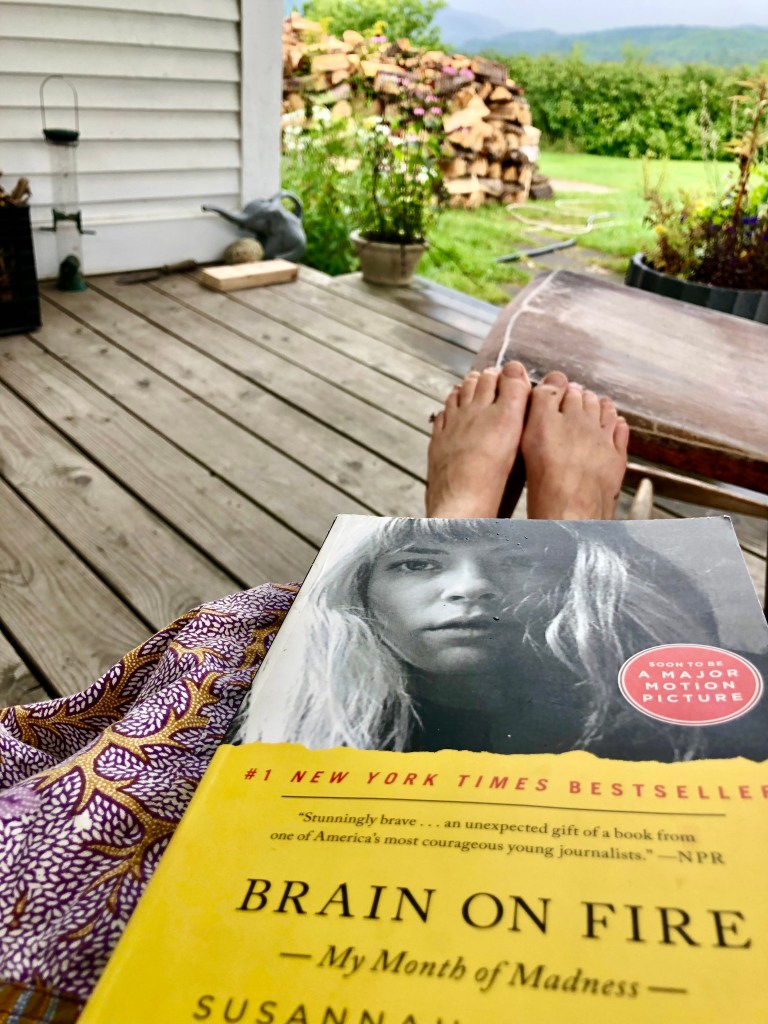
For a chunk of this weekend, I read Susannah Cahalan’s memoir about the madness that attacked her body, the book so many people I knew read a few years ago, and I picked up from a roadside free pile this week.

The heat’s returned, with fine swimming weather and thunderstorms. Sunday evening, we kayak in Greensboro, carrying out bacon and tomato sandwiches and watermelon. Afterwards, I swim far out from shore, and swim back slowly, watching my daughters who lie on the pier, talking.

At home, I walk around the house, opening windows to let in the evening’s cool air, hanging towels over the porch railings, talking to my brother on the phone. He tells me about listening to S-Town. Over the porch railings, I see Japanese beetles clustered on the primrose.

Cahalan’s book asks that hard question: how much of our lives do we direct? Who’s in the driver’s seat? My brother keeps talking, and around us the past rises. “You can’t escape that shit,” he says.

I stand on the porch steps, watching my daughters unload the kayaks. Rain has skipped over us. In the morning, I’ll need to water.

“Maybe it’s true what Thomas Moore said: “It is only through mystery and madness that the soul is revealed.” 

— Susannah Cahalan, Brain on Fire: My Month of Madness