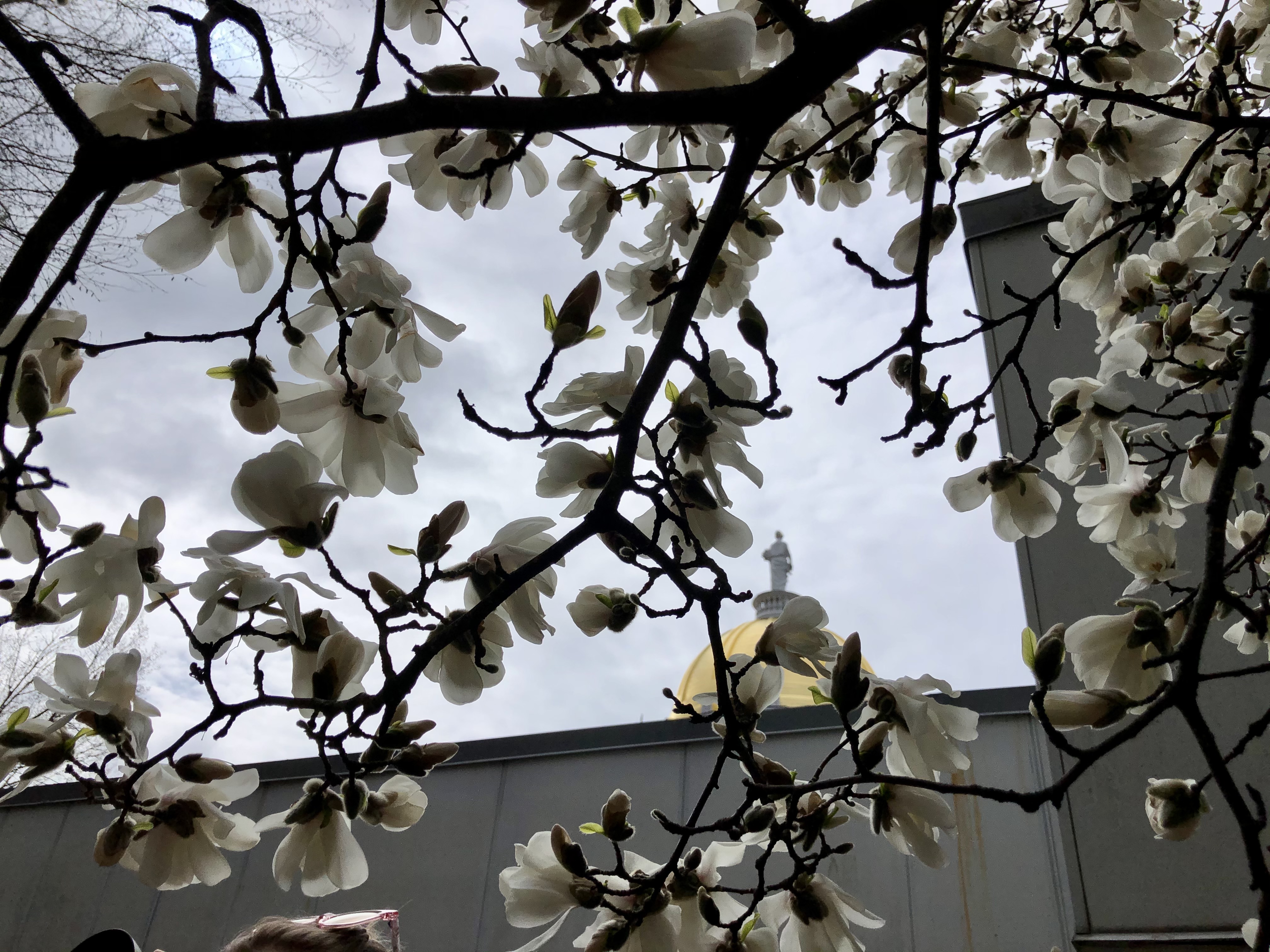
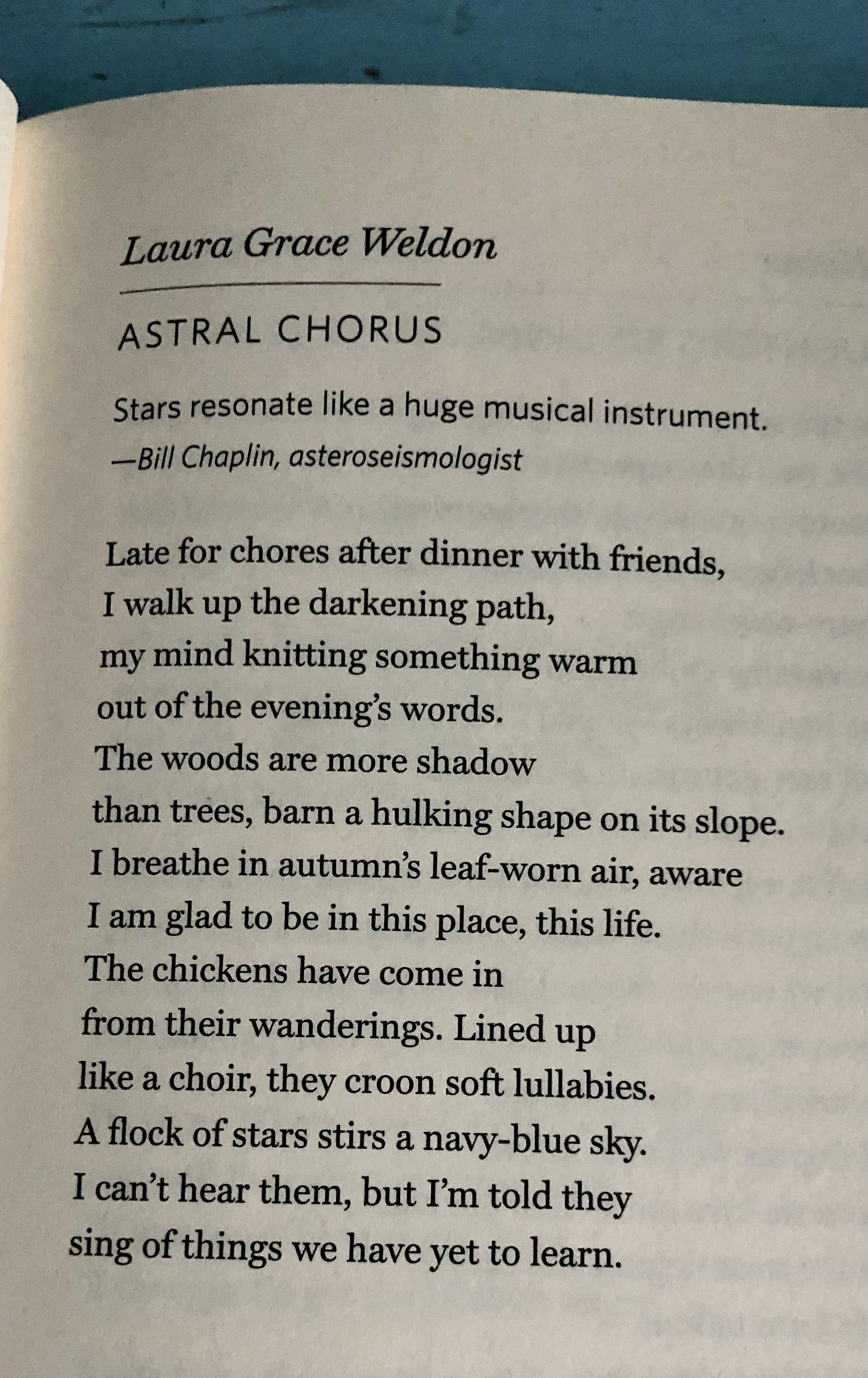
Long before the pandemic, the trees
knew how to guard one place with
roots and shade. …
Now is our time to practice–
singing from balconies, sending
words of comfort by any courier,
hoarding lonesome generosity
to shine in all directions like stars.
— Kim Stafford, “Shelter in Place”
House Work
I’m not a subscriber to so-called retail therapy, but I’m not averse to paint brightening up my patch of the world, particularly when I’ve chosen a light blue named Innocence.
My amusement mystifies my kids, and, honestly, myself, too. A better word to describe our life these days would perhaps be Koan. But try putting that on a paint can and marketing it. Who wants a little more koan, please?
Instead, I buy a used bureau from a couple who has seen far better days, or so I hope, and offer it to my daughter. From our basement, I pull out the can of yellow Little Dipper paint I used for our living room. She paints it on our back porch. I lean against the railing, looking at the trash that’s blown over the railing — junk mail, a used mask, a cardboard box I’ve used for kindling.
A sparrow sings in the box elders.
I turn around and watch her paint. What? she asks, looking over her shoulder at me.
Nothing, I lie. I reach for the quilt I washed that morning, hung over the railing, and fold it carefully.
I save my love
for the smell of coffee at The Mill,
the roasted near-burn of it, especially
the remnant that stays later
in the fibers of my coat.

Signpost
Earth Day gives us snow in Vermont, that poor man’s fertilizer.
In a lightly falling snow, I lean against a school building, talking on the phone to my brother while my daughter plays soccer. Snow drifts in flakes about the size of a nickel, some melting on the pavement, others accumulating on tree branches and the toe of my boot.
The phone connection is stunningly clear — a surprise in rural Vermont.
As the snow falls, we wonder at the happenstance of circumstances — how the fall of a family member might have gone disastrously awry. Our conversation wanders beyond that, to the Chauvin trial, and the bystanders on that terrible day who, by happenstance, were present, and the teenage girl who pulled out her phone and shared her witness’s eyes with the world.
We’re in no hurry to hang up, and my brother suggests that, if Washington D. C. achieves statehood, the flag’s tidy stars will be kicked out of kilter. Vermont should succeed, he says.
After I hang up, I lean against that wooden wall. A fat robin lands in the snow, seeking a worm. My daughter and two friends walk across the parking lot, laughing, their braided hair damp with melted snow, their cheeks and bare knees bright red. It’s spring.
Vermont Spring Palette
I leave work in the middle of the day, to take my daughter from here to there. A downpour has suddenly stopped, and sunlight sparkles over the wet world. We drive with the windows and sunroof open, the breeze blowing in. Although both girls have had Covid, and I’m vaccinated, we’re wearing masks. When won’t we be wearing masks?
The girls talk about classes, and I tune out, listening to their voices. We pass clumps of golden daffodils. On my way back to work, I drive through fields of green so brilliant I blink.
All around me, the human world feels fraught these days with chaos, both self-inflicted and not. Meanwhile, the earth pushes alive with spring. In the evening, walking up a dirt road, I look back at my daughters beneath an enormous maple, its branches still bare. Behind us, the mountains hold a deep blue. The peepers chorus, and the red-wing blackbirds sing sweetly.
It may yet snow again this week. Meanwhile, spring.
We walk up the road and down through the cedar forest, where the path is black earth. We linger so long that we walk home in the dark.
“Walking . . . is how the body measures itself against the earth.”
— Rebecca Solnit
Somewhere in Snowy Spring….
Through a few inches of snow, I follow stone steps down to nearby Lake Caspian, winding around a cedar-shingled house, holding a railing someone has taken the care to build, baluster by baluster.
The homeowner wants to build a tiny boathouse by the shoreline. While I listen to his plans, I eye the lake visible beneath the bent that hang over the lake. Although I’m wearing my winter coat, I imagine wading in, sweeping my fingers in the cold water.
The few of us stand among white birches, sharing names and stories. Because this is Vermont, we talk about the weather, the need for precipitation, and how everyone’s wood pile is faring. We make our way back up the hill, still talking.
A robin, in a crazed songbird rush, swoops by, nearing clipping one woman’s ear. She laughs.
It’s Saturday. Later that afternoon, I’ll stand in my driveway, talking with my friend about the fat list of things that worry and stress us. But for this half hour or so, I visit with acquaintances and strangers, talking about the area’s barns, how these great structures were built with care. Some remain; some are simply memories.
For listening recommendations, my father passed along this link to This American Life‘s Three Miles.
Short Visit
A retired man shows up at my job, looking for a little info and then stays to talk, sitting in a chair while I lean against one of the cement posts that hold up the ceiling, and the building overhead.
A former landscaper, he’s survived numerous joint replacements, an overseas war as a young man, and he’s holding cancer at bay, for now. He’ll succumb to the cancer, he says, at some point. But for now, he tells me how much he savors that first slurp of hot tea every morning.
I have plenty to do, but for that time, I might as well, really, have nothing else to do. He tells me about a double blossom primrose flowering in his garden. Another spring, he says.
Snow expected today; that’s Vermont spring, too.