Living Literature

My kids and I saw a live theater production today of one of my favorite books, To Kill a Mockingbird, a novel I tutored to high school students years ago. At one point, I had taken that novel apart in all kinds of ways, knew it backwards and forwards, in and out: mad dog, camellias, serving lemonade in times of stress.

Listening today, for the first time I realized compassion (that thread I’ve returned to, over and over this year) is at the heart of this novel. Tom Robinson, poor Southern black man, is the only person who has compassion for Mayella Ewell, a young woman about as white trash as could be, with a nasty father, too many little siblings and no mother, and scant means all the way around.

Tom Robinson did what Atticus advised; he imagined walking around in another’s skin, not because he desired anything from this woman, but purely from the decency of his own heart. If for no other reason, that’s why we need literature more than ever now: we desperately need that imagination.

Boo was our neighbor. He gave us two soap dolls, a broken watch and chain, a pair of good-luck pennies, and our lives.

– Harper Lee, To Kill A Mockingbird
IMG_2072.JPG


Novelist as Voyeur

Among many, I’m reading Gay Talese’s intensely bizarre The Voyeur’s Motel, and I squelched an impetus to conceal the unmistakable cover at the lake with my kids this afternoon. There’s an underlying subtext of, well, porn, which is something I never read.

Perhaps the other subtextual issue is that I realize, like all novelists, I’m a tenor of voyeur, too, always looking at other people and parsing their lives, wondering at the mechanics not only of their material lives, but their souls, too. Talese’s book reminds me of the far classier Blink by Malcolm Gladwell, and the four horsemen in relationships. Over and over, I’ve thought of that Contempt horseman rearing its head. (How much I wish I’d heeded Gladwell’s words, many years ago.)

A third of the way through the motel book, I’m already longing for Talese to toss me some kind of bone of human decency, and perhaps one reason I keep reading is I want that decency to rear up at some point.

You can never really determine during their appearance (of couples) in public that their private life is full of hell and unhappiness. I have pondered why it is absolutely mandatory for people to guard with all secrecy and never let it be known that their personal lives are unhappy and miserable.

– Gay Talese, The Voyeur’s Motel

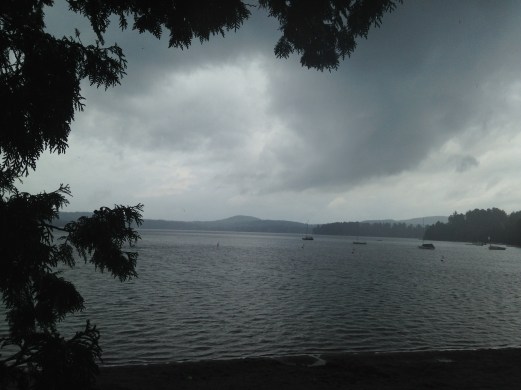
Such a grim view. Then there’s this: swimming, we could see a bank of clouds rushing across the lake today. In this humid day, with no sign of lightening, only the rain rushing in and rushing out, the girls kept swimming in the downpour, just the two of them in all that cool water. Voyeur that I may be – beneath a cedar tree in a shower storm – I hope to catch a more joyous slice of human life.

IMG_2076

Greensboro, Vermont

And A Little More Tension All Around for Everyone?

A recent unpleasantness with my eye meant a seat in the opthamologist’s chair, where I was reassured to hear at least I had good eye pressure going for me. I mean, that’s something. In the garden later, plucking a drooping and dying pepper plant, I realized pressure, of course, is part of what makes us alive; tension imbues us with the life force.

We’re at that point in the midsummer now, where the initial ecstasy of sleeping with the windows wide open and splashing through the shallow edge of a lake has lost its rarity. Our life – while good – is filled again with a kind of tension that might just be contemporary American life, or might just be who we are in this household.

The truth is, tension is creativity’s life force. All afternoon, working alone, I sunk into writing my book, spiraling deep, imagining myself upside down, descending into an abandoned stone-lined well. Nothing flaccid, nothing flabby, but all muscle, clenched and cunning. Alive.

Like most others, I was a seeker, a mover, a malcontent, and at times a stupid hell-raiser. I was never idle long enough to do much thinking, but I felt somehow that some of us were making real progress, that we had taken an honest road, and that the best of us would inevitably make it over the top. At the same time, I shared a dark suspicion that the life we were leading was a lost cause, that we were all actors, kidding ourselves along on a senseless odyssey. It was the tension between these two poles – a restless idealism on one hand and a sense of impending doom on the other – that kept me going.

– Hunter S. Thompson

FullSizeRender


Writing Lists

At a meeting recently, the person beside me pulled out a handwritten list and flipped it over a few times, reading. Because I’m me, I naturally tried to read that list. In between crossed out items, I read fold laundry.

A serious list-writer myself, that particular chore has appeared numerous times on my lists, along with buy cooking oil and go to dump. Isn’t a list a written map, in some ways, of who we are? Years ago, in between buy toilet paper and teach Molly to read, I had  find publisher for novel. I’ve now crossed that item off my list, and now, simply, on every list I begin is write every day. While lists are inherently interesting, what may be more interesting is what doesn’t make lists. For years, while my marriage was disintegrating, I likely should have written either fix this or file divorce papers.

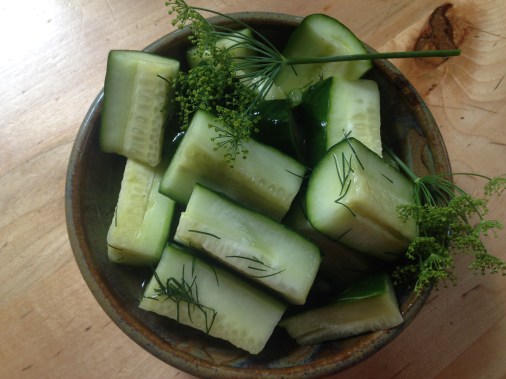
At this point, in my forties, I’d far prefer my lists to read write and fold laundry. I would have scoffed at that simple normalcy in my twenties, but now – a little more steady everydayness goes a very long way. That’s one more reason to savor homemade pickles – although here I am, writing, among veritable mounds of unfolded laundry…..

Deliver me from writers who say the way they live doesn’t matter. I’m not sure a bad person can write a good book. If art doesn’t make us better, then what on earth is it for.

– Alice Walker

IMG_1814.JPG

Woodbury, Vermont

The Tall and the Short of It

Running through the Atlanta airport – far larger than the Vermont village we live in – my 17-year-old daughter is the sharp one among us, pointing her younger sister and I through the crowds to the T concourse, up an escalator and a second one, laughing as we rush for our plane, breathlessly relaying how she ran in high heels last winter, alone, for the final flight into Burlington before a snowstorm.

In an underground train, the younger sister reads aloud, “Hold on when the train starts,” and then immediately asks, “Hold on to what?” Surrounded by people, the younger girl and I look up. We are both under five feet, and I stretch my hand up hopelessly for the overhead strap.

As the train lurches forward, we both clutch her older sister (a girl who is, as Raymond Carver wrote, a long tall drink of water), and everyone around us laughs out loud.

With a delayed flight, we currently remain in Atlanta, waiting with chipper Vermonters we don’t know but are beginning to, exchanging weather, geography, and history stories – beneath a stunning double rainbow.

Here’s a few lines from Thomas Christopher Greene‘s novel If I Forget You I’m reading:

She climbs into the yellow cab that is first in the line of yellow cabs. Henry is running now. He is at the window. She looks up at him – those eyes, unchanged, the pale blue of sea glass – and he stretches his hand toward the closed window and the cab lurches out into traffic, merging quickly, a damn sea of yellow cabs, and he tries to keep his eyes on the one that carries her, until he is no longer sure which one it is and a phalanx of them moves up Broadway and out of sight.


FullSizeRender

Atlanta airport, GA

More Than the Whole

This afternoon, my daughters baked a raspberry tart, gathering like any craftswomen the pieces of their creation: oats, sugar, butter, fruit. Thinking over the book I’m writing, like any writer I gather my pieces – characters in their tangible and intangible complexities (a green and gold wool vest, a port wine birthmark, the memory of driving rashly along a rainy street), story, and language – shaping this creation.

But a book is greater than the sum of its pages and cover, and I kept thinking of Akenfield, a nonfiction book about a small Suffolk village in the 1960s, told primarily in the villagers’ own voices. The village, too, of course, is more than the sum of its people: nurse, blacksmith, head mistress, gravedigger, odd-job man.

Now that the tart is half-eaten, made in merriment by two sisters, I see that sweet delight is more than the sum of its parts, too.

… I am willing to forgo a lot of the things other people now take for granted in order to keep Akenfield, by which I mean the deep country. The power of wonder is here…. It is man’s rightful place to live in Nature and to be a part of it. He has to recognize the evidence of his relationship to the great natural pattern in such things as flowers, crops, water, stones, wild creatures. Where he destroys such evidence… he gradually destroys a part of himself.

From the village poet in Ronald Blythe, Akenfield

IMG_1682

Galisteo, New Mexico