Summer Song

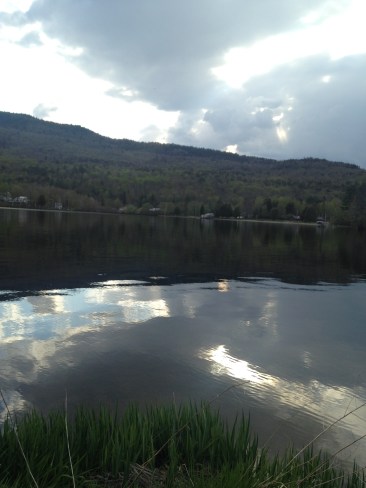
On this first day of summer, my daughters and I swam in Caspian Lake, the cold and beautifully clear water where we’ve swum for years. The earliest, this far north in Vermont, that I’ve swam there has been April, a month where the ice sometimes still knocks up against the shore. The latest was a sunny first of October, and that evening I knew I was pregnant with my second child.

Everyone must have their sacred spaces on this earth. Here’s one of mine, singing eternally the melody of the changing sky, water or ice, some measure of wind, and the children – happy, happy, happy, to be there. Yeah.

Juana sang softly an ancient song that had only three notes and yet endless variety of interval. And this was part of the family song too. It was all part. Sometimes it rose to an aching chord that caught the throat, saying this is safety, this is warmth, this is the Whole.

– John Steinbeck, The Pearl

FullSizeRender

photo by Molly S./Greensboro, Vermont

Writing Dialogue

There’s this odd word gnomon in James Joyce’s story “The Sisters” which is used in the mathematical manner: it’s a way of knowing a physical void by what is visible. That returns to that notion of understanding ourselves as creatures of change: not full and certainly not complete.

A writer once pointed out to me the gnomon is a way of writing dialogue, too. Truest dialogue always reflects the sub-story of what we’re not saying. We live in worlds of stories we create: the spoken story we share, and then all those winding sub-stories beneath.

Isn’t that partly what makes us so infuriating to each other at times, and, conversely, also so intoxicatingly fascinating? Behold, then, the strawberries, the nasturtiums, sun rising through a scrim of fog, the Milky Way arching through the black of a moonless night – this exquisite world we inhabit – and us, with our endless stories…. essence of our humanity.

 If a writer of prose knows enough about what he is writing about he may omit things that he knows and the reader, if the writer is writing truly enough, will have a feeling of those things as strongly as though the writer had stated them. The dignity of movement of an ice-berg is due to only one-eighth of it being above water. A writer who omits things because he does not know them only makes hollow places in his writing.

–Ernest Hemingway, Death in the Afternoon

FullSizeRender

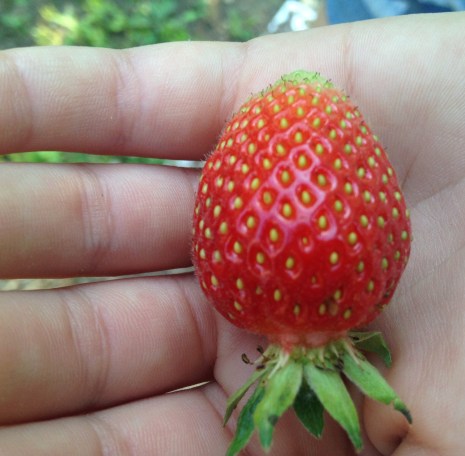
first berries from our garden

Imagine Me Gone

Here’s one reason to read: very late last night, I read through a twistingly wry scene between a sister and a brother. Then, at the very end of the chapter, a few lines tilted the scene into an entirely different perspective. All day, I’ve been thinking over this novel, how those lines are like ones in my own life, rare and yet terribly real. Our everyday realm is bona fide, too, but imagine literature – or life, for that matter – without the raw pulse of emotion, a literal opening of the heart in a world suddenly listening?

He had ceased his fidgeting… The house had gone quiet around us.

“I love you,” he said. “For whatever it’s worth.”

– Adam Haslett, Imagine Me Gone

IMG_1224

Elmore, Vermont

Gravy, Today

Early this morning before dawn, I woke and heard rain falling. Not much, but enough to satisfy the seedlings I’d planted yesterday. My garden has been dry, almost dusty. For those moments, I lay still, listening, letting the world around me do its work.

Gratitude’s a funny thing. Like empathy, I think it’s taken me decades to know its miraculous depths. Also early this morning, I received an email with a review of my novel in The Emerald City Book Review. I’ve never met the reviewer, yet she read my book in the way I had hoped the novel would be read, even quoting lines from where I consider the book’s heart, something I have never told a soul.

Like most writers, I toil at the bottom of a narrow, stone-lined well. But today: gratitude for someone who took the time to read and write so well about my book, gratitude to this earthly life that I could chisel out this book, and gratitude for this morning’s moments of rest, lying and listening to the sweet spring rain, falling on my garden.

Gravy.
Gravy, these past ten years.
Alive, sober, working, loving…

Pure Gravy. And don’t forget it.

Raymond Carver, “Gravy”

IMG_1267.JPG


Tree Collecting

I stepped outside the Montpelier Library today and stood for a moment with my face turned up to a shower of cherry tree blossom petals steadily raining down.

As a writer, I collect words I particularly love: myriad and succor, litany and exquisite, constellation and pinwheeling. For years now in my travels around Vermont, I’ve noted particular trees of exceptional grace, like Hardwick’s beauty mark of three silver maples on route 15.

Last weekend, stepping out the back door of my brother’s brewery, I nearly walked into an enormous apple tree covered in pearly blossoms and humming bees. What’s this?  I asked.

Amazing tree, he answered.

What a strange thing!
to be alive
beneath cherry blossoms.

– Issa

FullSizeRender.jpg

Photo by Molly S.

Unwinding the Rope of Writing

Not long ago, I was at the county courthouse in Barre, Vermont, waiting for the final hearing of my divorce. That courthouse contains the ebb of human life, chock-full of misery and grief, and every time I’ve entered that immense building I’ve witnessed adult women and men crying. I stood alone in a large room whose windows looked into a courtyard where trees were in bloom, and the sunlight shone bright and full of promise. What I was thinking about was a terrible illness in a family member, and how mortality’s knife lies in all of us. Dormant or not, at any moment that knife might turn and slash fatally.

Standing there, I vowed not to let my particular cup of sorrow raise so high that I couldn’t see beyond the vessel of my own brew. Lose a husband, a family life, an occupation, beloved friends: but lose my soul to bitterness, too?

Thoreau’s desire to live as fully as possible, to suck out life’s marrow, to know it as fully as possible is yet my own, despite the bile I naively never expected. Deep in the unlit realms of faith, I know writing is a rope out of that courthouse’s sludge, that art – and making art, like living a human life – holds the potential to burn our hearts in its kiln and emerge with deeper compassion. The sun rose and set on that day in my life, as it’s risen and set for centuries. Even when I was in the windowless courtroom, working through legal litany, I knew the sun would shine in the courtyard when I emerged.

If you stand right fronting and face to face to a fact, you will see the sun glimmer on both its surfaces, as if it were a cimeter, and feel its sweet edge dividing you through the heart and marrow, and so you will happily conclude your mortal career. Be it life or death, we crave only reality. If we are really dying, let us hear the rattle in our throats and feel cold in the extremities; if we are alive, let us go about our business.

Henry David Thoreau, Walden, or Life in the Woods

FullSizeRender.jpg

Crawford Notch, New Hampshire