Writing Lists

At a meeting recently, the person beside me pulled out a handwritten list and flipped it over a few times, reading. Because I’m me, I naturally tried to read that list. In between crossed out items, I read fold laundry.

A serious list-writer myself, that particular chore has appeared numerous times on my lists, along with buy cooking oil and go to dump. Isn’t a list a written map, in some ways, of who we are? Years ago, in between buy toilet paper and teach Molly to read, I had  find publisher for novel. I’ve now crossed that item off my list, and now, simply, on every list I begin is write every day. While lists are inherently interesting, what may be more interesting is what doesn’t make lists. For years, while my marriage was disintegrating, I likely should have written either fix this or file divorce papers.

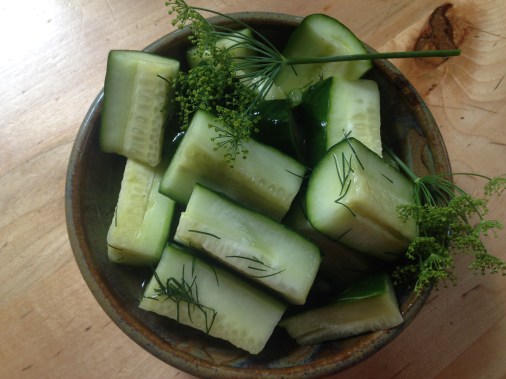
At this point, in my forties, I’d far prefer my lists to read write and fold laundry. I would have scoffed at that simple normalcy in my twenties, but now – a little more steady everydayness goes a very long way. That’s one more reason to savor homemade pickles – although here I am, writing, among veritable mounds of unfolded laundry…..

Deliver me from writers who say the way they live doesn’t matter. I’m not sure a bad person can write a good book. If art doesn’t make us better, then what on earth is it for.

– Alice Walker
IMG_1814.JPG

Woodbury, Vermont

The Tall and the Short of It

Running through the Atlanta airport – far larger than the Vermont village we live in – my 17-year-old daughter is the sharp one among us, pointing her younger sister and I through the crowds to the T concourse, up an escalator and a second one, laughing as we rush for our plane, breathlessly relaying how she ran in high heels last winter, alone, for the final flight into Burlington before a snowstorm.

In an underground train, the younger sister reads aloud, “Hold on when the train starts,” and then immediately asks, “Hold on to what?” Surrounded by people, the younger girl and I look up. We are both under five feet, and I stretch my hand up hopelessly for the overhead strap.

As the train lurches forward, we both clutch her older sister (a girl who is, as Raymond Carver wrote, a long tall drink of water), and everyone around us laughs out loud.

With a delayed flight, we currently remain in Atlanta, waiting with chipper Vermonters we don’t know but are beginning to, exchanging weather, geography, and history stories – beneath a stunning double rainbow.

Here’s a few lines from Thomas Christopher Greene‘s novel If I Forget You I’m reading:

She climbs into the yellow cab that is first in the line of yellow cabs. Henry is running now. He is at the window. She looks up at him – those eyes, unchanged, the pale blue of sea glass – and he stretches his hand toward the closed window and the cab lurches out into traffic, merging quickly, a damn sea of yellow cabs, and he tries to keep his eyes on the one that carries her, until he is no longer sure which one it is and a phalanx of them moves up Broadway and out of sight.


FullSizeRender

Atlanta airport, GA

More Than the Whole

This afternoon, my daughters baked a raspberry tart, gathering like any craftswomen the pieces of their creation: oats, sugar, butter, fruit. Thinking over the book I’m writing, like any writer I gather my pieces – characters in their tangible and intangible complexities (a green and gold wool vest, a port wine birthmark, the memory of driving rashly along a rainy street), story, and language – shaping this creation.

But a book is greater than the sum of its pages and cover, and I kept thinking of Akenfield, a nonfiction book about a small Suffolk village in the 1960s, told primarily in the villagers’ own voices. The village, too, of course, is more than the sum of its people: nurse, blacksmith, head mistress, gravedigger, odd-job man.

Now that the tart is half-eaten, made in merriment by two sisters, I see that sweet delight is more than the sum of its parts, too.

… I am willing to forgo a lot of the things other people now take for granted in order to keep Akenfield, by which I mean the deep country. The power of wonder is here…. It is man’s rightful place to live in Nature and to be a part of it. He has to recognize the evidence of his relationship to the great natural pattern in such things as flowers, crops, water, stones, wild creatures. Where he destroys such evidence… he gradually destroys a part of himself.

From the village poet in Ronald Blythe, Akenfield

IMG_1682

Galisteo, New Mexico

Night

When we were girls, my sister and I shared innumerable books. In elementary school we began with library books (Starring Sally J. Freedman as Herself), and by high school we were onto James Joyce and Tom Wolfe – most recently Anthony Doerr. It’s a habit that’s spanned throughout our entire lives.

One slender book has always remained in my consciousness. Even now, I remember reading this book for the first time with my sister, the two of us horrified, by happenstance of geography and time blessedly never stepping even near the peripheral edges of the profoundest human suffering. The book is Night

We must not see any person as an abstraction. Instead, we must see in every person a universe with its own secrets, with its own treasures, with its own sources of anguish, and with some measure of triumph.

– Elie Wiesel

September 30, 1928-July 2, 2016

IMG_1668

Santa Fe, New Mexico


Thirst

Out of my Vermont landscape, traveling, I’m surprised to see, again, how profoundly landscape – like the desert’s grit-filled wind – shapes perception. I gauge my world through water’s motion: Have the spring beauties spread their tiny petals? Whose garden has been dealt a killing frost? Is travel impractical because of muddy roads? When will the overcast skies break?

The New Mexican desert revolves around the exquisite geometry of light, shadow, wind, the near-absence of water: the same life-driving axis of knowledge, turning in an opposite direction.

This is the yin and yang of the earth, an energetic feedback. What happens below relates directly to what is happening on the surface and in the atmosphere and vice versa. Tectonics does not end at the ground beneath your feet. It is a dynamic system from the earth’s interior all the way into the sky and back.

Craig Childs, Apocalyptic Planet


FullSizeRender

Santa Fe, New Mexico

Summer Song

On this first day of summer, my daughters and I swam in Caspian Lake, the cold and beautifully clear water where we’ve swum for years. The earliest, this far north in Vermont, that I’ve swam there has been April, a month where the ice sometimes still knocks up against the shore. The latest was a sunny first of October, and that evening I knew I was pregnant with my second child.

Everyone must have their sacred spaces on this earth. Here’s one of mine, singing eternally the melody of the changing sky, water or ice, some measure of wind, and the children – happy, happy, happy, to be there. Yeah.

Juana sang softly an ancient song that had only three notes and yet endless variety of interval. And this was part of the family song too. It was all part. Sometimes it rose to an aching chord that caught the throat, saying this is safety, this is warmth, this is the Whole.

– John Steinbeck, The Pearl

FullSizeRender

photo by Molly S./Greensboro, Vermont