The sound of one hand clapping, revisited.

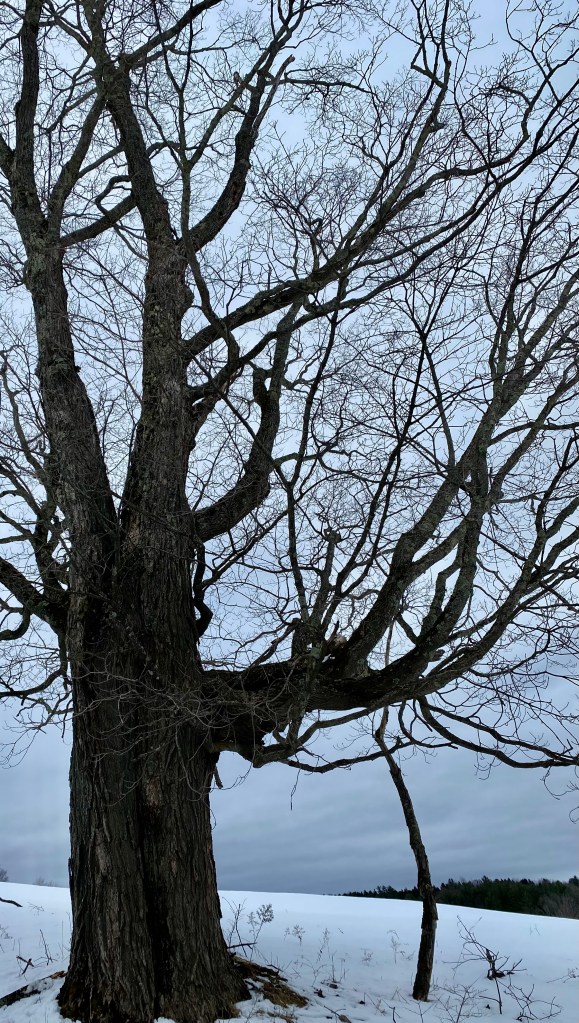
This week, I unexpectedly find myself waiting for someone I don’t really know and end up reading a copy of Ken Wilber’s collected writings. Winter has finally come. The purest and loveliest of snowfalls fills up our world. I wait much longer than I had guessed. A woman comes in to sweep the floor, and we talk for a bit. Sunlight pours through enormous windows.

Here’s some Ken Wilber I soaked in:

You know the Zen koan, “What is the sound of one hand clapping?” Usually, of course, we need two hands to clap – and that is the structure of typical experience. We have a sense of ourselves as a subject in here, and the world as an object out there. We have these “two hands” of experience, the subject and the object. And typical experience is a smashing of these two hands together to make a commotion, a sound. The object out there smashes into me as a subject, and I have an experience – the two hands clap together and experience emerges.

And so the typical structure of experience is like a punch in the face. The ordinary self is the battered self – it is utterly battered by the universe “out there.” The ordinary self is a series of bruises, of scars, the results of these two hands of experience smashing together. This bruising is called “dukkha,” suffering. As Krishnamurti used to say, in that gap between the subject and the object lies the entire misery of humankind.

On my way home, I do something I’ve never done in the winter. I park along the edge of an unfamiliar road. I’ve forgotten my hat. The wind is wild, as if I’m on a stormy sea. My hair tangles over my eyes. Oh sun, oh wind, oh endless snow.

Midwinter, here.

A little chaos…

I call the mechanic back about my car who says it’s all good news, a replaced muffler, and the car looks fine.

Finally. Something repaired in the chain of a dying range, a done-in washing machine, my own washed-out and piss-poor attitude.

In one of the few sunny days I’ve seen recently, I’m standing on my back porch, listening to water dripping. We talk a little about the shitstorm of this decade so far, the election roaring up in nearby New Hampshire. He mentions he doesn’t know my political leanings, and I laugh. I’ve been writing him checks for years now, and I’m certain it’s no surprise who I didn’t vote for. But he bends our conversation a little further, kicking the standard gloom-and-doom away and remarks that we might as salvage some happiness in this life.

On this rainy midwinter day, I convince my youngest to drive north to a library in search of a Claire Dederer book. Here’s a few lines from the last chapter of Monsters.

Love is anarchy. Love is chaos. We don’t love the deserving; we love flawed and imperfect human beings, in an emotional logic that belongs to an entirely different weather system than the chilly climate of reason….

Monsters. Childcare.

I stand outside the town office building, eating leftover beet-carrot-garlic salad for lunch, watching the sky alternately break apart in sun or drop rain. If there’s a rainbow, it eludes me. A retired couple who lives up the street walks by, returning from their daily post office walk. We kick around the news: a petition to close the town’s elementary school and how last night’s snow turned to rain.

Slushy, slushy.

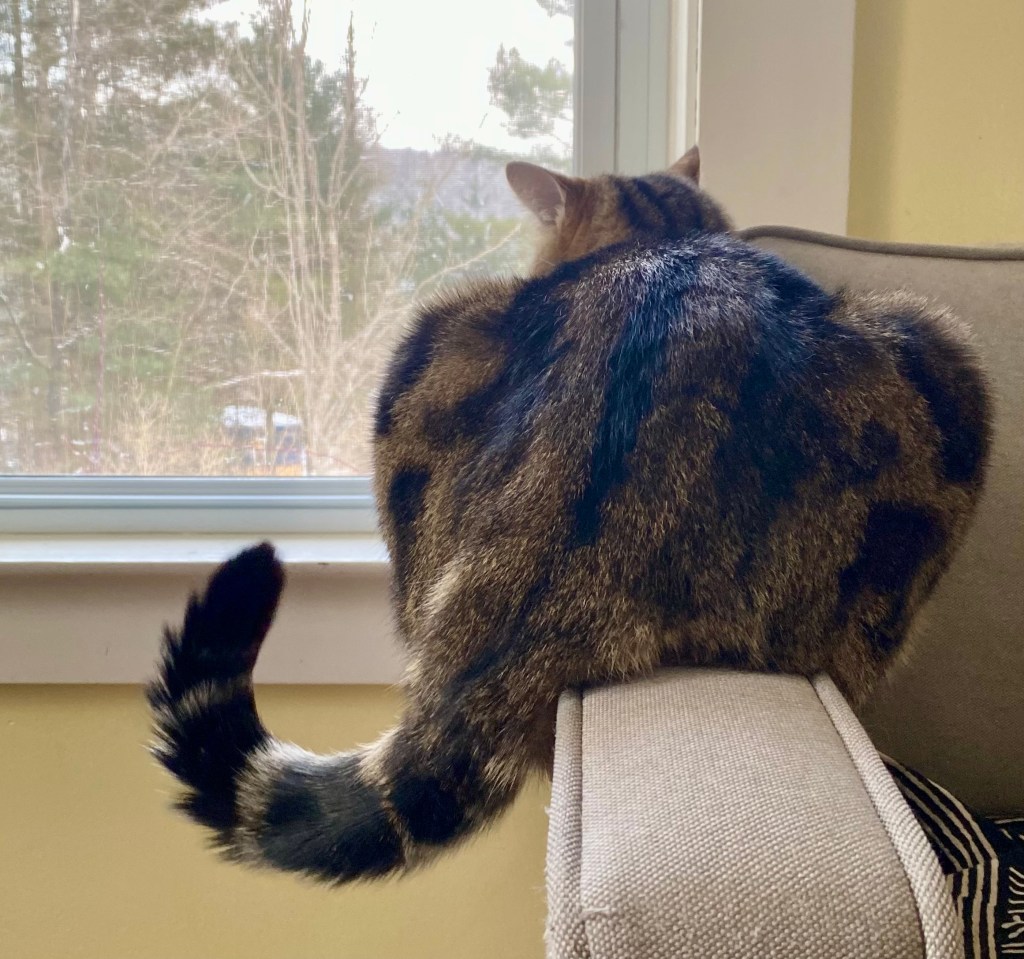
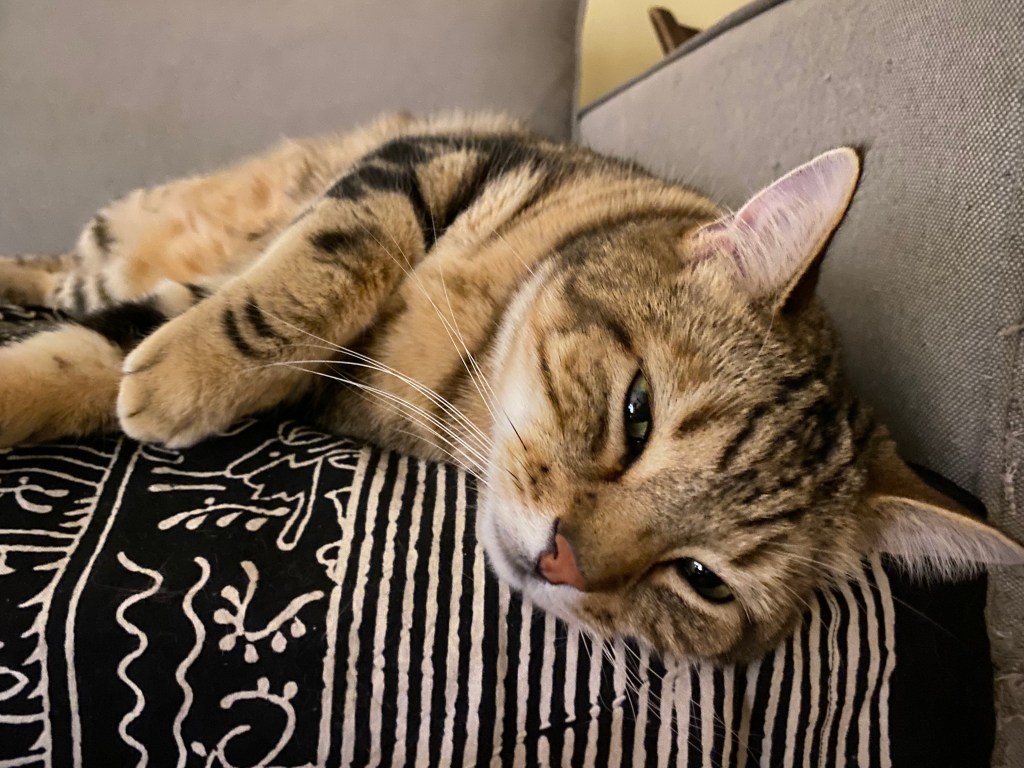
The wind kicks up a hint-of-late-February warmth, the way that month can smell of thawing earth, of the gradual thaw-and-freeze-and-thaw that morphs into spring. Midwinter here, the weather out of whack. The afternoon opens into sunlight. The sun’s rare January appearance carries me through the afternoon and into a cheerily ebullient Selectboard meeting, and home again along an icy road, the stars glittering over hayfields, to play cards with my daughter while the cats savor their feline leisure, sprawled before the wood stove.

I lay awake late reading Claire Dederer’s Monsters. Dederer writes:

… the genius is not you. Not me. The genius, as we understand it, is not the person who spends most of her time, and I mean that quite literally, thinking about childcare. My major artistic concern for the past twenty years has been childcare, it has preoccupied me more than any other subject; even now that my children are mostly grown I’m still not sure I managed it well, I lie awake worrying about it, and meanwhile old Pablo was putting out cigarettes on his girlfriend’s face.

Solstice Dandelion.

I stopped into a candy shop in Montpelier to buy chocolate Santas for my daughters. We’ve been visiting this store since my daughters were so young I always held their hands downtown. The owner read my book, and we always talk about writing and family and Vermont small town life. Her store had reopened recently after July’s devastating flood. The rain and snowmelt in the forecast hovered around us as I filled a white paper bag with those bright foil-wrapped chocolates. As I listened, I added chocolate pastilles and more Santas, for her or my daughters or me, for the giving or taking, or maybe both.

This week’s rain likely spared this sweet shop, but towns around us were flooded again. In the town where I work, sections of roads carefully repaired after July’s flood broke again.

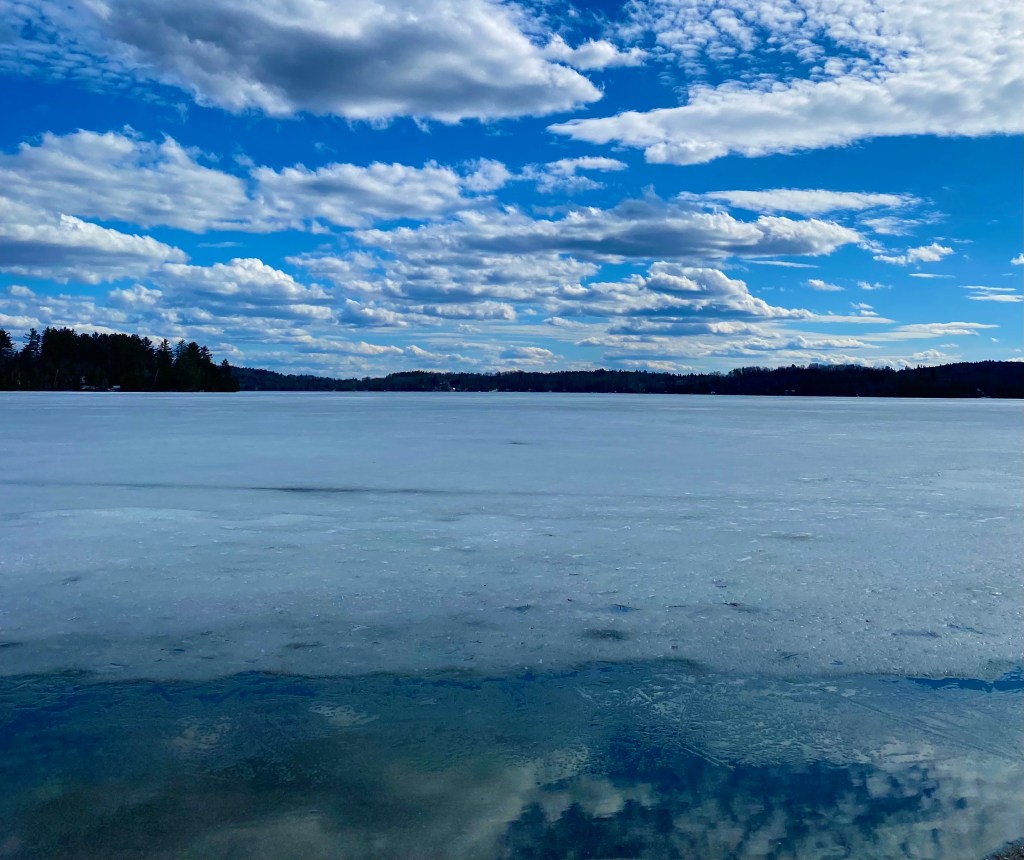
Yesterday, I spied a folded dandelion blossom in the town green. I squatted down and stared, not touching this brilliant gold in its emerald set. Overhead, those bunching clouds. A balmy breeze stirring over the lake that by day’s end will whet a bitter cold.

Solstice: hallelujah on this spinning planet.

Less and less surprises us as odd.

— Tracy K. Smith

I believe in good gloves.

At the Vermont Almanac‘s celebration of volume four, I talk with people I haven’t seen in years — my daughter’s beloved elementary school teacher, a couple who bought a house down the road from where I once lived. As the staff from the center where the celebration was held clean up, ready to head home themselves, I walk out with my former neighbors. We stand for a few moments by a fire burning in a pit, talking about sugaring and our daughters and Vermont dirt roads. Through the wide windows, I watch people wrapping up the remains of cheese and dried sausage. In my house, I am still eating the remains of Thanksgiving’s cheese, the sharp cheddar I used in my friend’s birthday sandwich.

Overhead, stars strained again the clouds.

I’d been asked to read a poem, “Dear Day in Late September,” for poet Kerrin McCadden, who couldn’t attend. I consider this poem a love letter in the tenor of love letters I admire most — elegantly stripped down, mindful of life’s deep sadness and the beauty of our world fat with bees.

On my way home, I think of the line “I believe in good gloves.” As a former sugar maker, I’ve used up countless gloves. With my small hands, I’ve never had a pair of gloves that fit. At Thanksgiving, in a shop looking for boots, my daughter handed me a pair of petite gloves. I nearly laid them to the side (thrift, thrift), but I bought them. Yesterday, wearing these gloves to bring in wood, I realized the gloves fit me perfectly, downy on the inside. Warm, strong, practical. What do you know.

…. I want to tell you I am

thinking about closing up shop for the winter. I am settling

my accounts. Enclosed, please find a brace of birds,

which I hope you will accept as payment against last winter’s

oil bills. There is much to do. Up in the barn, I have spelled

out the name of the man I love with crabapples. It is one way

to know a man’s heart. I believe in his name, though,

like I believe in good gloves. Oh, how we fight the cold

with everything we have.

Kerrin McCadden

Stitching, in Friends & Wool.

December, and by five o’clock, the dark has hammered in for the night. A friend and I walk to the post office, talking about work and family, laughing as we avoid icy patches glowing beneath the streetlamps. We meet a neighbor walking home with her two children from the afterschool program. The boys have glowing strips wrapped around their wrists, red and green, that draw lines through the darkness as they pinwheel their arms.

We return to my dead-end street where the light glows on my back porch. At the silhouette of mountains across the valley, an immense column of amber light illuminates the night sky. Moonrise. It’s not particularly cold. We linger and watch the stars and planets rub on against the darkness, one by one, and keep talking about those complicated stories of family, of how history bends back upon itself and what this might mean for our children who are in the time of their youth.

Above, stitches of a sweater I knitted for a faraway friend, something I created with pleasure and gratitude, that I’ll box up and mail away. Who knows when I’ll see these friends again. But it’s the only way forward that lends any illumination for me: stitch. When need be, unravel and begin again.

“The products of science and technology may be new, and some of them are quite horrid, but knitting? In knitting there are ancient possibilities; the earth is enriched with the dust of the millions of knitters who have held wool and needles since the beginning of sheep. Seamless sweaters and one-row buttonholes; knitted hems and phoney seams – it is unthinkable that these have, in mankind’s history, remained undiscovered and unknitted. One likes to believe that there is memory in the fingers; memory undeveloped, but still alive.”

Elizabeth Zimmermann