The Ole Golly Space

When I was about seven or so, my older sister read me Harriet the Spy, a book she liked so much she wanted to share with me, who couldn’t yet read that length of novel.

Early in the book, we hit a plot point of great excitement, when Harriet takes the journey to visit Ole Golly’s mother – her nanny’s mother. Oddly enough, I can still remember the rented townhouse living room where we read, with the glass doors leading out to a balcony suspended over a scrubby backyard.

It’s the ‘Ole Golly’ space I find in reading – and in my own life – forty years later. Open up that door. Introduce me to someone who will make think differently about this life. Clearly, I am no longer seven, my sister and I gnawing on the ends of our braids, but don’t we live the same things in our lives, over and over, and yet all the time changing?

Well, you must realize, Harriet, knowing everything won’t do you a bit of good unless you use it to put beauty in this world. True or false?

thumbnail_FullSizeRender-2.jpg

Hardwick, Vermont

Robert Pirsig

Robert Pirsig, dead at 88, I hear this morning, driving along a rutted back road.

I pilfered Zen and the Art of Motorcycle Maintenance from my dad’s bookshelf when I was a teenager, intrigued by its title, lured by the lush fatness of reading material. Not that many years later, my dad showed me an article (in the Times Book Review section, maybe?) Pirsig had written about his son’s murder.

What I’ll always remember about that book is the high school teacher who told me the book saved his life. What higher complement to give a writer? And yet every time I think of Pirsig, I think of that essay, too…..

Sometimes I like to think about truth in the image of an old and wrathful Buddhist master who grabs us, shakes us, and shouts, ‘Drop it now!’ Truth can be wrathful.

– Anam Thubten, No Self, No Problem: Awakening to Our True Nature

FullSizeRender


Murky Matters of the Heart

I’m in the firewood chore time, a task I’m embracing with gusto. Wood stacks satisfyingly, drying for toasty winter evenings sprawled before the hearth, with tea and books and board games. The chore is pretty much zero-loss; if the piles fall down, I’ll restack, a redoing with little loss but of time – perhaps even a gain in the muscle category.

Not so, in other aspects of human life. Last night,  I lay awake late, sucking lemons and reading Jung Yun’s Shelter, a novel about specific family actions with that extremely gray subtext of what I can only call ‘matters of the human heart’ – the moral (or immoral) meanings of our actions, the elements of our lives that mean the very most to us. The novel reminds me of Steinbeck’s East of Eden, a family saga about human choice: the uniquely human element that often seems so baffling. What the heck must I do now?

Hence, the pleasure of stacking wood on a balmy August day, with the bittersweet scent of freshly-drawn sap, the dryness of dust on split logs, and the tidy wisdom of ordering a piece of my land for the colder days to come.

Of all the people in the world, he (Kyung) never expected Reverend Sung to be a source of comfort, the first real sense of comfort he’s felt in so long. He’s thrown by it, stunned silent by the possibility that he isn’t so underserving of kindness as he believes himself to be. Kyung sits down and takes the reverend’s hand, squeezing it to convey the volume of things he can’t, and the reverend, in another act of kindness, simply stands there and lets him, saying nothing in return.

Jung Yun, Shelter

FullSizeRender

Woodbury, Vermont


Living Literature

My kids and I saw a live theater production today of one of my favorite books, To Kill a Mockingbird, a novel I tutored to high school students years ago. At one point, I had taken that novel apart in all kinds of ways, knew it backwards and forwards, in and out: mad dog, camellias, serving lemonade in times of stress.

Listening today, for the first time I realized compassion (that thread I’ve returned to, over and over this year) is at the heart of this novel. Tom Robinson, poor Southern black man, is the only person who has compassion for Mayella Ewell, a young woman about as white trash as could be, with a nasty father, too many little siblings and no mother, and scant means all the way around.

Tom Robinson did what Atticus advised; he imagined walking around in another’s skin, not because he desired anything from this woman, but purely from the decency of his own heart. If for no other reason, that’s why we need literature more than ever now: we desperately need that imagination.

Boo was our neighbor. He gave us two soap dolls, a broken watch and chain, a pair of good-luck pennies, and our lives.

– Harper Lee, To Kill A Mockingbird

IMG_2072.JPG


Novelist as Voyeur

Among many, I’m reading Gay Talese’s intensely bizarre The Voyeur’s Motel, and I squelched an impetus to conceal the unmistakable cover at the lake with my kids this afternoon. There’s an underlying subtext of, well, porn, which is something I never read.

Perhaps the other subtextual issue is that I realize, like all novelists, I’m a tenor of voyeur, too, always looking at other people and parsing their lives, wondering at the mechanics not only of their material lives, but their souls, too. Talese’s book reminds me of the far classier Blink by Malcolm Gladwell, and the four horsemen in relationships. Over and over, I’ve thought of that Contempt horseman rearing its head. (How much I wish I’d heeded Gladwell’s words, many years ago.)

A third of the way through the motel book, I’m already longing for Talese to toss me some kind of bone of human decency, and perhaps one reason I keep reading is I want that decency to rear up at some point.

You can never really determine during their appearance (of couples) in public that their private life is full of hell and unhappiness. I have pondered why it is absolutely mandatory for people to guard with all secrecy and never let it be known that their personal lives are unhappy and miserable.

– Gay Talese, The Voyeur’s Motel

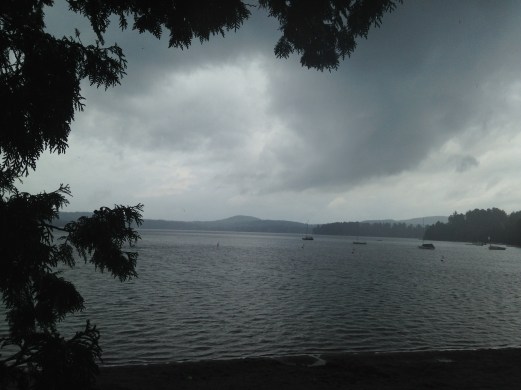
Such a grim view. Then there’s this: swimming, we could see a bank of clouds rushing across the lake today. In this humid day, with no sign of lightening, only the rain rushing in and rushing out, the girls kept swimming in the downpour, just the two of them in all that cool water. Voyeur that I may be – beneath a cedar tree in a shower storm – I hope to catch a more joyous slice of human life.

IMG_2076

Greensboro, Vermont

And A Little More Tension All Around for Everyone?

A recent unpleasantness with my eye meant a seat in the opthamologist’s chair, where I was reassured to hear at least I had good eye pressure going for me. I mean, that’s something. In the garden later, plucking a drooping and dying pepper plant, I realized pressure, of course, is part of what makes us alive; tension imbues us with the life force.

We’re at that point in the midsummer now, where the initial ecstasy of sleeping with the windows wide open and splashing through the shallow edge of a lake has lost its rarity. Our life – while good – is filled again with a kind of tension that might just be contemporary American life, or might just be who we are in this household.

The truth is, tension is creativity’s life force. All afternoon, working alone, I sunk into writing my book, spiraling deep, imagining myself upside down, descending into an abandoned stone-lined well. Nothing flaccid, nothing flabby, but all muscle, clenched and cunning. Alive.

Like most others, I was a seeker, a mover, a malcontent, and at times a stupid hell-raiser. I was never idle long enough to do much thinking, but I felt somehow that some of us were making real progress, that we had taken an honest road, and that the best of us would inevitably make it over the top. At the same time, I shared a dark suspicion that the life we were leading was a lost cause, that we were all actors, kidding ourselves along on a senseless odyssey. It was the tension between these two poles – a restless idealism on one hand and a sense of impending doom on the other – that kept me going.

– Hunter S. Thompson

FullSizeRender