Got Wool?

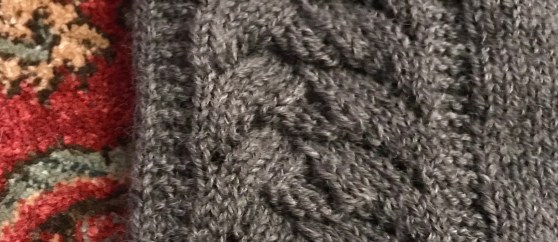
When I was 19, my mother gave me a heavy wool, intricately cabled sweater she had spent years knitting and I was certain I would never wear. I was living with my then-boyfriend in the coldest place I ever lived —  and anyone who knows me knows that means something. The beautiful old farmhouse was at the end of dirt road in southern Vermont. In one half of the house lived a single mother and her young daughter (I cringe now to think of what abysmal neighbors we were to her), and my friends and I housesat the other half.

The house was heated by a wood furnace. It was December, and the wood supply we had been left was nearly depleted. I certainly knew nothing about heating with wood. I was greener than the wood we burned.

I wore that sweater for the entire month I stayed there. I slept in it. I wore the sweater so hard and for so many years that only pieces of it remained when I moved from my last house.

What taught me to love scratchy wool? Cold Vermont.

5 below zero this morning….. Could be much colder. ‘Tis the knitting season.

Use It Up. Wear It Out. Make It Do. Or Do Without.

— Calvin Coolidge
 

IMG_4438.jpg

Wet Wool Memory

I buy my daughter a pomegranate, because she loves the fruit, because of the red it brings to our snowy Vermont landscape, and because Saroyan wrote about pomegranates. My parents did not buy pomegranates. As a kid growing up in New Hampshire, I wondered about that mysterious fruit — much like I wondered about Turkish Delight, the Narina sweet my father found in Ann Arbor and bought for us with great joy.

On a snowy day, the girls discover a coolant leak in my car. The mechanic who fixes the leak explains to my teenage daughter what the level of coolant should be in a car, when to add coolant, and when to worry. Standing between the two of them, I study his unzipped Carhartt jacket, stained with motor oil. Like Proust’s madeleine, so much of my past was redolent with wet and snowy clothes, work and words twined together.

Like that, then, the past’s gone. The girls and I stand outside the garage in a snowstorm again. I tell my older daughter as I always do, drive carefully. Laughing, they’re off again.

From one of my mentors, poet Ruth Stone:

Yes, we are everything, every experience we’ve ever had, and in some of us, a lot of it translates and makes patterns, poems. But, my God, we don’t even began to touch upon it. There’s an enormous amount, but we can touch such a little.

56866259260__FF99E9DB-165C-44FD-8B7C-9130B1EBFA24.jpg


Studded Snows

What’s the one thing that makes Vermont winters survivable? Friends? Laughter? Knitting? A chicken roasting in the oven? Nope: snow tires.

Driving to Burlington on a snowy Sunday morning to interview a young poet, I kept thinking, At least I bought new snow tires. When my daughter disappears in the darkness to work, I think, I’m so glad I shelled out for those tires.

On my way home through the Calais back roads, I pull over at the town hall, a beautiful and somewhat mysterious building to me — why is it here? what’s the history that’s now disappeared around this building? I’ve been listening to NPR’s Wait, Wait, Don’t Tell Me and laughing so hard I’m actually crying.

Outside my little Toyota, I’m immediately reminded of winter’s enchanting beauty, the bit of wind on my cheeks and the snowflakes in my eyelashes. Sunday afternoon, and no one’s out and about, save for one  grownup far down the road, walking a dog. Leaving my car at the roadside, I walk down to the meeting house and stand there, staring up at the steeple in the gauzy snow, listening. Then I put those snow tires to use again.

Winter seclusion —
Listening, that evening,
To the rain in the mountain.

— Issa

IMG_4381.jpg


Better Perspective

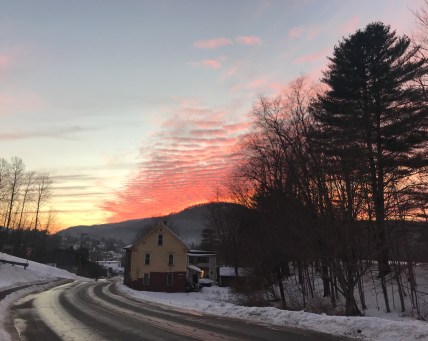
A milk truck rolling slowly up Bridgeman Hill catches the sunset on its long, silvery side. The mud-splattered Booth Bros.’s truck reflects that sky behind and above me — ruby clouds — and that movable art mural is so wonderfully awesome I’m taken out of time, snapped back into the world only as the truck has nearly passed and I realize the driver has lifted one hand, waving a greeting.

I watch the truck continue its gradual roll up the hill, where pavement gives way to dirt road. As I descend down the hill, the village glows beneath that magnificent sunset — the granite town building, the long strings of electric lines, the houses well-tended or ramshackle — players in a landscape of cosmic beauty.

When the winter chrysanthemums go,
There’s nothing to write about
But radishes.

—Basho

IMG_4370.jpg

Trout Fishing Reminescences

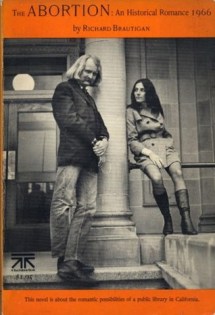
I’m listening to a recent This American Life podcast, when a section of Brautigan’s The Abortion is read aloud, I lay down the scissors I’m holding. I’m sixteen again, hidden in the public library stacks, unable to believe what I’m reading. What is this? Who is Brautigan?

An instant fan of Brautigan and simultaneously unable to exactly figure out why, when I listen to his words read aloud, I suddenly see his writing is all reverence, all poetry, all a hymn to living — in the most utterly mundane way — an acknowledgement of love and love gone awry, of abortion and bliss — funny and sorrowful and joyous.

Sometimes life is merely a matter of coffee and whatever intimacy a cup of coffee affords.

Richard Brautigan

160588

Reading

By lucky chance, I start reading Joshua Mohr’s Sirens — memoir of writing, drug use, broken spiritual and physical hearts — and I can’t stop. The slender book reminds me of when I was twenty, reading Death on the Installment Plan in bed in a second-floor Brattleboro apartment, savory from the downstairs Korean restaurant. Like Celine, Mohr’s writing is full of life as that Brattleboro Main Street, or as desolate as a snowy midnight.

Check out Two Dollar Radio’s Santa Fucked Up sale.

Our lives are always in flux, so many contradictions comprising our identities…. We are never one thing. I was never only the heart defect, only the author or junkie or husband or father or professor or drunk. I wear all these like layers of skin. Like stars creating a constellation.

— Joshua Mohr, Sirens

TDR_BookCover_sirens-by-joshua-mohr_2048x2048.png