Aren’t we all thinking about this Covid anniversary? A year into the pandemic?
Time’s such a tricky thing. I’ve lived through moments that seemed like an eternity — such as the terrible experience when my baby had an allergic reaction and ceased breathing. Those were endless moments before she gasped again, her tiny chest taking in air. Conversely, my second pregnancy appeared to stretch out far beyond the standard nine months….
One year into the pandemic realm, I’m at the point where I’ve accepted: Live here now.
In a conversation with someone today via Zoom, I’m asked what I’m doing in September.
September, on one hand, is not so far off. On the other hand, I’m hoping there’s a lot of living between here and there. (Plus, I can hardly envision what I’m doing next month.)
This makes me think of my younger, more hippie days, reading Ram Dass.
In the night, ice slides off our back roof and breaks our porch railing. I discover this in the morning while I’m carrying out the stove ashes, cautiously looking for one of the neighborhood skunks.
The broken railing doesn’t even register as an annoyance. While I’m making coffee, I think this over. Just a few years ago, I would have brooded on the broken wood, resentful of the expense of money and time to repair this piece of our house. Now, I think merely, That can be repaired.
There’s a lesson here, I think, on this mundane Thursday morning. Of all the broken things in my life — inevitably, in all our lives — a snapped piece of wood hardly matters. For years, I saw the accumulation of disrepair, from a loose coat peg to a leaking roof, as sure evidence that my family life was unfolding. A year into the pandemic, a broken railing is evidence of warming nights. Repair, and move on.
In the midst of surely what will be known in American history as a lousy time, Bernie Sanders inadvertently made knitting cool.
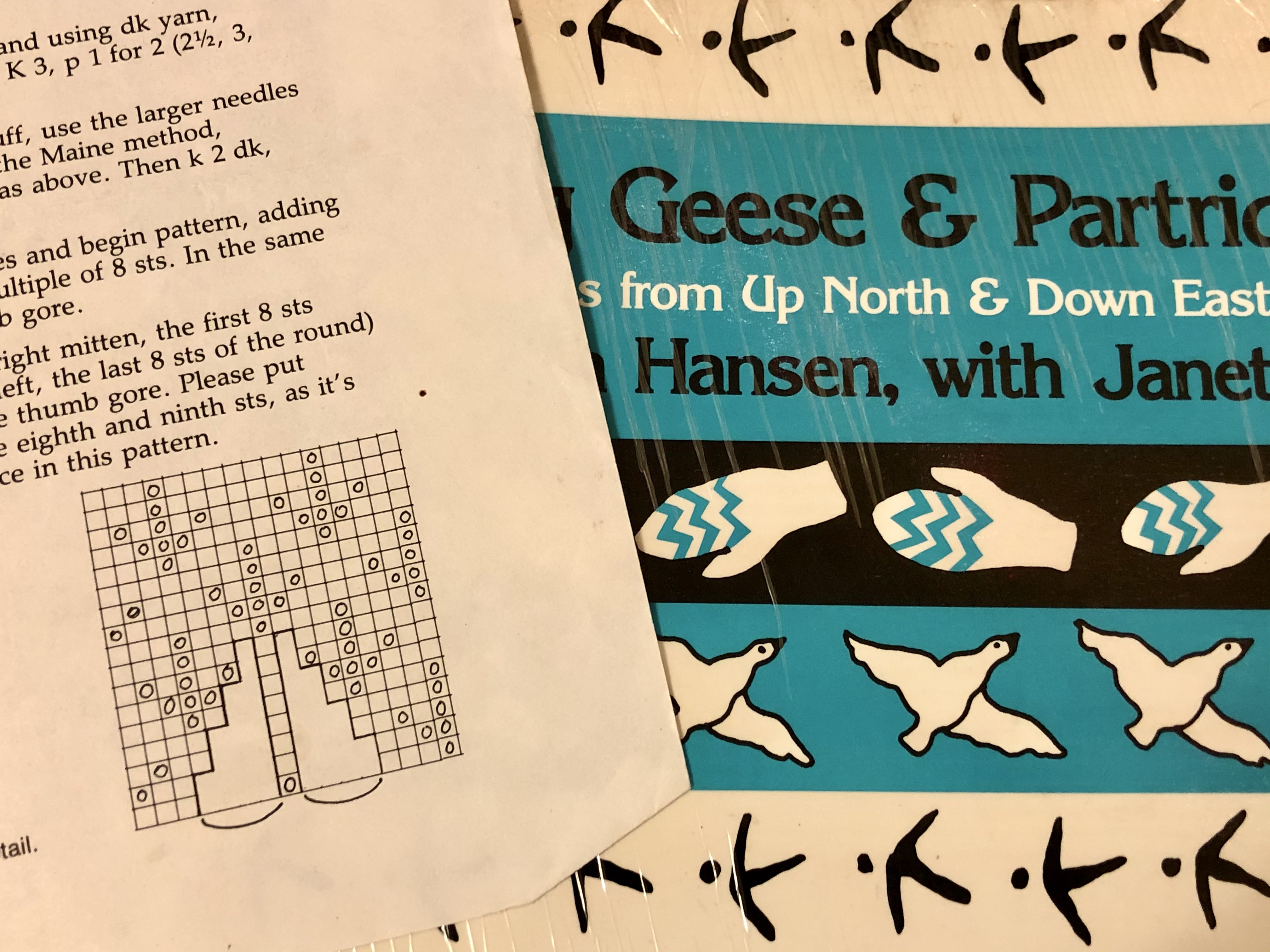
When my youngest daughter was a toddler, one winter I cracked open a knitting book my mother had given me from her stash and taught myself to knit two-stranded mittens. In those days of diapers and playdough and winter isolation, I experimented with yarn weight, needle size, and colors. The prettiest mittens I knit had one cuff gnawed by mice when I left the pair overnight in our sugarhouse.
When we moved from one house to another and we jettisoned so many belongings, I considered that particular knitting book before I packed it in a box. At that point, I wasn’t sure I would ever knit another pair of mittens, but I packed the book, more out of sentimental affection than anything else.
This morning, I pulled the book from the bottom shelf of my bookcase. I was looking for a pattern after offering to knit my brother a pair of mittens. In the center of the book, I found pages of one daughter’s artwork. She had a set of Noah’s ark stamps as a little girl, and had carefully stamped and colored a scene.
This daughter went through a period when a hand-me-down paperback Noah’s ark book was her favorite bedtime tale — all those animals and Noah’s family cozied in a handmade boat, first having a party, then enduring through a tediously long journey, with the rewards of the olive branch, the dove, dry land, and the rainbow at the end.
Yesterday, I was on the phone at work, talking with a woman I had never met who was helping me unravel a work question.
She paused suddenly and mentioned that she could hear the governor’s Tuesday press conference on the radio in my office. She told me she worked in the governor’s building and had been told to bring home work. Vermont’s capital — Montpelier — like so many places in our country now, is under careful public safety scrutiny.
Then, as I’ve found happening so often since last mid-March, a stranger and I had a passionate conversation about the uncertain state of our world. While a moment before we had been talking about details, we suddenly began sharing stories of our families.
Then her cell phone crackled, and we ended our conversation before her connection broke.
Green Mountains Review Online published the first chapter of my book Unstitched: Exploring Addiction in a Small Town. The book will be published by Steerforth Press in September. May our world be a less tension-choked place by autumn.
Saturday morning, we wake to a snowfall — gorgeous fat flakes swirling down — the kind of sparkling snow that miraculously turns the world brand-new and utterly beautiful.
In early afternoon when I return from work, the girls have shoveled the paths and driveway and deck. Inside, they’re drinking tea in front of the wood stove and putting together a puzzle my sister sent from Virginia, a pretty blue puzzle with birds.
I stand at the glass door drinking coffee, thinking where I stood that morning, on the shores of Caspian Lake, its center obscured by drapes of falling snow. Bundled in hats and masks and scarves, I stood talking with another woman about the small town planning process. Then our conversation wandered into the oddities of human life, how determined we all are at times — and I’ll put myself firmly there — to keep our attention focused on our own little stamp of land and home, be it a postage-stamp-sized piece or hundreds of acres. Meanwhile, the snow, the rising and setting sun, the wandering woodland creatures, continue on.
Saturday afternoon, I claim my own place near the fire and read The New Yorker‘s recent “The Plague Year” by Lawrence Wright, reading aloud pieces to my daughters, saying, This is the history you’re living through. This is your story, too…. It’s a lesson for me, too, when I dream of living elsewhere, where sleet doesn’t fall, where the cost of living isn’t crazy-high, where the sun shines even in the heart of winter — a reminder for me to embrace my own accidental luck to live here.
Nations and states that have done relatively well during this crisis have been led by strong, compassionate, decisive leaders who speak candidly with their constituents. In Vermont, Governor Phil Scott, a Republican, closed the state early, and reopened cautiously, keeping the number of cases and the death toll low. “This should be the model for the country,” Fauci told state leaders, in September. If the national fatality rate were the same as Vermont’s, some two hundred and fifty thousand Americans would still be alive.
On the solstice Monday, I’m standing along a dirt road, bent down, petting a dog.
The recent cold snap has broken, and the midday is nearly balmy. Some winters in Vermont are like this: cold and thaw ricochet back and forth. Each thaw reminds us that we’ll endure the bitter cold. Beneath my boots, mud may not be far away. But I know — and not just by the low declination of light — that plenty of winter remains.
The conversation I’m having bends around again to the observation I’ve gnawed over and over: how human irrationality winds all through these bucolic Vermont villages. Likely, it’s the human condition.
Irrationality or not, for these moments, I’m standing in shallow snow, on a hillside with a view of the valley below and the not-so-far blue mountains in the distance. The little dog’s ears are velvety to my bare fingers. And, for these few midday moments, I soak in these landscape of brown dirt road, pristine snow, pale blue sky, conversation. Spring is an infinity away, but spring always arrives. I’ve been here before.




 Stony Soil Vermont