What’s Real

Like a quilt, the fall’s early darkness abruptly pulls over us.

Late afternoon, I swing by the library, then pull off my wool sweater and go for a run. The rain falls so hard I appear to be running through clouds. I’m on a loop, so I keep on — there’s no easy turning back to get home. At home, I feed the hungry cats and light the first wood stove fire of the year, just a small one, with a few handfuls of kindling. There’s no turning back for fall, either.

After dinner, the daughters sprawl on the couch. The cats, who didn’t care much for summer, anyway, curl in a laundry basket, utterly satisfied.

Again, I realize I’m looking at this the wrong way: there’s never any turning back, just going on.

The wonderful poet Kerrin McCadden will be reading and talking with me virtually tonight, hosted by The Norwich Bookstore. Check in, if you have time and inclination.

“To think in terms of either pessimism or optimism oversimplifies the truth. The problem is to see reality as it is.”

– Thich Nhat Hạnh

A House You Can See Through

On my way home from work last night, I stop by a house in town to drop off a borrowed survey (another long strange story…)

I’d never been to the end of that narrow one-lane road built on a ridge over a lake. The owner’s car is a Subaru the color of mine, but years older. As I walk towards the house, I realize I can see right through the house. The walls from driveway to lake are all nearly all windows.

A breeze moves through the trees. Down the hillside, the lake washes against the rocky shore. He invites me into the open house, where everything is wood and glass, not at all slick and polished, but clean and well-used. The house was built just after World War II by his family, and it’s been loved dearly. He’s on his way back to Europe, and I wish him safe travels.

When I leave, I keep thinking of this house where the sunlight washes right through. I can’t help but wonder if that’s perhaps why he’s so calm. Maybe it’s nothing more than coincidence. But living in a house of wood built by your grandfather, where the sunlight streams in all day, surely would round off anyone’s corners. It’s a good, bright spot — this quiet place.

Hardwick, Vermont

Good and Hard Place

Balmy days move into our wedge of Vermont. The leaves are turning colors in scattered spots — some gold, a glimmer of red — but nothing threatening, nothing ominous yet.

Live in Vermont as long as I have (a few eons, perhaps, it feels like some days), and you know winter isn’t far in the offing. But for now, the days and nights when we sleep with the windows open, the air is redolent with sweetness.

If there’s one thing we’ve collectively learned from the pandemic, I suppose it would be that the Here and Now matters immensely. We soak up sweetness, knowing tomorrow may bring an unknown kind of hardness.

Thank you to all who came out last night, in-person, to the Hardwick Town House. The Town House has had so much history, and last night’s audience of listeners in masks — well, that’s the history we’re participating in these days.

I’m now on a mostly virtual book tour. If you can stop in at all, please do.

Finally — I mentioned last night that the original working title for Unstitched was A Good and Hard Place. There’s plenty of hard things in my book, but it’s full of the goodness of life, too. Here’s hoping you have a taste of goodness today, too.

And, a thank you to Literary North for running a short original piece.

Love Lies Bleeding.

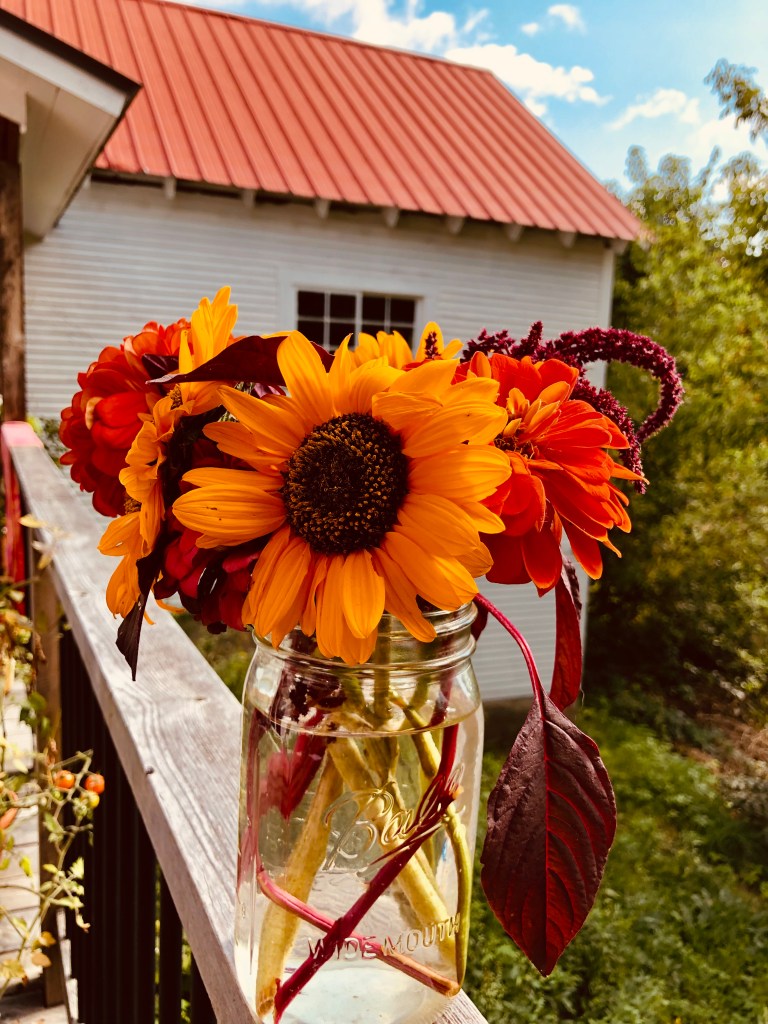
My daughter returns from a hectic work week with a mason jar of flowers from a friend. Our cat immediately gnaws on a zinnia leaf, and so my daughter sets the jar of flowers on our table on the back porch.

A week later, the flowers are still vibrant — giant orange zinnias and sunflowers and maroon amaranth that drapes over the jar’s edge. This, despite the fluctuations of cold and heat for days.

The other name for amaranth is Love Lies Bleeding.

On this Saturday morning, my daughters already at work and soccer, I drink coffee and catch up with email. Next year, I imagine, maybe I’ll plant my entire garden in flowers, vegetables be damned. I won’t; I know that. But I sowed an enormous variety of Love Lies Bleeding in along my brassica this year. We’re devouring all of that.

Petal. Stone. Blood.

Just before school starts this year, we spend a Sunday driving to the other side of Vermont, down along Lake Champlain, and crossing at the Crown Point bridge. There’s little traffic anywhere. We stop in Bristol for coffee, and then I keep driving, my friend and I in the front, our three daughters with their long legs sprawled in the back.

We’re headed to Fort Ticonderoga. Our daughters are taking an intensive history course this year, and I’m thinking the girls view the trip at first as a combination of the dusty past and an Instagram opportunity. Very quickly, we realize this is a site of stone, metal weapons, rammed earth, strategy, and bloodshed.

In the day’s sultriness, we wander behind the fort and discover the Fort’s immense gardens, now given over almost entirely to flowers. There’s few visitors and apparently no staff.

Below us, the lake lies still as a photograph, blue surrounded by the green hills. The crickets unfurl their slow late summer song. We’re in absolutely no rush at all, lingering among these flowers petals while, up on the hillside, someone bangs a constant dirge on a drum.

This ruined temple

should have its sad tale told only

by a clam digger.”

— Basho
Mount Defiance, New York

Sunday Morning Reading.

On my drive a few weeks ago to New Hampshire, I listened to Donald Antrim’s essay in The New Yorker about his hospitalization shortly before he published a memoir about his mother’s death. He was eventually treated with electroconvulsive therapy, partly at the urging of David Foster Wallace.

In this sticky August weekend, I’m reading that memoir, The Afterlife.

Here’s a line from this fiercely written book:

People are fond of saying that the truth will make you free. But what happens when the truth is not one simple, brutal thing?”

— Donald Antrim
Greensboro, Vermont