Butterflies and Crickets

On a balmy afternoon, I’m on Nature Conservancy Property in Greensboro, Vermont — Barr Hill — the first place my daughters hiked. Nearby lies the glassy blue gem of Lake Caspian.

On my short drive there, I’d been listening to the governor’s twice weekly press conference. By now, like so many people in the state, I’m familiar with Scott’s voice, his cabinet members, and the press. Scott allows the press to ask question after question; these sessions have an interesting kind of intimacy, a we’re going to get through this kind of attitude.

On my way along Barr Hill, I pass rusting old farm equipment in fields where cows are grazing. Here, the past is both near and hidden.

In a field, I paused and admired the view of the mountains and the line of lake. The sky these days is slightly overcast with smoke from the west coast wildfires. Around me, butterflies flew over the blooming goldenrod, and crickets leaped in the dusty path around my feet.

I had such a sense of living in an historic time — the Covid pandemic — and yet I just soaked up that all that sunlight, those tiny flickering wings.

Small Victories

Like so many places, I’ve limited occupancy in my one room library, and, for the most part, that’s worked. This afternoon, just before the after school program started for the first time in months, the adults stood around in our usual pow-wow and returned to the same theme: we’ll make do.

We did.

One boy leaned in the open door, begging to come in. I told him to wait, wait, that I’d come for him when the space emptied out a little.

When it did, I stepped out on the grass and spied him across the playground. When I gestured for him and called his name, he came running.

Messed-up world notwithstanding, what utter joy to see this sprinting boy.

In honor of RBG, her words:

Earlier, I spoke of great changes I have seen in women’s occupations. Yet one must acknowledge the still bleak part of the picture. Most people in poverty in the United States and the world over are women and children, women’s earnings here and abroad trail the earnings of men with comparable education and experience, our workplaces do not adequately accommodate the demands of childbearing and child rearing, and we have yet to devise effective ways to ward off sexual harassment at work and domestic violence in our homes. I am optimistic, however, that movement toward enlistment of the talent of all who compose “We, the people,” will continue.

— Ruth Bader Ginsberg

Photo by Molly S.

Mid-September?

Three years ago, I sold our house on a back road and moved into the village, for a few reasons, for mostly so my daughter could walk to school. By then, I was a single parent, hustling a livelihood, and I needed my youngest to be able to get herself around. Rural Vermont, for those not in our world, depends on the car or pickup to get yourself around.

In the pandemic world, where I often find myself ticking off what I’m grateful for, as an antidote to the long list of what I’m decidedly not grateful for, that 15-minute walk ranks pretty high up my list.

These days, I’m wondering how this pandemic will shape my daughter’s generation.

A year ago, she was a freshman in high school, with a regular slate of classes and fall soccer games. As a sophomore, she’s more like a college student, grabbing in-person classes instead of online classes, insisting I’m not to interfere; she’s worked out her own schedule.

Study hall on Monday afternoon? I’ve given her permission to walk home with her friends.

So, while she’s hoping her year will be filled with chemistry, anatomy and physiology, trigonometry, Spanish, and French, I see a different kind of education this year. When her father and I divorced, her childhood had a hard line — a Before and an After. Now, across her whole generation, I see a Before and an After.

I’m incredibly curious to see how that unfolds.

The Uses of Sorrow | Mary Oliver

(In my sleep I dreamed this poem)

Someone I loved once gave me
a box full of darkness.

It took me years to understand
that this, too, was a gift.

Hardwick, Vermont

Butterscotch Lifesavers

In the evening, as dusk settles in, my daughter and I walk downtown to the corner store.

I’m looking for Lifesavers, a rare treat in our house. She asked if I would mind buying her Lifesavers on my way home from work. I’d forgotten her request in my hurry home.

At the corner store, we realize she’s forgotten her mask, so I go in alone and stand there, pondering the three Lifesaver options that store offers. What the heck, I think, aren’t there like a thousand flavors of Lifesavers?

Outside, I find her leaning against the store’s cement block wall, talking on her phone to her uncle, who’s called to find out how school’s going and what’s up in the realm of pandemic adolescence. She’s talking and smiling, glad to hear from him, spilling her happiness with her math class and driver’s ed, the two bright spots in what otherwise appears to a whole lot of chaos.

These days, my head feels jammed with a snarly chaos, with a stream of work and winter prep, a marathon-length school board meeting, and our first frost. As my daughter talks, I wander along the river, its bank piled with old tires. Oak trees spread over the water, their leaves still summer green. What a story, I think, this will be one day, for these kids who grew up in the pandemic’s shadow.

I slide the packs of Lifesavers into her jacket pocket, my small offering.

Members Only

Sunday afternoon, rain showers fall intermittently. In between, the sunlight sprinkles the garden — the most delicious weather for the garden. I read on the front porch couch, the cats wandering between me and my daughter.

I bought this novel to add to the library’s collection — Members Only, by Sameer Panda — after listening to the author on NPR. It’s clever, sharply written, utterly relevant, and its plot hinges on what seems to be a single slip up by the protagonist, but gradually a whole story of circumstances and choice is revealed.

This July, like my garden, I’m soaking up sunlight and rain showers — as if my daughters and I can store these lovely days in our DNA for the long winter yet to come. Why talk about my daughter’s sophomore year? Who knows what will happen in American schools this fall and winter? Like just about everyone else I know, I’ve accepted we’re not headed anywhere, anytime soon or not soon. The ubiquitousness of the disease is a strange kind of leveling field — there’s no longer the wealthier kids my daughter knows who are headed on extended vacations while I suggest to my daughter that she repaint the north side of the house.

While it’s day by day here, as the parent I’m always eyeing that future, and that, perhaps, more than anything else, brings me back to day to day, in this sweet July.

IMG_8017

Dissonance

One good thing a day — take joy in at least one thing a day — is my new mantra.

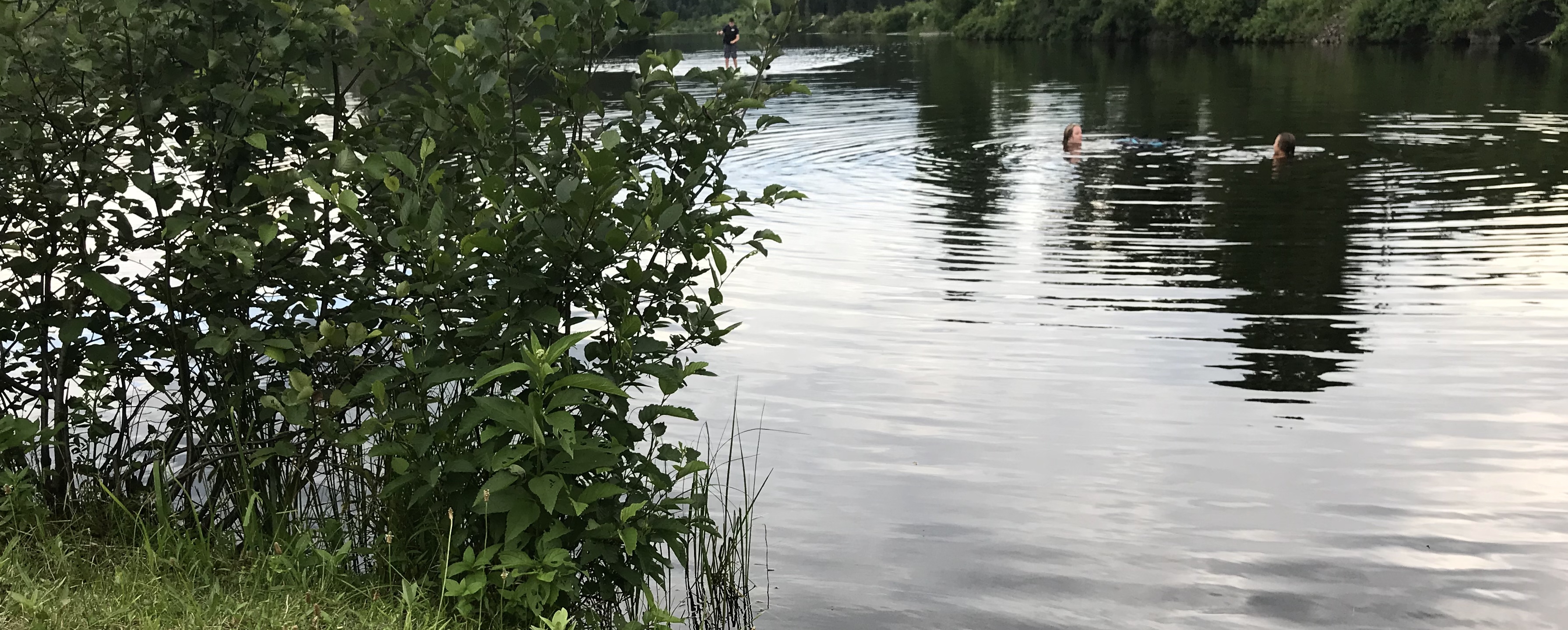
Swimming or drinking coffee. A colleague moved a rock in her garden — how happy that made me. Spying foxes down in the woods. My daughter’s pleasure in making bracelets. A giant swan floatie my daughters bought while I was at work one day.

I’m not hoarding; I simply note that one thing. The odd thing is, once I note that, I find endless amounts of good things — the Sweet William in my garden, laughing on the phone as I ask a librarian to put out a book for me, please, and then calling through the (closed) library’s door — thank you!

None of this alleviates or alters the world — that I live in a state of incredible wealth where thousands of people have lined up in their cars for eight hours to receive a box of free food. The future is utterly obscured — from a national level literally igniting, to a personal level, where so many people’s lives around me are in upheaval.

This summer, as my daughter steps happily into the driver’s seat, I sit beside her, cautioning — slow down for this intersection. Don’t expect others to turn their turn signals. Be wary of children on sidewalks.

The truth is, I resist this stage of parenting, of giving her the physical keys to head into that vast and confusing world. Yet, it’s her world, too.

So, I identify those good things, like stones in a turbulent river, as we undertake a crossing.

Dissonance
(if you are interested)
leads to discovery.

— William Carlos Williams

IMG_8031.jpg