Hard, Sweet Pears.

The couple who owned this house before me planted two pear trees in the front yard. The runt leans into the lilac hedge, as if hiding its crown. The taller has expanded into a pear tree version of pirouetting ballerina. Late afternoon, after pulling out withered lily leaves from the flowerbeds, I pluck two hard sweet pears and head over to the neighbor.

She’s created an unusual little garden with little pools of running water, so the delight is for your ears, too. I hadn’t realized it was the anniversary of her husband’s passing. We sit in her garden while the sun sinks down, talking about random things — work and the school board and gardens. The little boys across the street bike into her driveway. She’s parked as far back as possible to give the children a little more space on our tiny street.

When chilly shadows cover the garden, I stand, throw my pear core into her weeds, say goodnight. The boys have been called in for the night. As the cold edges in, mist thickens in the valley below. I watch how those cloud layers drift, cushioning the village, layered work just for the night. Then I pick another pear for breakfast.

Some days I find myself wondering how I’ve landed in this town, what random circumstances drove me here. There’s that trite old phase that the only constant is change, but of course that’s not true, either. All around us flow the steadiness of children, of loss, of those ripening pears.

September: such a pretty, sweet month.

Blackberry Eating

By Galway Kinnell

I love to go out in late September
among the fat, overripe, icy, black blackberries
to eat blackberries for breakfast,
the stalks very prickly, a penalty
they earn for knowing the black art
of blackberry-making; and as I stand among them
lifting the stalks to my mouth, the ripest berries
fall almost unbidden to my tongue,
as words sometimes do, certain peculiar words
like strengths or squinched,
many-lettered, one-syllabled lumps,
which I squeeze, squinch open, and splurge well
in the silent, startled, icy, black language
of blackberry-eating in late September.
Crash, smash, end of summer….

Sure, it’s hot again, but it’s a day without swimming. I’m in the nether in-between place where the youngest is headed back to college, and my life inevitably tips towards the not-so-fun adult things I’ve kicked down the proverbial road. Borrow a spark plug wrench and fix the lawn mower, walk down the hill and ask the young carpenter what to do about that stucco that crumbled from the house foundation, just behind the rose bushes that we sliced away last weekend, tearing away the moss to keep the moisture, moisture from my house.

We are inside and outside all day long, hanging up laundry and sweeping the porch, loading a car… The cats are confused. The kitchen floor is sandy. I think of this day and the next and the few following until I might meet my friend for dinner, exchange our mothering stories, ask what’s happening? what now? what next? This year, I have officially crossed over into the population of the dead mothers club. In a strange kind of way, I find this like membership in the new parents club: once you’re a parent, you’re in, a lifer, whichever way you’re going to take that ride. As for me — and maybe it’s really my suspicion I’ve been poisoned by mold at work — but I turned with an anathema against cattiness and pretense, as if my own death perches on my back just like my daughter now heading back to college classes who hung on my back not that many years ago, her miniature fingers curious against my ears, reaching for wild blackberries. Evenings, the August she was one, I walked her sleep every night as the twilight sank and then laid her, sodden with dreams, on our bed.

So it goes, this rich wild life.

On a whim, I buy a copy of Pearl by Siân Hughes in Montpelier. Oh, novel of my heart:

Had I stopped to think for a minute that the fracture in my family, the rift opened in my own heart, would be passed down to the next generation, through my own damage if nothing else? No, I hadn’t. It never crossed my mind….

“Everything blooming bows down in the rain…”

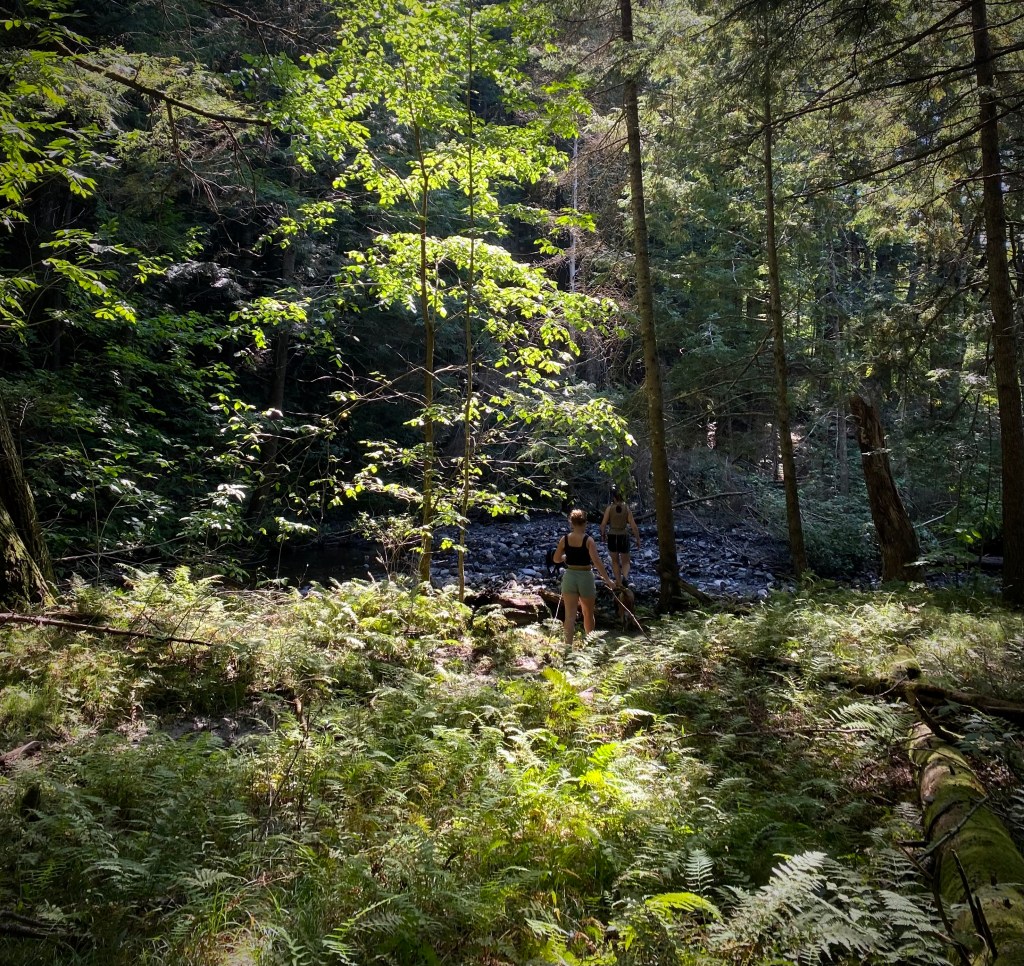
In the sultry dawn, I’m wandering barefoot in the garden, snatching the lingering strawberries before birds have nabbed the remainder. By late afternoon, thunderstorms have settled in. I’ve left a wooden chair on the porch, a throw rug over the railings, both sodden now. Book in my hand, I lean against our house’s dusty and pollen-layer clapboards, reading in the coolness that’s washed in. Our porch looks out over a bed of bleeding hearts, false Solomon’s seal, hostas. Beyond that, the cemetery, the river valley below. Behind our house, the wild presses in. Ferns tall as my shoulders, goldenseal, the groundhogs, thrush, chittering sparrows, the cut of ravine and the great life there.

Equinox; the lushness burgeons. Bring it on. The rain blows through the bedroom screens whose windows we left open all day. The box elder shoves between the porch railings. The grapes rise hungrily against the barn. All night our rooms are filled with moonbeams, the blowing dew, the mixture of milk trucks rattling down the road and the calling frogs.

Everything blooming bows down in the rain:

white irises, red peonies; and the poppies

with their black and secret centers

lie shattered on the lawn.

~Jane Kenyon

Some news…

… in a year unlike any other year in my life (youngest off to college with the first year’s bill figured out, grating loneliness and joyous solitude, so much writing and small publications, a radiant writing residency, new friendships, and my mother’s death — say this again, my mother’s death) Regal House Publishing, an Indie press in Raleigh, picked up my second novel, Call It Madness, pub date summer 2026.

Chapter One

            I didn’t know what made my parents drive from Bellingham to faraway Vermont the summer I turned four. I had never met my great-grandfather Opa until that afternoon my mother rolled our station wagon down Breadseed Lane. Earlier that day, a stranger had helped my parents change a flat tire on the New York turnpike, but the spare was a misfit. For hours, our car had been thumping while I stared through the backseat windows at the trees and fields passing by, pondering the puzzle of that strange word breadseed. Could seeds blossom into loaves? We hadn’t stopped for lunch, and I was hungry. Was this Opa character cooking us dinner? Turned out, he was not.

Sips of May.

As the spring dusk settles down, I’m wandering around the edges of my garden. The lilacs have just begun opening, a tiny four-petaled blossom here, another there, the remainder of that lavender flower still knotted, not yet relaxed into the wide open spring season.

I’m in my ragged jeans, dirt under my nails, when my neighbor pulls into her driveway and gets out of her Prius. She’s wearing what she calls her rag-bag dress, and the two of us make a kind of pair. I’ve known her since our oldest kids were babes in arms, not yet eating smashed carrots.

It’s been a year for each of us — and I mean that: a year. We both have college-aged kids in and out of our houses. Under the fragrance of pear blossoms, we immediately head into that long-running conversation we have about her work and my work, about writing and art, about aging parents. The half moon rises over my apple tree.

May, in all her radiant beauty. Here I am, with a hundred chores in one day — a hot water heater repair, more writing, plant arugula and Brussel sprouts, my constant fiddling with the wood pile, the daughter chat. How this Vermont world loves to green. Yes, and again, more, yes, yes.

Heart Runneth Over…

The Gihon River runs through the Vermont Studio Center campus, turning as a river does just out my studio window. All day long, the mallards do their duck thing, swimming up and downstream. In the wild honeysuckle’s tiny bits of green leaves, cardinals perch.

In this week I’ve spent at the Vermont Studio Center, I’ve leaned with a ferocity and joy into writing. A week to write, unfettered by the everydayness of commerce and cooking, of checking the car oil, adhering to those endless lists of can the house insurance get a lower premium, and am I ever going to paint the back side of my house? A thousand things comprise a life — some stupidly trivial like repairing a kitchen cabinet knob, some sacredly profound, like mourning a parent’s passing. 

Does writing, does sculpture, printmaking, poetry, make the world a finer place? The jury’s out perhaps, but art certainly unites the finer parts of who we are as humans, and makes this life more bearable.

Thank you again for reading.