Truth at the Door.

Center Road, Hardwick, Vermont

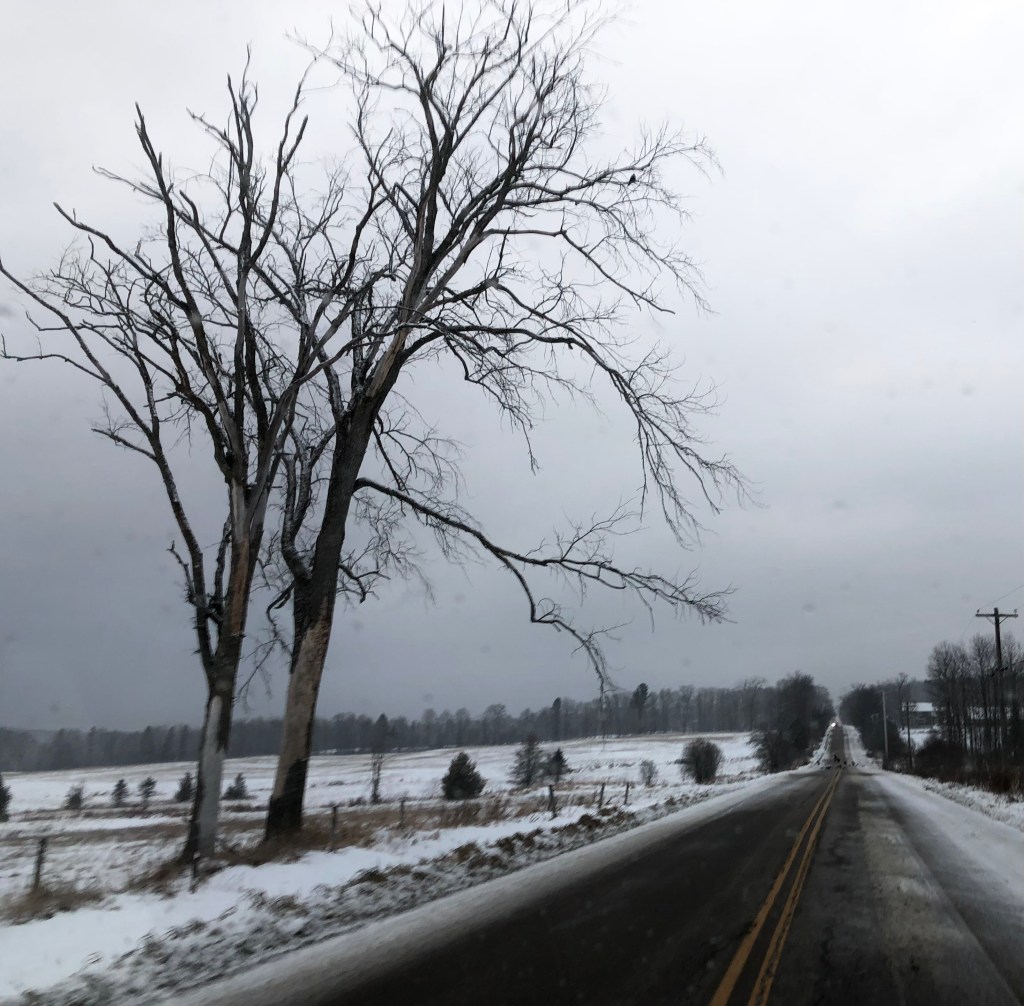
I stopped for a flock of crows this morning on my drive to work, half a dozen or so of them, pecking at roadkill. In the slow way of November, the birds contemplated me and then turned back to their feast.

For a moment, I got out of the car, just me and the crows and the morning too cold to be damp. Eight crows, two yellow lines, one dead tree, and all that snowy field and sky around me.

Driving, I had been thinking of the poet Lucille Clifton, who wrote the saddest poem I’ve ever read, “The Lost Baby Poem.” The poem that needs no commentary, nothing further.

Clifton wrote about sorrow, but plenty more, too. She advised, “You might as well answer the door, my child,/the truth is furiously knocking.” It’s a line I’ve returned to over and over in my life, one of my guiding stars. This November morning, cawing crows opened my Subaru door.
Distance.

We’re deep in the season of darkness now, night so thick at 5PM I could hide my hands in it. At work this morning, my daughter texts me news of a murder-suicide in a nearby town. The deaths occurred this morning while my youngest and I were eating granola and yogurt, talking idly about Monday morning.

I’ve lived in Vermont darn near forever, and this marks the fifth murder in a handful of weeks. While my daughter and I cook dinner we talk about violence in Vermont — domestic, and not. There’s nothing I can say to change any of this. But I tell my daughter she’s part of the world, now frequently without me or her older sister. In my own mother speak, I remind her that she has her own part in the world, too.

Pay attention, I urge.

In the dark, I chop wood beneath the stars.

A Miniature Temple.

A number of years ago, my friend and I were sitting near a lake watching our little kids play in the sand when somehow our conversation drifted to fear. I began rattling off what I feared — and the list was long. My friend had her long list, too.

Years later, my list might be shorter, but the items are all darn scary.

I wake in the dark as our cats creep around the downstairs, fearful and entranced about my visiting brother’s dogs. Over the millennia of human history, countless people have lived — and are living — through periods when the world around them was crumbling apart or being blown to smithereens. On this Thursday morning, here’s a few lines from a recent poem in the The Writer’s Almanac.

Wishing happiness to all of you, in whatever way the light finds you….

Isn’t it enough to be a person buying

a carton of milk? A simple

package of butter and a loaf

of whole wheat bread?

… I look outside,

but I can’t see much out there

because now it is dark except

for a single vermilion neon sign

floating above the gas station

like a miniature temple.”

— Marlena Morning

Nearing Thanksgiving, a few lines for the Cashier….

….. who checked me out countless times with my bags of cat litter and chocolate chips and toilet paper and English muffins. We always did the usual ‘good afternoon’ or ‘have a nice day’ kind of thing. Then one day, she tugged the sleeves of her sweater over her wrists and said, “Seven years I’ve worked here, and they’ve never fixed that cold air coming down on me.”

Come the pandemic, and she’s disappeared. Where you are now, I have no idea, but, gracious, woman, I hope no cold breeze dumps down on you all day.

… Rereading Ann Patchett in anticipation of her upcoming book: “I could understand why Gautama had to leave his wife and child in order to find the path to nirvana. The love between humans is what nails us to this earth.”

The waxing moon is especially cream-hued tonight, strutting her mysterious beauty. No nirvana here, but plenty. Plenty.

Zen. Broken Sink Drain. A Meaningful Life.

back porch view

I’m lying on the couch reading Sigrid Rausing’s Mayhem when my daughter calls from the kitchen, ‘Mom, you’re not going to like this!’

The sink drain has split apart again and gray water floods the kitchen floor. For a moment, I think, whatever, and then ask her to get an old towel.

I have now repaired this drain three times, each time in nothing but sheer annoyance and impatience.

The problem, naturally, has something to do with PVC and epoxy, but more to do with me. My ex-husband put in this drain, in his trademark cob-job way, fitting together scraps of plastic pipe. I’m irritated at my own ineptness, my unwillingness to devote real time to YouTubing a solution, the scantness of my nonworking hours.

I’d rather paint a wall than repair a drain.

After we mop up the water and pile the unwashed dishes on the sink drainboard, we put on our boots and take a walk in the falling snow. It’s the first snowfall of the year. Snow is our old friend, falling silently, sparkling in house and streetlights. This first bit will melt today and return again soon.

Sunday morning. Put the house in order. Take the broken pieces to the hardware store. Ask for advice.

True recovery is a profoundly ethical journey, finding meaning and dignity through solidarity and restitution. Without that, there may be a cessation of drinking or substance use, but there is no real recovery.”

— Sigrid Lausing

Frost Slivers.

Hardwick, Vermont

Vermont November is the month of introspection.

Beloved friends from long ago stop by for coffee and conversation on their way from here to there. We’d last seen them when we first moved in this house, less five years ago.

We take that figure of five years and turn it around and around — so much has happened in those five years. As with everyone I meet from afar these days, I ask what’s happening where they live. The conversation has a strange, almost wartime sentiment, as we compare notes.

In mid-afternoon, I bury daffodil bulbs. The soil has already begun to freezing. My bare fingers burrow through silvers of white frost, the teeth of winter beginning to grow. Finished, I brush off my hands on my jeans and stow my shovel in the barn.