My Familiar

The past two mornings, a large fisher cat has slunk through my snow-covered garden, scoped out the compost, and wandered back into the woods, with that odd, weasel-esque serpentine back motion. The creature is dark as a rain-sodden forest floor.

My house is for sale now, and strangers have been wandering in and out. Do they admire the blue I’ve painted the windows? Are they as annoyed with the unfinished trim and stair treads as I am, or are they starry-eyed, as I would have been, years ago?

I’ve told none of them of this wild creature wandering in and out, my own particular secret, the wildness I’ll carry with me, no matter where we go.

The truth felt stranger than the myth.

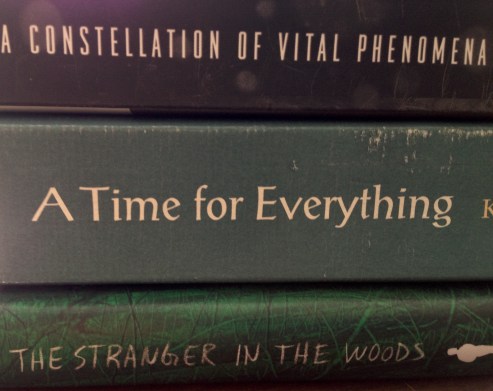
Michael Finkel, The Stranger in the Woods: the Extraordinary Story of the Last True Hermit

FullSizeRender

fitting reading, these days

Early January, at Home

In the morning, driving along the Lamoille River and its flanking snow-buried farm fields, my daughter and I note the river’s ice buckled across its serpentine surface and speculate about its thickness. With this year’s early insulating snow, the fire department posts warnings about treacherously thin ice.

These days are long, beginning in darkness and ending in darkness, arcing over the eye of grayish light in the middle. Last night, our windows filled with spinning snowflakes, while my teenager and I held onto the day, talking, talking, our words swirling around each other, sharing our worlds.

Later, as the wind howled over the house, I read from my library book Staying Alive: Real Poems for Unreal Times – irresistible title.

Poetry is like the sawdust coming from under the saw
or soft yellow shavings from a plane.
Poetry is washing hands in the evening
or a clean handkerchief that my late aunt
never forgot to put in my pocket.

Jaan Kaplinksi, “‘Once I Got a Postcard…..'”

fullsizerender

North Calais, Vermont

Magical Realm

As the kids and I drove into Barre, Vermont, this afternoon, the little boy in the back seat said,  I really don’t like Barre.

I’m with the kid, I’m reluctant to say, for reasons no doubt wholly different than the boy’s. We were headed to The Nutcracker, in the gracious Barre Opera House. On the way there, I drove behind the county courthouse, repository of windowless hallways and claustrophobic rooms, countless tears of human misery.

But I trusted ballet could rewrite my experience of that city, and the magical dance did not let me down. At the performance’s very end, high up in the balcony, I realized  – in what should be a, well, duh, moment – that ballet was all about the transformative might of imagination.

All the way home – and here’s yet another driving story, yet another journey – we drove on icy roads through the smokey blue-black twilight, and then arrived in our own home town with full darkness ringed all around, velvety and deep, and the village lights twinkling white. The town itself might have been the opera house stage, lit-up and beautifully arrayed for the holidays.

When I was twenty, I worked nights for a summer. I loved driving at night as a young woman; the darkness around my two Volkswagen beetle headlights felt ripe with possibility, and I believed myself invincible with youth. In an odd juxtaposition, nearly thirty years later, possibilities stretch out even more infinitely before me. Although I now know the illusion of invincibility, I think I’ve traded that for something deeper and far more valuable in those sparkling lights.

Unamuno might be describing the artist as well as the Christian as he writes, “Those who believe they believe in God, but without passion in the heart, without anguish of mind, without uncertainty, without doubt, and even at times without despair, believe only in the idea of God, and not in God himself.”

– Madeleine L’Engle, Walking on Water: Reflections on Faith and Art

fullsizerender

Technological “Advances” in Rural Vermont

Living in Vermont and relying on a cell phone means knowing the best reception landscape around you – precisely which few feet along your dirt road have enough bars to dial out.

Yesterday, with our home reception reliably lousy these days, I parked behind the Greensboro Garage’s yellow barn, opened my notebook, unstrapped my sandals, and went to work. The crickets were singing, and the sun was a peachy end-of-August temperature. I spread my notebook on the dash, with the doors open, in a little breeze that moved along that valley. As a writer, I’ve worked in all kinds of places, from cemeteries to a hospital closet, and this was prime territory, but I’m not sure this represents all that much of a technological advance.

I once used a landline at my own desk; now the phone fits in my hand, which is good thing because I sometimes need to hold it up, believing that will improve reception or send off an email I’m anxious to move along.

Admiring this substantial barn reminded me of Salinger’s Raise High the Roof Beam, Carpenters. Remember Seymour Glass calling his fiancée in World War II?

The connection was so bad, and I couldn’t talk at all during most of the call. How terrible it is when you say I love you and the person at the other end shouts back “What?”

– Salinger, Raise High the Roof Beam, Carpenters & Seymour: An Introduction

Yesterday evening, parked at the top of Kate Brook Road, near a meadow storybook-beautiful with wildflowers and ringed by mountains, neighbors stopped and asked if I had a flat tire. When I held out my phone, they said, Use our landline anytime. The door’s unlocked. If I stopped by, chances are, I’d leave some of my tomatoes, and sample some of theirs.

FullSizeRender

Hardwick, Vermont


Book Group

For years, my daughters and I have been eating peppermint stick ice cream at Cassie’s Corner in Greensboro, Vermont, while admiring an immense red barn just across the side road. Who lives there, we wondered?

This sun-filled afternoon, I was lucky to sit with a group of women who had all read my novel and asked stellar questions. What a gift for a writer. Often, I imagine myself straddling the outside ledge of a cupola, my fingers hardly holding a grip, my toes clenching a ballpoint pen, while I fervently ponder plot and backstory and spy on passersby. The truth is, maybe I just need to get out more.

Many doors have opened to me via Hidden View, but to sit with a group of smart women, talking about craft and literature, is an especially savory bit of summer. Who knew open barn door would reveal such a stunning view of the lake  – and couple that with conversation? – terrific.

One has to be just a little crazy to write a … novel. One must be capable of allowing the darkest, most ancient and shrewd parts of one’s being to take over the work from time to time.

– John Gardner

FullSizeRender

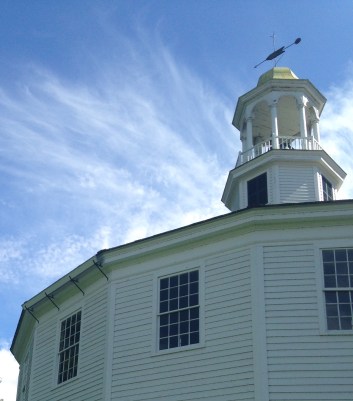
Round Church in Richmond, Vermont


Revision: Made by Hand

I’m revising both a book and my knitting these days, yanking apart for the fourth time the same skein of yarn. At some not-too-distant unraveling, this lovely yarn may disintegrate. Isn’t revision one of the great beauties of knitting? Unlike in my own life, I can re-do, refashion, re-envision. That’s a gift in writing, too, that the writer cannot use in her own life.

I keep returning to that Aristotelian word teleology from my undergraduate philosophy days. What is the purpose of this ball of yarn? How can I aid that lovely azure linen to achieve its intended purpose? What is the purpose of the book I’m writing, and how do all these pieces within help achieve that end?

Here’s the faith aspect: I’ll find the proper gauge and use for this yarn. The writing will clear. And what cannot be undone in a human life is an intrinsic part of the whole.

The work of the world is common as mud.
Botched, it smears the hands, crumbles to dust.
But the thing worth doing well done
has a shape that satisfies, clean and evident.
Greek amphoras for wine or oil,
Hopi vases that held corn, are put in museums
but you know they were made to be used.
The pitcher cries for water to carry
and a person for work that is real.

Marge Piercy “To Be of Use”

IMG_1599

Shelburne, Vermont