Hardwick Postcard #5: Wear a Hat

Mexican hero Emiliano Zapata insisted, The land belongs to those who work it with their hands. With the snow here to stay, I’m already dreaming of star-shaped potato blossoms, the first tender snips of garlic shoots, rain-drenched rows of glossy greens.

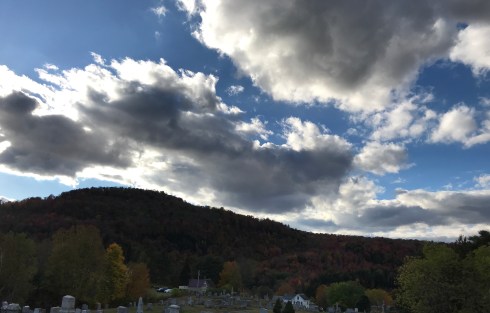
Meanwhile, my daughter – far more interested in eating than agriculture or politics – claims her territorial lines. At 12, she walks. A few years from now, like all the other rural Vermont kids, she’ll finagle a vehicle or rides from friends – opening up an entirely different landscape for her – but for now, she learns her path to middle school footfall by footfall, first over the cemetery fence. She turns to wave goodbye to me and hurries off to meet her friend.

To reach the school, she and her friend walk down the hill into the valley where Hardwick village lies along the Lamoille River, then up the hillside where the standard brick middle/high school sprawls. The entire walk – past the dead, the elementary school with its crossing guard, two auto parts stores, a busy diner, a few storefronts, a laundromat and a library – takes less than 20 minutes.

December’s lesson: wear a hat and mittens. The walk is cold.

At the risk of seeming ridiculous, let me say that the true revolutionary is guided by a great feeling of love. It is impossible to think of a genuine revolutionary lacking this quality.

– Ernesto Che Guevara
 

IMG_0576.jpg

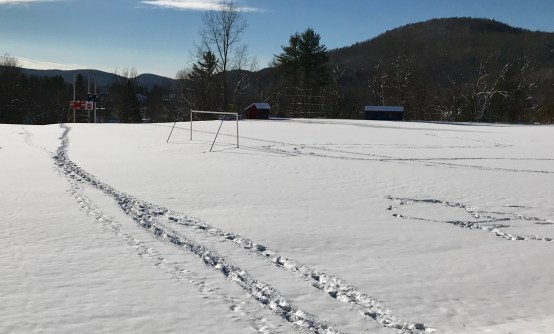
Hazen Union, Hardwick, Vermont


Round and Round

Autumn is my Proust’s cup of tea, recollecting for me all those childhood afternoons I walked home from elementary school, scuffing through knee-piles of fallen leaves, as they crumbled and broke, releasing their rich humusy scent.

Each morning, my 12-year-old hoists her backpack and walks across the dewy lawn, leaping over the chain link and heading down the cemetery hill. Sometimes she looks back over her shoulder to see if I’m watching; sometimes she disappears into her day without a look back, unconsciously and imaginatively creating her own teacup of memories.

While the landscape shines postcard-pretty, behind our back porch the  box elders shake loose their leaves, and up-close we’re beginning to see what was hidden under the summer’s greenery. My 12-year-old fantasizes about a zip line from the porch deep into the ravine. Her eyes sparkle as she imagines flying down that ravine, deep into the heart of a place not yet well-known.

this piercing cold—
in the bedroom, I have stepped
on my dead wife’s comb


– Ueda

IMG_0024

Autumn, Now

Talking to my brother while frying sausages with garden greens for dinner, I mention the girls and I have just gone swimming, with the temperature high in the 80s. He says, The climate isn’t changing; the days are just getting warmer. I immediately take the phase and turn it around to reflect something inane in my own life. We’re going to use that joke for years to come.

At a soccer game, another parent mentions he’s been watching Ken Burns’ Vietnam series, and he offers that his dad served a tour in Vietnam. I share my memories of my father watching Walter Cronkite every night and drinking bourbon, fiercely opposed to that war.

Collectively, as a parent group, we wonder what our kids will remember about these years; as adults now, we sense tension rising in our own rural Vermont. But these September days are balmy and beautiful. We cease talking and admire dragonflies nipping by, fat shafts of sunlight between us filled with dust. Even when the girls have hit the locker room, and then scamper around us, hungry, we keep on admiring, filled with the great good luck of being alive on such a day, mothers and fathers of healthy strong girls, at a leisurely, end-of-the-day soccer game.

The summer moon.
There are a lot of paper lanterns
On the street.

– Buson

IMG_2005

Tiny Treasure

A little boy, maybe six, came into the library yesterday with his hand cupped around some precious thing. I had propped the door open to let in the warm September sunlight and a few stray flies. His short hair sweat-soaked, he wore a t-shirt so large it nearly covered his knees.

He laid a crumpled bird shell near my laptop and asked me to keep it safe. I found it, he said by explanation.

The boy was supposed to be somewhere else, and we heard an adult outside calling his name. On his way out, his hand hovered over an apple on my desk, a yellow-skinned fruit with a few dark blemishes I had picked from a wild tree that afternoon, walking to the post office.

I told him it wasn’t sweet, as I lifted the apple and handed it to him.

September’s such a quiet month, with the cricket songs slowly spinning quieter. Wordlessly, he considered, and then he took the apple and disappeared into the sunlight again.

I wondered if the boy would return for his treasure. He did.

Soon the child’s clear eye is clouded over by ideas and opinions, preconceptions, and abstractions…. Not until years later does an instinct come that a vital sense of mystery has been withdrawn. The sun glints through the pines and the heart is pierced in a moment of beauty and strange pain, like a memory of paradise. After that day, we become seekers.

– Peter Matthiessen

IMG_1900.JPG

Nichols Ledge, Woodbury, Vermont

“This Infuriatingly Intricate Web”

A well-known local author mentioned at the most recent of his readings I attended that he’s writing a book about koans – a book I can’t wait to read, because isn’t life just a series of unfolding koans? Have I ever actually solved one? Some days, it seems to me, not likely.

My daughter spied a V of geese winging south yesterday, the first we’ve seen of this season, but one among countless Vs we’ve watched since she was a tiny girl, her arm crooked around my neck. Fall is familiar, graciously beautiful, infinitely sad, followed by the brilliant beauty of sparse winter: the same Vermont story, year after year, and yet I’m always surprised by the September mornings’ cool mist, the cucumber vines shriveling, all done with this life.

Cooking dinner yesterday, I read an article in the New Yorker about that terrible disease, cancer. Innocuously enough, the article begins with mollusks in Lake Michigan, journeys through seed and soil, and ends with a koan:

… as ambitious cancer researchers study soil as well as seed, one sees the beginnings of a new approach. It would return us to the true meaning of “holistic”: to take the body, the organism, its anatomy, its physiology—this infuriatingly intricate web—as a whole. Such an approach would help us understand the phenomenon in all its vexing diversity; it would help us understand when you have cancer and when cancer has you. It would encourage doctors to ask not just what you have but what you are.

– Siddhartha Mukherjee

FullSizeRender


Antidote: Wild Bears

When I visited Michigan as a kid with my family, years ago, we saw a man with a t-shirt marked with the phrase Say something GOOD about Detroit. These days, I often feel that way about the news. Or, worse, just say something not underpinned with corruption or misery.

So here’s my something: nearly 70 curious folks showed up in tiny Woodbury’s town hall last night to hear New Hamphire’s Ben Kilham speak about his experience raising orphaned bear cubs, reacclimatizing these creatures into the wild, and his decades of studying and admiring these beautiful woodland mammals. On a hot July evening, in this historic one-room building, friends and strangers listened, asked numerous questions, bought books. The Kilhams themselves reminded me of my parents, with an IMAX filmmaker in tow who I thought at first was their son, navigating their route and arranging a late post-presentation dinner plan.

Afterwards, lingering and chatting under a floodlight, we passed around the leftover donut holes and swatted mosquitoes. Summer. July. Vermont.

In late winter
I sometimes glimpse bits of steam
coming up from
some fault in the old snow
and bend close and see it is lung-colored
and put down my nose
and know
the chilly, enduring odor of bear…
From Galway Kinnell’s “The Bear”
FullSizeRender