Postcard from Vermont, July

An elderly woman and I stand in the library’s open door, sheltered by the overhang, watching rain move in, great billows of fine drops rushing across the field.

Summer people visit the library on these steamy afternoons, in a their winding-down, relaxed, vacationing way. We’re different here, one man tells me. I like how we are in Vermont. 

Boys with their faces painted a greasy blue-and-black circle around the library and school, hiding in the woods and behind the greenhouse, in an elaborate game. Two best-friend girls stroll in, return books, ask for fish crackers, and request more books. When I leave that afternoon, the girls are still there, lying on the slide’s top platform, staring at the cloud-heavy sky, talking.

All afternoon, bits and pieces of people’s lives knock into mine: a woman applying for a job online, a saleswoman over the phone, a couple who needs a letter written.

Later, when I’m alone again, gathering strewn puppets and closing windows, I realize my phone has a message. Someone dialed my number without realizing it, and I stand in the doorway again, in the sweet post-rain scent, listening to that odd audio window of others’ conversation. A gangly-legged heron flies overhead, then disappears over the trees. I erase that unintended recording and lock up for the day.

When I was nineteen,
I told a thirty-
year-old man what a
fool I had been when
I was seventeen.
‘We were always,’ he
said glancing down, ‘a
fool two years ago.

— Donald Hall

IMG_2847.jpg

Independence Day, 2018

What, to the American slave, is your Fourth of July?

…  your denunciation of tyrants…  mere bombast, fraud, deception, impiety, and hypocrisy — a thin veil to cover up crimes which would disgrace a nation of savages.

— Frederick Douglass, 1852

IMG_2411

Montpelier, Vermont

Local Wanders

When I lived on 100 acres in fairly rural Vermont, I didn’t imagine we’d change that story. 100 acres is a large chunk of land, and those 100 acres didn’t end at any boundary save a single dirt road along one side. The corners were rebar pins, surrounded by thousands of acres alive with fisher and bear and moose, jack-in-the-pulpit and hobblebush.

Living in Hardwick village now, the wild still surrounds us. Along our former road, tumbled-in stone foundations are reminders of farming families, who at some point packed up and moved along.

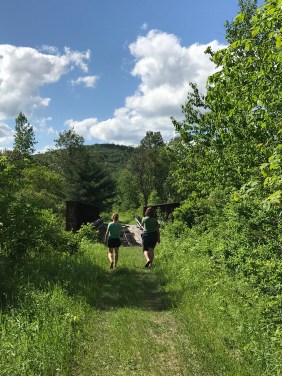
Yesterday, we walked along the railroad tracks, walled in at times by forest, and crossed the Lamoille River over a questionable bridge, hidden in this oh-so-June green beauty behind the town. I could imagine a hundred years ago, terrain cleared around the tracks, the rail bed studded with cinders. Save for the four of us, we saw no one but a crow.

The first step … shall be to lose the way.

— Galway Kinnell
l

IMG_5392

Photo by Molly S.

Constellations

11 at night, I’m at the high school, waiting for my daughter to return from a band/amusement park trip. The sun set hours ago, and I grab an extra sweater on the way out. It’s cold, cold enough I’m surprised I don’t see a ghostly cloud of my breath.

I get out of my car and hurry down the steep hill to the soccer field. Away from the lights in the school’s parking lot, the constellations appear, this silent beauty. I walk all the way around the field, to the far end where the woods begin. These fields, one of the most well-used places in Hardwick, are empty. On the rise of land above, I see moving car lights as parents pull in.

If the grass weren’t drenched with cold dew, I’d lie down. I remember being 19-years-old, the first year I lived in Vermont, and hiking in the middle of the night with a friend to a field. Rural Vermont, there were no human lights surrounding us at all. It was November and quite cold, but we were well-dressed and very young, and we lay down in the field and talked and talked.

I could feel the universe’s energy come up through the not-yet-frozen black earth, through the glacial pebble and tangled root, through my vertebrae and flesh, all the way up to the countless stars overhead.

IMG_8426.jpg

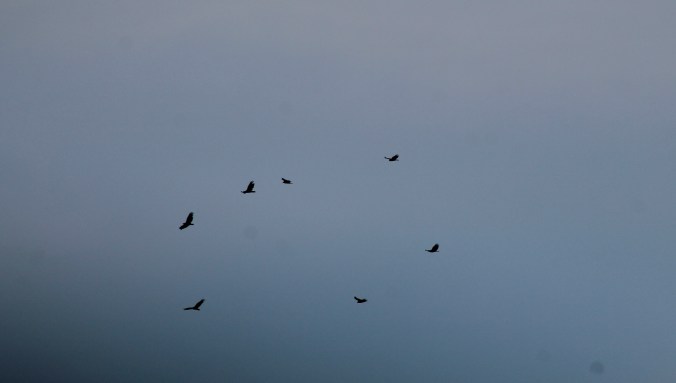
Vultures/by Molly S.

This Old Book

Walking with my friend through town, we find a cache of free, reeking-of-basement-mold books — a strange collection of Zen and psychoanalysis and car repair that might have come from my own  jammed shelves.

I pull out a skinny book with no title on its cover, only a black-and-white photograph of a long-haired girl in a white dress on a pile of rubble. An early edition of Brautigan’s The Pill versus The Springhill Mine Disaster.

For the rest of our walk, I hold the book loosely in one hand, past the the old granite cutting sheds, houses well-tended and houses abandoned, through the wet woods and blossoming bloodroot and a hillside of trout lilies just beginning to open. I keep thinking about my second book I’m finishing now, how I’m lacing together the connections within that story: a stolen jar of farmers market cash, a dead dog, a torn crimson scarf.

That night, reading the book, I discover a bookmark jammed in the book’s pages, from the Bedford, NH, bookstore of my childhood.

In a Cafe

I watched a man in a cafe fold a slice of bread
as if he were folding a birth certificate or looking
at the photograph of a dead lover.


— Richard Brautigan

IMG_1779.jpg

Necessary Flowers

In these last few days, in my corner of Vermont, we’ve experienced snow, raw cold, heavy rain this morning — and now rushing radiant sunlight.

Suddenly, as if reluctant to waste a moment, little blossoms around our house have opened — some I planted, the crocuses and grape hyacinth — but all through the flowerbeds and behind the compost are tiny blue flowers — Scilla siberica. 

When I was a novice gardener, I only planted vegetables, with some crazy notion that my labor should go solely towards what ends up on the dinner table.

This afternoon I see the pollinators are already busily working on these beautiful petals. Balance, balance.

If ‘dead’ matter has reared up this curious landscape of fiddling crickets, song sparrows, and wondering men, it must be plain even to the most devoted materialists that the matter of which he speaks contains amazing, if not dreadful, powers, and may not impossibly be, as Thomas Hardy has suggested, ‘but one mask of many worn by the Great Face behind.’

— Loren Eiseley, The Immense Journey

IMG_1699.jpg

Glory of the Snow, Hardwick, Vermont