Hill Farms

A drawback to easy-access tech is a proliferation of images, everywhere.

And then, this. From the library, I picked up Richard W. Brown’s The Last of the Hill Farms: Echoes of Vermont’s Past, a stunning book published by Godine, with the most amazing black and white photographs of rural farming Vermont.

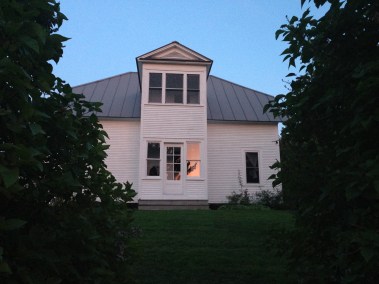
Check out page 95, with the moon sailing over a barn’s cupola, righteously high with a cow weathervane, intimating great height over farm fields. Broken-paned, paint peeling,

There it is: that elegant, perpetual juxtaposition of human endeavor and the lasting beauty of our landscape.

A neglected landscape silently gathered the patina of the passing years. Weather stained the unpainted barns and farmhouses the color of tarnished silver and gently bowed their rooflines with the weight of one hundred winters’ snow. Seemingly forgotten by the rush of progress, they aged with a poignant grace: spare, worn, yet, to my eye, hauntingly beautiful.

— Richard W. Brown, The Last of the Hill Farms

IMG_0902

Winter’s Wow Factor

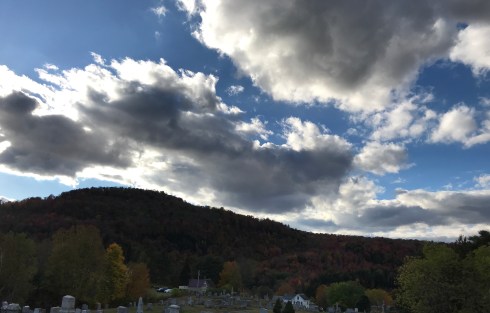
Checking to see a child arrived home last night, I drive around a hillside — the cemetery hillside — and my daughter says, Whoa, under her breath, with not a tinge of 12-year-old sarcasm. Just wonder.

Feral, the ebbing, ravenous wolf moon. A profusion of moonlight in an unending night, and all that cold. 6º and expected to get much, much colder.

We feed our own hunger — for warmth, for color, for stories spoken and read.

All night long, while we’re sleeping, meshed in cats and blankets, that pristine moon sails silently over our rooftops, more luminescently magical even than St. Nick.

Endless bare fields
not even a bush
nowhere to abandon a child

— Buson

IMG_0817


Postcard #10: Uninvited Guest

This marks an even dozen of Hardwick posts, despite the #10, but all of these have skirted around the jagged edges of where I’m really aiming: that community, like family, is suffused with some of the best and some of the very worst, too, of human nature. The little, one-room library (nearby, but not the Hardwick library) where I reign as Chief Cataloguer and Window Washer is visited by kids who sprawl on the carpet between the shelves and read, who crawl behind the wing chair and create magical worlds with puppets and stuffed animals — toys I leave when I vacuum and then turn off the lights, for children I expect will return.

My library has also been visited through a window and burglarized. My desk, where I keep stickers and budget sheets and book orders has been touched by hands not mine.

There’s a story behind this that’s not a nice story, about this visitor I didn’t invite in, but whom I would have, had he used the door like anyone else. My face, writing this, must reflect my anger and my fear. I’m no tabula rasa, and this entry into a place I’ve considered a kind of personal sanctuary cuts me.

And yet — and this is a very, very big and yet — I’m familiar with that ghastly howl of addiction, and my guess is that this intruder seeks the intrinsic human need of coming in out of the cold.

Yet, he didn’t come through the open door.

Driving home with my daughters over snowy roads in the dark last night, listening to their music, we drove around Lake Willoughby with no one else on the roads, and the waxing moon pushed through a scrim of clouds. Cold, cold: nearly zero. Enchantingly beautiful. A terrain known and yet unknowable.

I don’t have answers to why some children are well-tended and dressed, while others have drawn a short stick of basic things like food and clothing. I’m not naive enough to think the uninvited guest will ever use the library door, nor do I ever intend to welcome him through a window. But in this Christmas season of redemption and giving, I keep returning to that reality that doors and windows open, and the world is wider than I’m often inclined to credit.

I wanted to try to write a book about poverty that didn’t focus exclusively on poor people or poor places. Poverty was a relationship, I thought, involving poor and rich people alike. To understand poverty, I needed to understand that relationship. This sent me searching for a process that bound poor and rich people together in mutual dependence and struggle. Eviction was such a process.

— Matthew Desmond, Evicted: Poverty and Profit in the American City
IMG_0699

Hardwick, Vermont


Hardwick Postcard #5: Wear a Hat

Mexican hero Emiliano Zapata insisted, The land belongs to those who work it with their hands. With the snow here to stay, I’m already dreaming of star-shaped potato blossoms, the first tender snips of garlic shoots, rain-drenched rows of glossy greens.

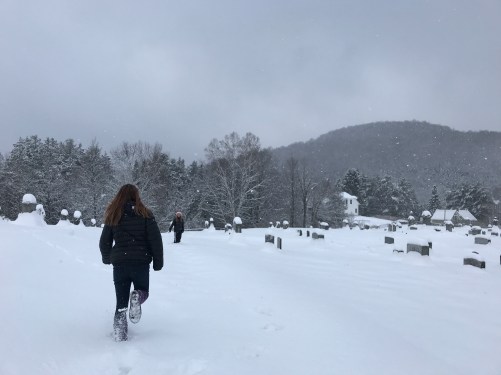
Meanwhile, my daughter – far more interested in eating than agriculture or politics – claims her territorial lines. At 12, she walks. A few years from now, like all the other rural Vermont kids, she’ll finagle a vehicle or rides from friends – opening up an entirely different landscape for her – but for now, she learns her path to middle school footfall by footfall, first over the cemetery fence. She turns to wave goodbye to me and hurries off to meet her friend.

To reach the school, she and her friend walk down the hill into the valley where Hardwick village lies along the Lamoille River, then up the hillside where the standard brick middle/high school sprawls. The entire walk – past the dead, the elementary school with its crossing guard, two auto parts stores, a busy diner, a few storefronts, a laundromat and a library – takes less than 20 minutes.

December’s lesson: wear a hat and mittens. The walk is cold.

At the risk of seeming ridiculous, let me say that the true revolutionary is guided by a great feeling of love. It is impossible to think of a genuine revolutionary lacking this quality.

– Ernesto Che Guevara


IMG_0576.jpg

Hazen Union, Hardwick, Vermont


Round and Round

Autumn is my Proust’s cup of tea, recollecting for me all those childhood afternoons I walked home from elementary school, scuffing through knee-piles of fallen leaves, as they crumbled and broke, releasing their rich humusy scent.

Each morning, my 12-year-old hoists her backpack and walks across the dewy lawn, leaping over the chain link and heading down the cemetery hill. Sometimes she looks back over her shoulder to see if I’m watching; sometimes she disappears into her day without a look back, unconsciously and imaginatively creating her own teacup of memories.

While the landscape shines postcard-pretty, behind our back porch the  box elders shake loose their leaves, and up-close we’re beginning to see what was hidden under the summer’s greenery. My 12-year-old fantasizes about a zip line from the porch deep into the ravine. Her eyes sparkle as she imagines flying down that ravine, deep into the heart of a place not yet well-known.

this piercing cold—
in the bedroom, I have stepped
on my dead wife’s comb


– Ueda

IMG_0024

Autumn, Now

Talking to my brother while frying sausages with garden greens for dinner, I mention the girls and I have just gone swimming, with the temperature high in the 80s. He says, The climate isn’t changing; the days are just getting warmer. I immediately take the phase and turn it around to reflect something inane in my own life. We’re going to use that joke for years to come.

At a soccer game, another parent mentions he’s been watching Ken Burns’ Vietnam series, and he offers that his dad served a tour in Vietnam. I share my memories of my father watching Walter Cronkite every night and drinking bourbon, fiercely opposed to that war.

Collectively, as a parent group, we wonder what our kids will remember about these years; as adults now, we sense tension rising in our own rural Vermont. But these September days are balmy and beautiful. We cease talking and admire dragonflies nipping by, fat shafts of sunlight between us filled with dust. Even when the girls have hit the locker room, and then scamper around us, hungry, we keep on admiring, filled with the great good luck of being alive on such a day, mothers and fathers of healthy strong girls, at a leisurely, end-of-the-day soccer game.

The summer moon.
There are a lot of paper lanterns
On the street.

– Buson

IMG_2005