Shape of May

I always imagine Medieval life as so much field around all those storied castles. In May, the Vermont landscape is wide open. The forest aren’t leafed out yet. The bushes are sticks without greenery. The shape of the land is there for the looking.

The comparison ends there, I know. Contemporary Vermont isn’t bound by class or infused with religion. No holy temples are built here, save what each family builds for themselves.

But there’s still all this land, fallow, ready for seed. All this potential, of yet another growing year.

Singing, planting rice,
village songs more lovely
than famous city poems.

— Basho

IMG_5315

Bearing Up

I’m nearly sure to lose our household bet of what date the garden will be freed of snow — our variation of “ice out” on the lakes. I’ve picked Monday, April 15, both tax day and the anniversary of Lincoln’s death.

April’s the season of running water in Vermont, the carrying off of snow to Lake Champlain. Nature’s licked us — once again proving the futility of competition, industrial revolution notwithstanding.

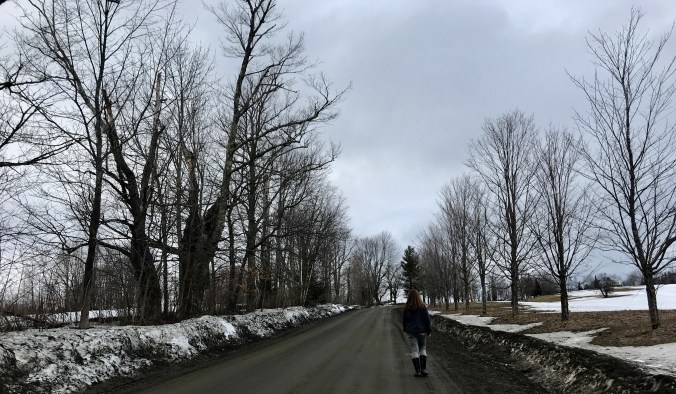
On our evening walk up a nearby dirt road, snowmelt reveals a winter’s worth of Bud light cans. We see three deer, maple trees stitching together the sky and the great hayfields brown and drying in the spring breezes. Spring, going about its business.

I’m going out to clean the pasture spring;
I’ll only stop to rake the leaves away
(And wait to watch the water clear, I may):
I sha’n’t be gone long.—You come too.
IMG_5137.jpg

The Only Question

Picture this: the three of us — two daughters and myself — clustered together in my older daughter’s car, driving to Craftsbury to ski. My older daughter is talking, talking, talking, when her 13-year-old sister dryly mentions from the backseat the kind of tepid comment she sometimes offers — a sentiment along the lines of what the heck is life all about, anyway? A kind of classic, existential angst that seems perfectly normal — to me, at least — for a rapidly-heading-toward-adolescent.

Bingo, I think. There’s the question. The only question, really.

Her sister, cut perhaps from a very different philosophical cloth, directs our attention to the afternoon which is turning sunny, and notes the skiing is going to be amazing, yet. That terrific kind of April skiing that’s like dessert.

Later, I go looking for my old copies of Alan Watts and find this:

Really, the fundamental, ultimate mystery — the only thing you need to know to understand the deepest metaphysical secrets — is this: that for every outside there is an inside and for every inside there is an outside, and although they are different, they go together.

— Alan Watts

IMG_5099.jpg

Magic Trick

Like a great joke, a few more inches of snow arrived on April Fool’s Day. By afternoon, however, the day evolved to a breezy sunniness, brisk but radiant. I walked with writer Natalie Kinsey-Warnock to her car in the Woodbury School’s dirt parking lot. It’s Woodbury — the village built in a swamp — and, for that moment, there’s nowhere I’d rather be. In the treetops, blackbirds sang crazily. Why not? It’s Vermont spring.

Natalie shared stories with the school kids today, and at one point, I couldn’t figure out what she was headed — how did a 1865 steamboat catastrophe in the Mississippi River figure into rural Vermont?

Then, abruptly, like whisking an indigo rabbit from a top hat, the story shimmered. It’s as though Natalie unfurled one of her grandmother’s handstitched quilts, and the connections between the history’s enormity and this woman, and these children and their own place in history, lie visible as much as can anything can be seen in history’s rough beauty, the concealed pieces teasingly beckoning.

I’m the librarian, the hostess of this event, the timekeeper to move this along, make sure the kids have time to grab their coats and catch the school bus, but for these moments I’m merely me, surrounded by these rapt children, loving this particular story.

Oh, the long days of circling to sow and reap,
but, O, those few days on the river each year.

— Leland Kinsey, from “Northern Traverse”
IMG_5082.jpg

One Gallon of Paint: What It Creates

My daughter and I paint my bedroom a light blue that reminds me of a bedroom I painted the summer I was 21 and living in an old house in Brattleboro. Those hot months, I was waitressing at the Skyline Restaurant, making great tips. On my days off, a friend and I painted much of that house and drank gin and tonics. While my afternoons of G&Ts have long passed, painting hasn’t.

I pour the paint into the pan; my daughter gently sets her cats outside the door and then takes the roller from my hand. I got it, she says. I stand back, offering my pro tips about using enough paint, and she repeats again, gently, I got it.

Truth is, she does.

I pick up the paintbrush and continue cutting in, keeping ahead of her in some kind of way. After a while, she hands me back the roller and heads out to her cats who are stretching their paws under the door.

Listening to the redwing blackbirds through the open window, I wonder about the paint and wallpaper layers in this 100-year-old house. Who’s been here, over these years? Us, now.

“Finding A Long Gray Hair” by Jane Kenyon

I scrub the long floorboards
in the kitchen, repeating
the motions of other women
who have lived in this house.
And when I find a long gray hair
floating in the pail,
I feel my life added to theirs.

IMG_5047.jpg

Birdsong, Mortality

Where the fields have opened up, robins flock in the trees, singing the melodies that always remind me of spring’s running water — icy cold and much welcomed, harbingers of green. These are the first flocks we’ve seen this year, and we’re doing what I’ve done with this daughter since she was a little one on my back — we’re searching out robins, these beloved spring birds.

Same activity, different backroad. We’ve moved towns and houses, and so tinged through all of this cusp-of-adolescence for this girl is both the headiness of new experiences threaded through with loss. Impermanence, I remind myself over and over, sometimes daily, is the ticket price for all of us, even these little palm-sized birdies, the fat earthworms they’re devouring, and the stones in the fields, gradually giving up their edges to the elements.

We stop for a moment and talk about the dirt road behind our boots, the shape of its crown in the middle. Birdsong, wind, running streams. The fields are so wide open here we glimpse a herd of deer at the distant crest, just a quicksilver moment as they rush across the ridge and vanish again.

My daughter, humoring me, hungry for her late dinner, asks me, Are you actually talking to those robins?

Oh, that thin scrim between mind, body, landscape….

The more a thing tends to be permanent, the more it tends to be lifeless.

— Alan Watts

IMG_5030

Hardwick, Vermont