The natural course of things.

Dawn, I’m barefoot in the dewy garden, gathering peas, the world ignited. By the time my daughter and I meet in the kitchen, a little after five as she drinks coffee and heads to work, gray has skimmed over the sky, rain rain rain pushing in. (Side note: Red Sky at Morning, Richard Bradford’s novel, is a terrific classic novel, the former husband of my very long ago nursery school teacher, somewhere in Santa Fe….)

A year ago, heavy rains flooded much of my state. As I left Greensboro yesterday afternoon, I passed a village resident digging a trench with a shovel, some preventative channeling. About this time last year, I realized I knew a number of people who were driving around with shovels in their cars or pickups.

We are now in midsummer. Around two sides of our house, my garden grows — cottage roses and cup plant and phlox — and the wild rallies on the other two sides — jewel weed and box elder and goldenrod twine around porch railings, brush against the clapboard. Snip snip must be done, and yet somehow hasn’t yet. The groundhogs multiply, run beneath our chairs on the deck. I wonder about those foxes, about the natural course of things, wonder again, Well, what do I know? What will happen will happen….

A stranger appears at our house…

A stranger appears at our house while I’m watering one night, the little drink I offer my tomato plants on hot days. Her grandmother lived in this house, an old woman widowed now in another part of Vermont. I let the stranger in. She’s mystified that a tiny pantry in the kitchen was removed. I can answer some of her questions — that the four tiny bedrooms were changed to two tiny rooms and one larger one, that the downstairs walls were painted yellow by me.

Someday, I say, someone will knock down a wall and change this, too.

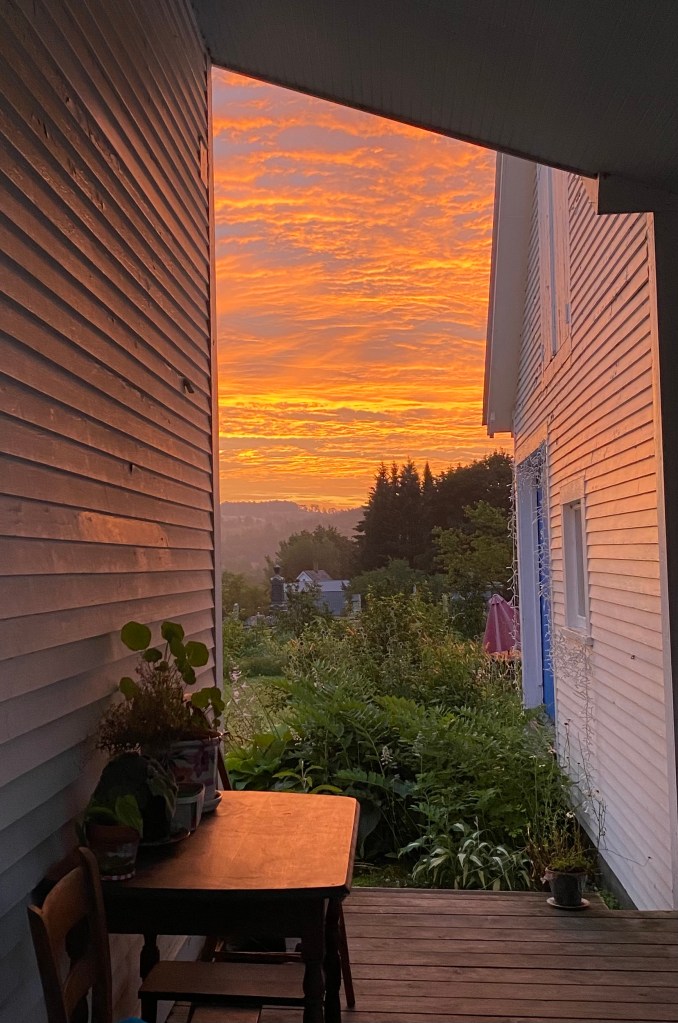
Outside, in the evening light that’s storybook shades of peach and lemon and lime, I tell her the soil is sand. She remembers the ants who bit her as a tiny child, and she remembers the lilacs. We stand talking a little about our lives — how I came to live here, where she’s now. I ask, Who planted the roses, but she doesn’t know.

Just before she leaves, she looks at the foot-wide strip of cement that surrounds the house. “My sister and I used to dress up in my mother’s old clothes and high heels. Everything was too big for us, so we scuffed the heels around the house.”

She gets back in that rusty mini-van, waves, and heads off. A few days later, she sends me photos, 1960s-style, of kids in what’s now my living room. And the wallpaper? She remembered it indelibly and wanted me to see it, based on some notion that pineapples and giant leaves were a fine addition to the walls of a small Vermont living room.

There’s one last thing, though. She even wanted to see the basement. As we stood looking at the stone walls and the rough-hewn floor joists, we wondered about the housewrights. How well-built this house is, tucked on a hillside in a place that seems both part of the village and not. My days, too, are numbered here. I’ll die here, or I’ll move elsewhere. All these stories are pieces of this house — these little girls, sixty years ago, in too-big shoes, hands pressed against this house for balance, giggling.

July, it’s worth noting again, July July July, month of growth, today own parents’ anniversary. Each of these July days…. Savor in some kind of way.

Growth.

In these days of long light, my daughter and I are drinking tea and talking on our glassed-in porch when she spies a fox walking along the lilacs that fence us from the road. The red fox, a real beauty, turns and looks at us.

June has been a season of the wild pushing in — the prolific groundhogs (and my thoughts will come to naught about this, but I’m wishing for a more even ratio of groundhog to fox, for my garden’s sake), the multiplicity of birds, raccoon and possum, the circling turkey vultures. This year, too, my garden grows half-wild, the amaranth reseeding around the Brussels sprouts, coreopsis sailing over the fence. One morning, I straighten and pause, brushing dirt from my fingers, when I spy a fox staring at me through the layers of hydrangea and pin cherry trees. For a time without borders, we hold each other’s gaze. What passes between us is a wordless language, with no clear question or agreement. Maybe simply curiosity.

There’s plenty of the human chatter around me these days, much of it rippling up in chaotic waves. But then, this, too. Last night, poetry at a rural arts center, with all the best things of Vermont June: wildflowers and the pleasure of company, the beauty of words stitched finely together.

…. Last, never least, here’s some words about the unsurpassable Vermont novelist Jeffrey Lent, in need of a little lift…

Child

How you’ve grown, child

of mine—pearl from my oyster,

you sparkle like snow. 

— Mary Elder Jacobsen

Seven years ago…

Seven years ago, my daughters and I moved from a rural hillside down to a village, about five miles away. I’d closed midweek, with plans to rally help for a Sunday move. The evening that I closed, two friends who had followed the jagged path of my divorce loaded up my car and their cars, and we carried in the first load of my family’s belongings.

It was heavenly June, warm without undue heat. I had no furniture. A friend had brought dinner, and we sat on the back deck, eating and talking. I wondered, which way would my story go? Last night, I remembered this first meal here, when a neighbor stopped by with cake and rhubarb sauce: how complicated life is and, sometimes, how very simple.

Now, in this beginning to a lush summer, I water my seedlings in these early mornings, listening to the birds and spring crickets, the drenching dew over my bare toes. The spinach is already wilting. The tithonia drooped dramatically, beginning for extra water. The blueberries have hard knots nestled among their leaves.

So much of life seems impossible — birth a baby, endure a divorce, survive a death, write a book, write another, pack up a house and move (bring the beloved tricycle, too) — and yet we do these things. We all do these things.

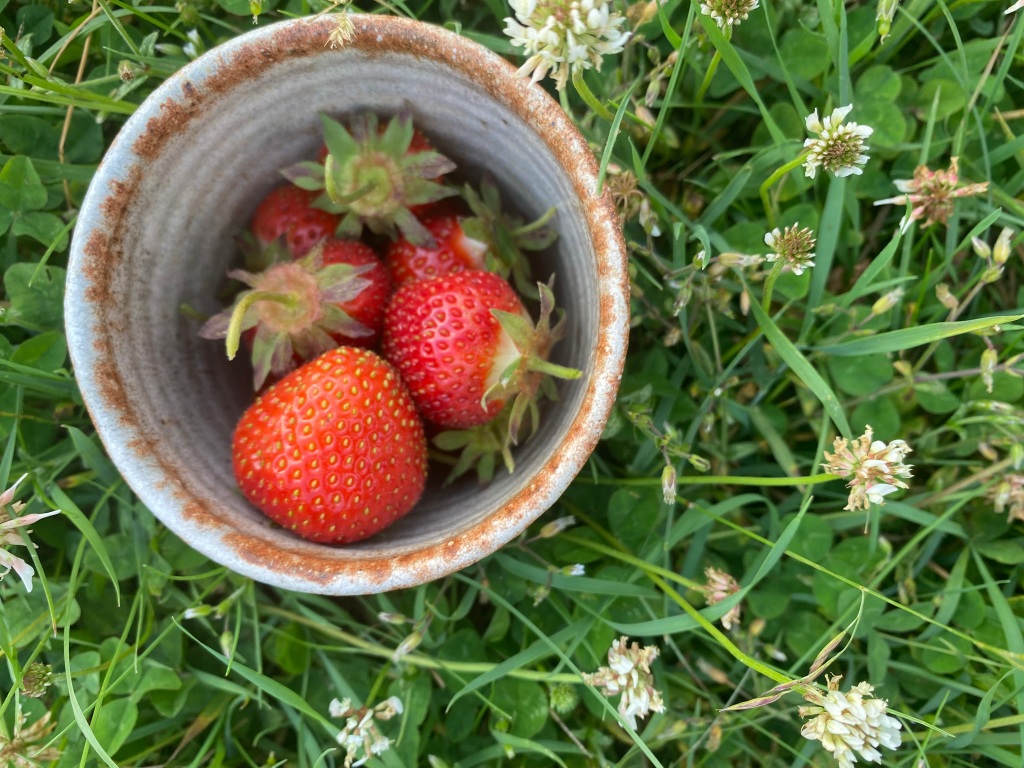
Seven years ago, would I have seen myself watering the sprouting green beans and listening to a woman on my neighbors’ porch sing the blues, the sky streaked with turquoise and crimson? I gathered a bowl of strawberries from plants I’ve let run rampart all through my garden beds. Messy, weedy. My youngest was given these plants when she weeded as an odd job in middle school. This year, the plants have given us so much sweetness.

Record temps are moving into Vermont, the world shifting rapidly. Around the globe and in my town, people are on the move. Which way will this story go? For a moment, I gather berries in the dewy morning. So much more day to come. But a steady start, my soles on the damp soil.

Bone Marrow.

The co-op cashier confides to me as she rings up my tomato and a loaf of bread that she loves this weather — brilliant sun interspersed with downpours. “Must be the Irish in me.”

The past few weeks have been a kind of July bonus: great growth in early June. My apple trees brushed out. I’ve placed an old desk and weathered chair on my covered porch. Recently, carrying out my laptop, I saw the desk sprinkled with gold pollen as if magic had swept through in the night. What luck, I thought, sat down and sneezed, worked.

I am of the wary bent, not to crow, don’t reveal a royal flush, a full house, for god’s sake don’t invite in bad fortune. At the little farmstand around Woodbury Lake, I park and walk behind the dilapidated barn towards the greenhouses, in search of a few more flowers for my garden, to fatten out the echinacea the groundhogs ate last year. In the tiny house, a dog barks. The farmer steps out and calls to me, my former library patron. He sings, “I’m saying it! I’m loving this.”

His words, not mine. Mine are this: in this northern realm, take in the sun and the green, store these gems in your marrow.

Don’t confuse hunger with greed.

At breakfast, I mention to my daughter that June 6, today, is D-Day. I’ll write what perhaps she would not want me to write: that she’s standing at the counter making avocado toast and drinking yesterday’s cold coffee. She pours sriracha over the cut avocado. She’s 19, and, lord, a sheer miracle of youth, this gorgeous young woman.

I say, The soldiers were your age. Younger.

We stand staring at each other in our small kitchen of June sunlight. On our table lies a pile of unopened mail, our tabby cat Acer grooming his whiskers, car keys and lip balm, a hunting knife that could extract a man’s heart.

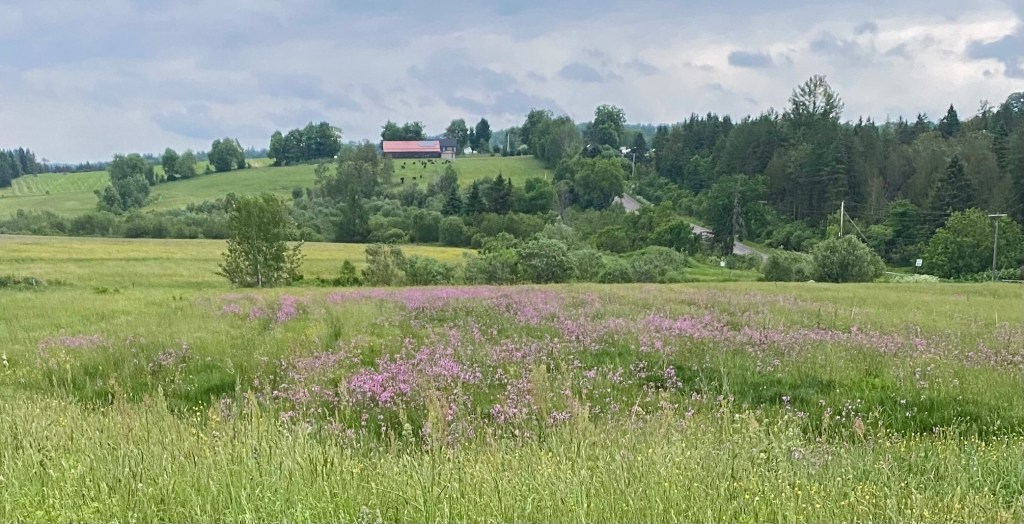
In the evening, I’m at the local arts center to see Nora Jacobson‘s documentary about poet Ruth Stone. The evening is still light when I drive home. I take the long way and pull over beside a field to admire the ragged robin, its pink spreading where the dandelions have gone to seed and green. In my Subaru, it’s me and that box of my mother’s ashes. I once knew a woman who kept her stepfather’s ashes for three years in a Datsun. Impossible, I thought. Now, I think, Sure, possible.

A day of such historical might, such profound sorrow. Yet, our own domestic dramas, the kitchen table stories: how real and meaningful these are, too. As a woman, as a writer, I’ve been thinking for weeks about Ruth Stone’s admonition: “Don’t confuse hunger with greed;/And don’t wait until you are dead.” In my garden, I grab a branch of lilac – the goregous white double blossoms, withering with rot – and breathe in the sweet fragrance.

There is only the wearing away,

The changing of means.

From Ruth Stone’s “Speculation”