Don’t let your cow get the upper hand, er, hoof…?

Ah, February, the month with the strange “U” that children stumble to spell. Two inches of a sugar snow this morning when I carried out the stove’s ashes, the cardinals whistling the day alive, a buttery full moon charming the evening sky. For the past few weeks, my life has overflowed with the challenges of faraway aging parents, with details mundane and immense, and all very very real. There’s that Tolstoy saying about families unhappy in their own way. Carrying in firewood, I remind myself: families endure the unspeakable in their own particular vernacular, swaddled in the way of all human life.

Sugaring season is hustling into Vermont now. The years I spent sugaring with a husband and two young daughters taught me to strip away the unnecessary, to bend into work when bending is required. It’s a habit I’ve carried to writing, and I’ve managed now to write three books against odds that even now seem not in my favor. But it was single parenting that honed my skills to grasp the nourishing in times of hardness, suck hard the marrow of the real. In a conversation with a young homesteader and poet today, she offers me a line of wisdom so pithy and wise I laugh out loud: Don’t let your milk cow get the upper hand on you. Yeah, think that one over.

Here’s a David Goodman interview with Elizabeth Price, mother of the young Palestinian man Hisham Awartani who was shot with two friends in Burlington, Vermont, last November. The family epitomizes courage, knowledge, and depth of heart — highly recommended.

Boots on the Land, the Ice.

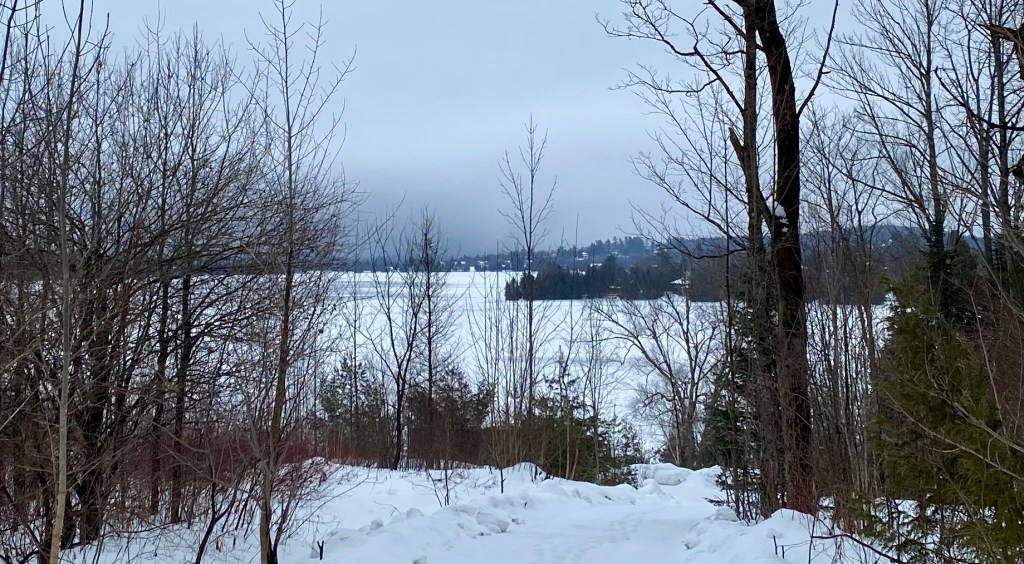
I’m meeting someone, late afternoon, who’s late, so I wait. The February sun has dropped into the horizon and clouds, and the day’s softening snow is tightening up, freezing again. I’m along one of the glacial lakes, a deep cut in the earth created by the planet’s unstoppable movements. It’s an old, old lake, not a newer pond formed by a human dam construction. Across from where I stand is the beach where I swam last fall, evenings and weekends. The water is shallow for a short stretch and then deepens quickly. My youngest had just gone to college. I would swim out as far as I could, then lie on the shore beneath the shaggy cedars, reading and watching the loons dive and reappear.

February exposes the bones of Vermont, the land’s steepness, the flatness of ice, the pale grace of a white birch in a hemlock forest. That afternoon, the stranger tells me a story of how the land was divided in families, re-divided and swapped, sold. Around this side of the lake, the state highway was built nearly on the water, and from here it’s easy to see the challenges of traffic and how the road hampers runoff from the mountains. It’s a familiar story that plays out in particulars in all but the wildest places.

On my way home, I stop at the town reservoir and walk a short distance over its ice. Walking on ice is always a kind of magic, a temporary thing. I don’t see the two bald eagles who live here: another day, perhaps.

‘I can feel my life start up again…’

We’ve crossed the halfway point of winter and can, again, believe in the possibility of crocuses, the promise of pearly-and-pale-pink apple blossoms. Monday morning, my friend Brad Ferland invites me onto his WDEV radio program Vermont Viewpoint again. I’m lucky enough to ramble on for a bit about writing, and I spoke a little about this blog. For those of you who are new here, I often write about what the seasons in Vermont mean to me. July is the Swimming Season. September the Season of Fat Sunflowers. February, in my mind at least, is the Season of Hope.

The days suddenly widen and grow. A sunshiny stretch like this, and my state’s collective spirit rises. February is still deep in the Woodstove Season, however, which means, as a writer, no need to worry about missing a few fine gardening hours. The clouds will descend again, and surely I’ll complain (again), but for now, with two days of radiance, savor. Savor.

I feel my life start up again, 
like a cutting when it grows
the first pale and tentative
root hair in a glass of water.

— Jane Kenyon

Thin Ice.

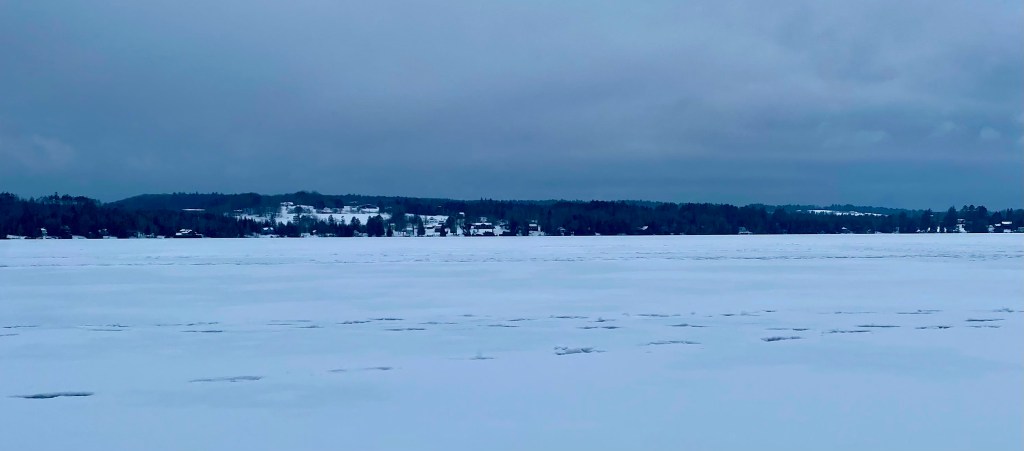
On my way home, I walk down to the lake and stand at its edge. Such a warm winter this has been. There’s not a single ice fishing hut on the lake. Across the middle, two people walk, talking intently, their hands gesturing. As they stroll south, I head towards the center of the lake.

At the beginning of any year I’ve walked or skated on lakes, there’s an always initial angst, a discombobulation about the deep water beneath, the zone where I’ve kayaked or swam. Midwinter, the summer folks are faraway on beaches or cities. The walking pair disappears, and then it’s just me and a lone crow making its steady way across the sky. This winter has clouds and clouds and clouds. Out on the ice, however, the sky spreads wide, its permutations of blue dazzling.

Twenty-five years ago, I was descending into labor with my first daughter, a period when dawn and twilight intermingled, a space where time had no meaning for me. Near the labor’s end (and she came into this world courtesy of a surgeon’s scalpel), all light had vanished from my world save for a distant circle, like a full moon gleaming on still water at the bottom of a well. I saw my right hand reaching down, fingers outstretched, seeking that gleam.

In each of my daughters’ births, the world’s illusions were ripped back. The rawness of blood and tears, of the ineffable power of a newborn’s gaze, filled my world with sacred might.

The ice groaned, shifting. I was certain of its strength for no real reason at all. In my thin jacket, I stretched out on the ice, let the cold hold my bones and flesh, and that vast sky steal my breath.

Roadside View.

In these tail-end days of January, I’m alone midafternoon when I stop by the edge of the road. We’ve endured a cold for days that’s not so much bitter but a raw damp that my brother says reminds him of the ocean. The kind of weather for wearing wool sweaters all day, that make you wrap your hands around cups of coffee. So many years ago, I lived for a winter in an apartment on a brick Main Street building in Brattleboro. The building was heated by radiators, clanging and spewing steam all over that large building, in a heating design where I was mere witness, the grateful recipient.

This dreary afternoon, I follow three-toed turkey tracks down a driveway. In the snowy field, the large birds set up a clanging holler when they spy me, ruffling feathers and jostling. It’s just me, I’d like to tell them, a small woman who’s forgotten her mittens and hat. I stand for a bit. Down the hillside, the frozen lake spreads immensely around the spits and coves of the shoreline: breathtakingly awesome.

After a bit, the turkeys seem to care little about my dull presence, gleaning through the thin granular snow.

Are you for real?!

The other night, I’m leaving a meeting in the high school library devoted, more or less, to hashing out what community means (nothing to be solved in a few hours). In the parking lot, a woman says Goodbye, Brett — and quicksilver, I shout, Are you for real?!

As the other folks empty out of the school into the spitting snow, she and I talk beneath the ghostly streetlamp. Very quickly, it’s clear to me how utterly wrong I am about this woman. What I believed was true was not. I once ate chocolate covered strawberries in her house with my youngest daughter. The woman packed up a bowl of these delicacies for one sister to give to another.

In ten minutes, we are speaking animatedly of matters of our hearts. We’re both shivering by then in the damp snow. We hug and head to our homes.

I don’t know what’s happening in the rest of the country, and I surely can’t speak for anyone else, but how glad I am that I called out in anger. And how much more grateful I am that she took the time to listen to me, to lend me her shoulder, and I could do the same for her. Indeed: real.

A community… is the knowledge that people have of each other, their concern for each other, their trust in each other, the freedom with which they come and go among themselves.

— Wendell Berry