Vermont Commune Story

Writing about summer camp — in February — makes me pause over photographs. How green and gorgeous is Vermont’s summer. The profusion of hydrangeas. The luxury of lying in green grass.

I spent a few hours last week speaking with Peter Gould of Shakespeare Camp fame. But Shakespeare Camp is just an iceberg tip of his fame. A few years back, I heard him read the title story from his collection Horse-Drawn Yogurt at the Galaxy Bookshop in Hardwick. The bookstore was packed. The evening may or may not have been snowing, but I remember the night as snowy, because the story, set in winter, is so evocative.

I’ve shared a few lines from this story below. The story is one of the very best stories I’ve read about the countercultural life in Vermont — the energy and enthusiasm and love of Vermont and the sadness, too.

The farm would remain. People would leave. Some would stay, working in town but making their home there, connected to the mythic past but not to the daily work of a farm. New folks would come, with new goals. Soon no one would remember most of what had already been tried, what this antique tool was for, what dream that pile of rotting lumber in the lower pasture represented. We would always plant a little organic garden, but that would not be our excuse for being. We could live off the economy better than we could live off the land.

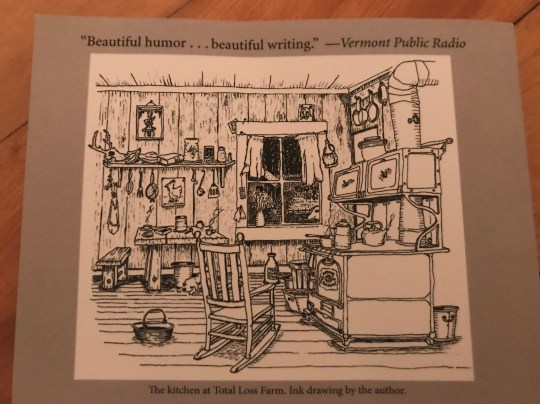
— Peter Gould, Horse-Drawn Yogurt: Stories from Total Loss Farm
IMG_7148

February: Light

Entirely out of keeping with the season, I’m thinking of spring. Save for houseplants, the Vermont world is entirely without a single leaf of tender green leaf — in utter hibernation — but the days are lengthening.

Groundhog’s Day holds no suspense here — that garden-eater always turns around and burrows back down for more winter. In the meantime, a spring haiku.

The spring breeze.
Being pulled by a cow
To the Zenkoji temple.

— Issa

59726909138__BF33AA8B-25A4-4628-93FC-66383F62A886

Ode to Winter

Cleaning off my car windshield this morning, I had the impulse to remove my mitten and bury my hand in the fluffy, utterly white stuff. At zero degrees, with a stiff wind cutting my face, I didn’t.

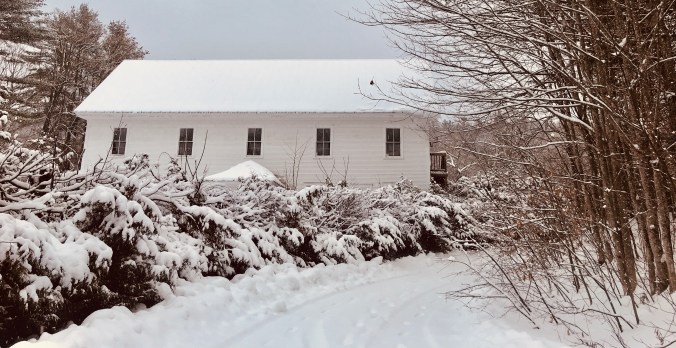
Snow has finally really come to Vermont — and kept coming and coming. Winter’s a hassle — always — in the realm of driving, of keeping the house heated, the windows closed, of missing walking barefoot through the garden and woods.

But winter’s simply ineffably beautiful, too. Driving to work, a scarf wrapped around my neck, my heavy boots in the car, too, just in case I break down, I’m mesmerized beyond VPR’s impeachment news as I watch swirls of snow skitter over the pavement. Since I was a little girl and my parents drove me, I’ve watched snow and wind work their silent mystery over the highway. Winter.

Calligraphy of geese
against the sky-
the moon seals it.

— Buson

IMG_7033

Calais, Vermont

Why Vermont?

The service we attended Sunday was for a beloved student in my daughter’s high school. A devastating, tragic death. Monday at dinner, her sister and I ask about the day. This is a rural high school, maybe 300 students in grades 7 through 12. The principal asked the whole school to crowd into the auditorium.

What did he think was going to happen? she asked me. We all cried. We all sobbed.

In particular, she told us about the teachers — the men, too, she emphasized. They cried.

There’s certainly less-than-desirable elements about living in rural Vermont: the winters can be nearly unendurably long. It’s an insanely expensive state to live in, particularly in a single income home.  But when the utter awfulness of tragedy rears — as it has before, and as it will undoubtedly do so again — these little communities circle the metaphorical wagons. These hard, hard experiences remind me why I live here, and why I can’t ever imagine leaving.

The earth says have a place, be what that place
requires; hear the sound the birds imply…

— Wiliam Stafford

IMG_7032.jpg

Quiet Day

Pea soup with scraps of leftover ham bubbled on our stove all day — a weekday more like a Sunday. Walking through town, I met no one.

At the end of the holiday school break, I head out before dinner to empty the compost pail in the bin. Amazingly, the afternoon is light yet, not dim as the afternoons were not long before the holiday. I stand there for a moment, watching wet snowflakes twirl down, the snow and I heedless of any time.

A radiance rises from the snow-covered town cemetery just behind my garden, bright despite the granite stones.

More so than other years, this holiday my daughters and I seemed to have rounded that bend from the divorce. Maybe it’s nothing more than the distance of time and physical space. Maybe it’s simply that time doesn’t cure, but it does scab over. Oddly this season, I kept thinking of Mary Oliver’s line about her box of darkness, and how that, too, was a gift. Maybe that’s part of this whole holiday season, too: that light does, inevitably, come of darkness, always.

Happy wishes for another decade of living: 2020.

Snow was falling,
so much like stars
filling the dark trees
that one could easily imagine
its reason for being was nothing more
than prettiness.

— Mary Oliver

IMG_7025.jpg

Cusp

On the eve of another year, my daughters and I talk about that trite tradition — resolutions — and I think of these lines from Rilke:

Whoever you are: some evening take a step
out of your house, which you know so well.
Enormous space is near, your house lies where it begins,
whoever you are…
The world is immense…

Not so long ago, walking outside our house meant wandering down our dirt road and looking for pebbles or newts. While the big world has always been around us, how much mightier the possibilities seem now. And that, I suppose, sums up where we are now.
IMG_7007.jpg