Wild

December: cold, a scattering of snow, the ice settling into the ground.

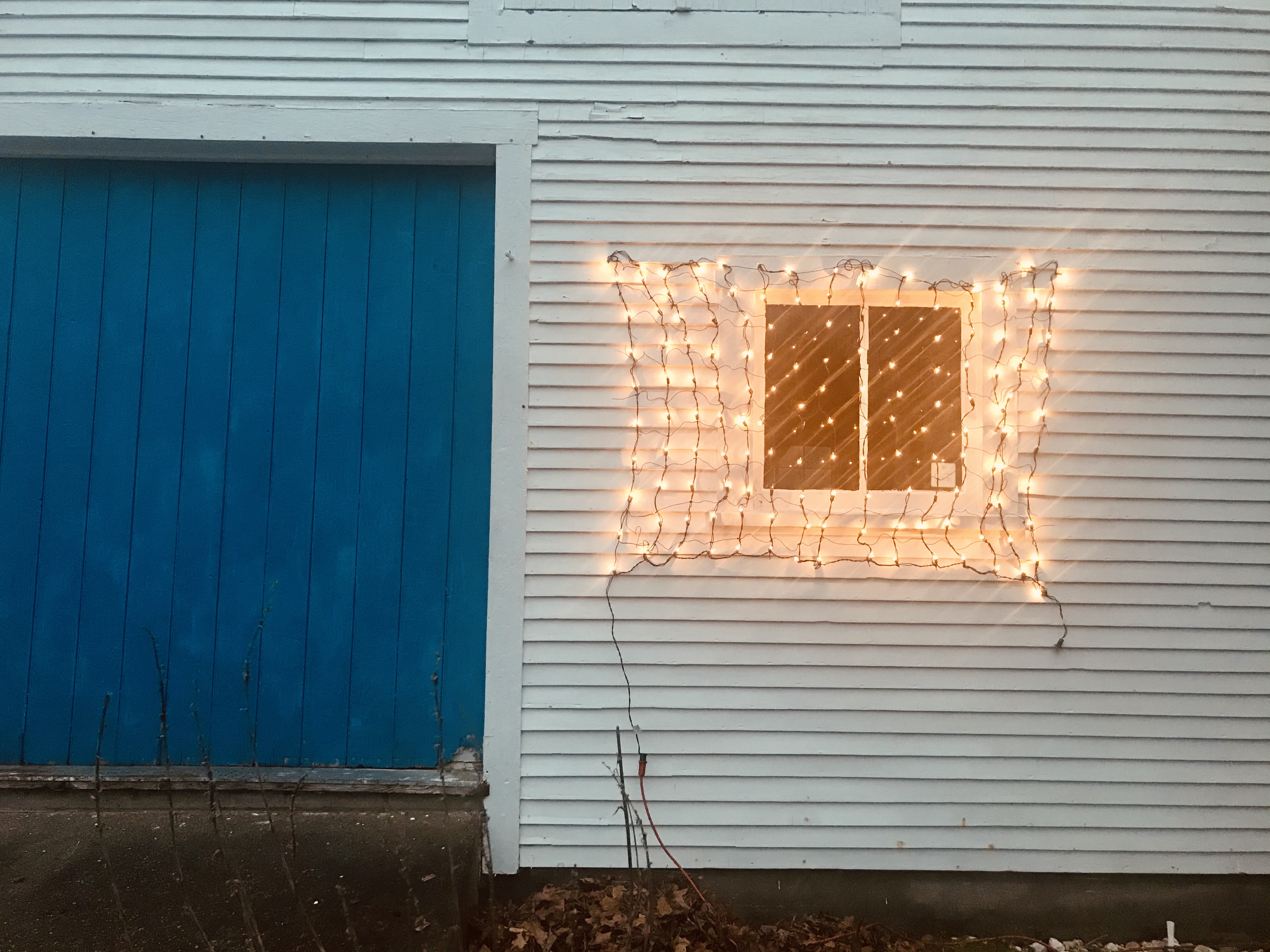
In Hardwick, on impulse, I stop into a store and buy a string of white lights with wooden reindeer for my daughters. It’s Sunday morning, and hardly anyone is out.

Walking home with those lights tucked into my backpack with a brown paper bag of rice and a square of cheese, a bottle of sesame oil, I cut through the cemetery. Before long, the cemetery will be snowed in for months.

I’m walking up the path from the piney woods, near last summer’s potato patch, when a bald eagle glides down from a white pine. I stand quietly — yes, white tail feathers, head, its curved beak earthward. Without flapping a wing, the eagle catches an upwind and drifts over my blueberry bushes and garden, then disappears around our white clapboard house.

I grew up in New Hampshire and never saw a loon as a child. We never saw wild turkeys, didn’t dream of bald eagles swooping over a trampoline in a backyard, never heard coyotes except when we were camping in the Rocky Mountains.

When I step into our kitchen where my daughters are baking cookies, they greet my news of the eagle with cool, and keep on with what they’re doing.

While the pandemic reigns, the wilderness hasn’t gone away. Hungry eagle, what did you find for dinner?

On our kitchen wall…

Phone Talk

I’m on the phone at work, answering some standard questions, nothing serious, just information passing from me to a woman. She offers that she’s working at home — she’s employed by the Barre, Vermont, school system. Barre closed up their schools awhile ago, when Covid spread through the town.

I offer a few words of thanks, and then her words keep unraveling. She works with kids at risk, and she knows kids who live in cars. Immediately, I glance through the window at the gray November day, on the verge of snow. Maybe, she says, the families have vouchers for a motel rooms.

I lay down my pen. For those moments, I keep listening.

The woman has moved here from Elsewhere, and she keeps talking about those hidden, or not-so-hidden pockets of deep poverty in Vermont. I think of my own daughter, home alone, in our warm house, with her two sleek house cats. Eventually, I say the only thing I can think to offer: thank you, just thank you.

She asks for my name again, and I spell out my strange name carefully, first and last names. When we hang up, I step outside in a rain that’s just beginning to fall. There’s no birds out today. The road is empty.

Inside, I dial my daughter who asks, suspiciously, why I’m calling.

I’m calling, I say, to say hello. What’s up? How are your cats?

Photo by Gabriela S.

Rubber on the Road

By chance, I start reading a new novel — The Father Clause by Jonas Hassen Khemiri — and I’m back in those young motherhood days I thought would go on and on eternally — changing diapers, mashing peas, carrying little kids. Those days didn’t, of course. The youngest is now learning to drive.

My youngest logs in hours for her driver’s ed class. Sunday morning, we head to Montpelier. She parks in front of the statehouse, and we walk up the enormous granite steps. There’s no one around, save for five joggers decked out in full Santa suits. They wave merrily at us.

We head south along Route 2, through stoplights, towards Barre, talking about green arrows, lane changes, and the rules about turning, or not, on red. I’m giving my daughter a road map. At the same time, she asks questions about her father and where he’s gone. Talking with my daughter, on this sunny Sunday morning, at the end of a November that hasn’t even gotten cold yet, I know there’s so much unknown in all our lives, that the mystery of pandemic and chance and human relationships is a piece of participating in the human world.

Be wary, I caution my daughter. Look before heading into intersections. Read signs. Get out and admire the view from the steps, and wave to the silly Santas, too.

Dead my old fine hopes
And dry my dreaming but still…
Iris, blue each spring

― Shushiki

Photo by Molly S.

Rain, Cats, Kids, Home

It was raining this morning when I carried out a pail of hot ashes. For a moment, I stood in the cold rain, looking at the village below, its few lights blurry through the mist that creeps in on these early winter mornings.

Like just about everyone I know, we’re home — the three of us — for this holiday, with not much more planned than cooking and walking and hanging out in our warm house, with the walls I painted the color of daffodils.

It’s the strangest time, for sure. Decades into my life, I know this, too, will pass. My daughters — ages 21 and 15 — will someday decades hence look back at this time. I imagine they’ll remember this holiday as a time when so many relinquished their own desires for the health of the whole.

So much in 2020 was not as usual, so it’s fitting, I think, that the holiday season starts this way, too. In past years, we’ve had a huge Thanksgiving table, or we’ve traveled, or sometimes it’s simply been our family. But this year, perhaps, draws out the quieter, deeper meaning of this holiday.

So, of all the many things I’m grateful for, I’m grateful that we can endure the pandemic together, the three of us. Around us, I know, as my daughters know, there’s so many eating alone today, separate, but lending their energy toward better community health, even in a cold rain.

I thank thee God, that I have lived
In this great world and known its many joys:
The songs of birds, the strongest sweet scent of hay,
And cooling breezes in the secret dusk

— Elizabeth Craven

White Rags or Gulls?

Across the road, I chat with my neighbor in mid-afternoon about the general weirdness of this time.

She says it’s like the country has no president now, and in a weird way that seems true, as though in Vermont we’re in our own sovereign world, under our earnest governor and his team. Of course, we’re not, as she knows and we all know. Among the endless lessons the pandemic has taught us is how our planet is connected. The governor pleads, Stay home for the holidays. Think of not just your wants, but the needs of others around you.

Pre-holiday, we’re again waiting: what way will our collective behavior push us? Will the virus surge again, or will the bulk of us concede and stay home?

My neighbor and I linger, talking. Her little boy pretends to be his younger brother, giggling under our conversation. He shouts with happiness when I call him by his brother’s name, ecstatic that I’ve fallen for his role change.

The pandemic has opened our eyes, too, to see what was always there. The Hardwick dam recently lowered the Black River to a trickle. On Saturday afternoon, we walked through the muddy bed.

Gulls flew overhead, pure white in a November landscape of gray and black, steadily flying into the wind.

“Throughout history, women have too often been seen as subjects of art, rather than artists… As a woman painter, one needs to work out a strategy.”

— Celia Paul, Self-Portrait

Friday Run

Just before dusk, I’m running along the rail trail, where train tracks once lay, when a woman steps out of the brushy woods, puts her hand over her chest, and gasps.

I’ve frightened her. She’s dressed in hunter’s orange and holds a rifle pressed against her body.

I stop. There’s no one else around, and I have the sudden terrible feeling that I’m in the wrong place at the wrong time. I’m wearing the ripped blue sweatshirt and knitted cap I always wear.

It’s hunting season, and I should be wearing orange. She looks angrily at me. I nod, edge away, and then keep on with my run. On this run, I’m mostly worried about a skinny dog at the one house I pass — a creature who doubtlessly is harmless. I run through the thick woods between the highway and the Lamoille River, snaking through its bends. It hasn’t escaped me how the wilderness presses right up against the village where I live, in acres upon acres of woods where I hardly ever see anyone.

On my way back, I again meet this woman with a florescent pink mask over her lower face. I’ve seen no one else, save the dog, and I slow to a walk again and apologize for not wearing brighter colors.

Jesus, she says and keeps walking.

Not long after, back in the village, the twilight drifts down like a gray snowstorm. My daughter’s school is closing again, perhaps opening in December, but maybe not. All around us, the pandemic continues to upend lives, through loss of in-person schooling, jobs and childcare, and the widening gulfs of isolation.

Walking back through town, I admire the holiday lights turning on as the darkness filters down — lights of all colors and blown-up snowmen and reindeer. The day has been unseasonably warm for November. Take this in, I think. And next time, bring a mask and wear orange, too.

“Writing often reveals us to ourselves, lets us name what’s important to us and what has been silent or silenced inside us.”


― Gregory Orr