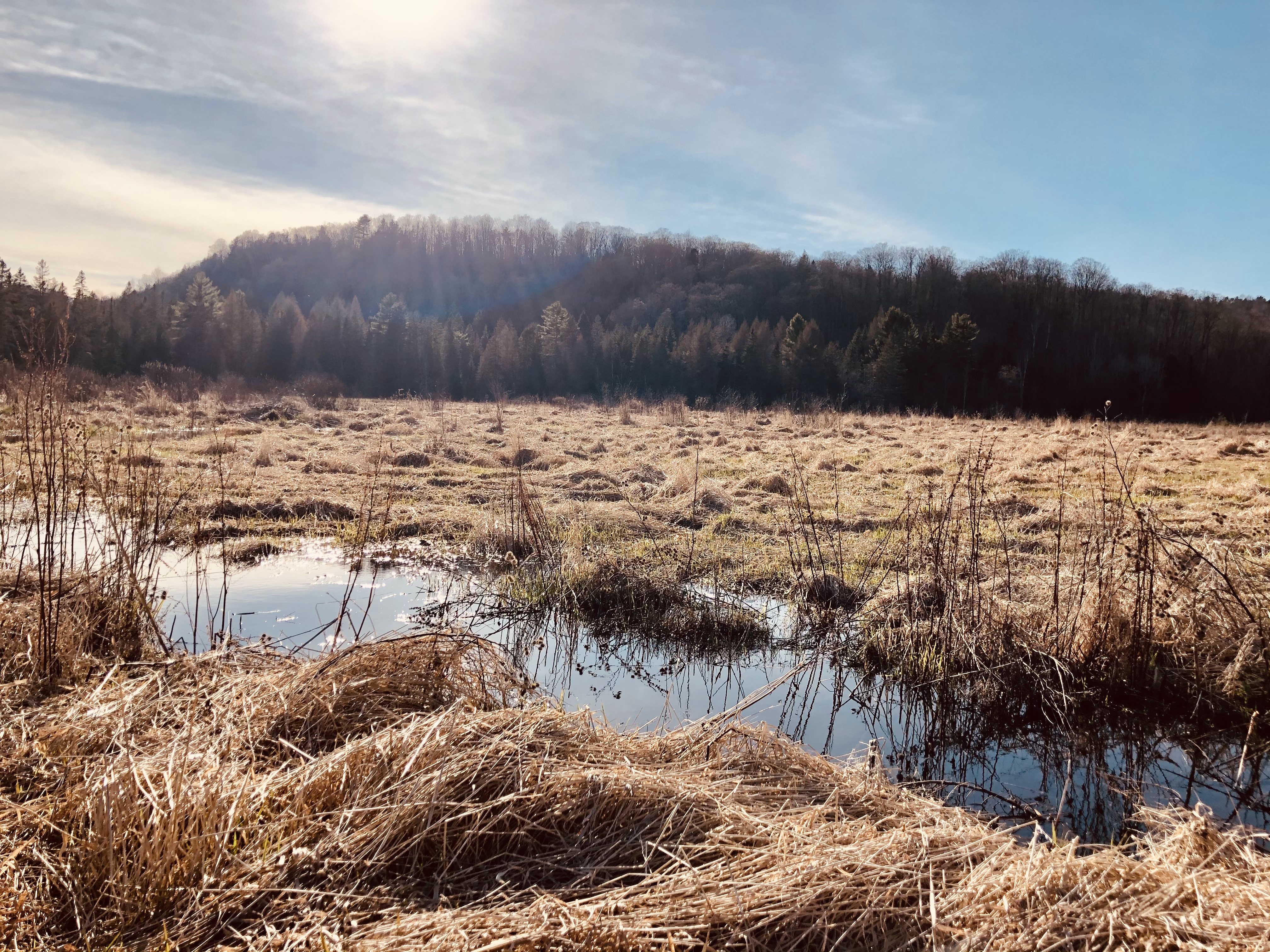
While waiting for my daughter to finish soccer practice, I wandered down the road and discovered three geese gliding through a wetland. I stood at the wetlands’ edge for the longest time, simply watching, as if by observing I can absorb some of their quiet certainty.
Everyday in Vermont, a few more strokes of green, a little more color.
“Empathy is more than putting yourself in someone else’s shoes; it’s using your power to fight for changes that don’t directly benefit you.”
Earth Day gives us snow in Vermont, that poor man’s fertilizer.
In a lightly falling snow, I lean against a school building, talking on the phone to my brother while my daughter plays soccer. Snow drifts in flakes about the size of a nickel, some melting on the pavement, others accumulating on tree branches and the toe of my boot.
The phone connection is stunningly clear — a surprise in rural Vermont.
As the snow falls, we wonder at the happenstance of circumstances — how the fall of a family member might have gone disastrously awry. Our conversation wanders beyond that, to the Chauvin trial, and the bystanders on that terrible day who, by happenstance, were present, and the teenage girl who pulled out her phone and shared her witness’s eyes with the world.
We’re in no hurry to hang up, and my brother suggests that, if Washington D. C. achieves statehood, the flag’s tidy stars will be kicked out of kilter. Vermont should succeed, he says.
After I hang up, I lean against that wooden wall. A fat robin lands in the snow, seeking a worm. My daughter and two friends walk across the parking lot, laughing, their braided hair damp with melted snow, their cheeks and bare knees bright red. It’s spring.
I leave work in the middle of the day, to take my daughter from here to there. A downpour has suddenly stopped, and sunlight sparkles over the wet world. We drive with the windows and sunroof open, the breeze blowing in. Although both girls have had Covid, and I’m vaccinated, we’re wearing masks. When won’t we be wearing masks?
The girls talk about classes, and I tune out, listening to their voices. We pass clumps of golden daffodils. On my way back to work, I drive through fields of green so brilliant I blink.
All around me, the human world feels fraught these days with chaos, both self-inflicted and not. Meanwhile, the earth pushes alive with spring. In the evening, walking up a dirt road, I look back at my daughters beneath an enormous maple, its branches still bare. Behind us, the mountains hold a deep blue. The peepers chorus, and the red-wing blackbirds sing sweetly.
It may yet snow again this week. Meanwhile, spring.
We walk up the road and down through the cedar forest, where the path is black earth. We linger so long that we walk home in the dark.
“Walking . . . is how the body measures itself against the earth.”
Through a few inches of snow, I follow stone steps down to nearby Lake Caspian, winding around a cedar-shingled house, holding a railing someone has taken the care to build, baluster by baluster.
The homeowner wants to build a tiny boathouse by the shoreline. While I listen to his plans, I eye the lake visible beneath the bent that hang over the lake. Although I’m wearing my winter coat, I imagine wading in, sweeping my fingers in the cold water.
The few of us stand among white birches, sharing names and stories. Because this is Vermont, we talk about the weather, the need for precipitation, and how everyone’s wood pile is faring. We make our way back up the hill, still talking.
A robin, in a crazed songbird rush, swoops by, nearing clipping one woman’s ear. She laughs.
It’s Saturday. Later that afternoon, I’ll stand in my driveway, talking with my friend about the fat list of things that worry and stress us. But for this half hour or so, I visit with acquaintances and strangers, talking about the area’s barns, how these great structures were built with care. Some remain; some are simply memories.
For listening recommendations, my father passed along this link to This American Life‘s Three Miles.
On a sunny spring Friday afternoon, I’m outside a St. Johnsbury car dealership, waiting for a recalled part to be replaced on my car.
A warm breeze blows up and drifts dust over my keyboard.
90 minutes later, I’m finished, and stop in the downtown. The doors of all the businesses are open. I wander into the bookstore, lift a book, and read — a casual gesture in a public space that I may not have done for a year, or more.
I open a book of poetry randomly and read:
You may have to break your heart, but it isn’t nothing to know even one moment alive. The sound of an oar in an oarlock or a ruminant animal tearing grass. The smell of grated ginger. The ruby neon of the liquor store sign
I have the strangest rush through my body, a tingling all the way down to my fingers.
On my way home, I stop in at a store and buy mayonnaise and two avocados at my daughter’s request. I walk out holding these things, blinking in the hot sunlight.
In the parking lot, a woman driving a pickup rolls down her window and remarks about the lovely weather, saying how happy she will be to get home. I nod, and we talk for a moment.
When she’s left, I stand with those things in my hands, on this ordinary afternoon, doing this ordinary errand. Someday, not too far off, this daughter will be out sourcing her own mayonnaise.
Our quarantine with Covid has likely turned my hair irretrievably to gray. So be it. Our lives were never meant to stay burnished and unblemished. I stand there, suddenly amazed at my good fortune, and then I head home for BLTs.
When my youngest was just over a year old and not yet walking, I was at a child’s birthday party around a pond. I sat her to play on a blanket. Her back was to me, and, after a while, a little girl ran over to me and said something was wrong with my baby.
My baby’s eyes were watering terribly. Before long, she seemed to have trouble breathing. A woman I had just met drove me and the baby to the ER. I sat in the backseat, talking to my littlest, hearing my voice speaking quietly, as if I was dividing in two. I knew I was terribly afraid, because I wasn’t panicking.
By the time we had reached the ER, whatever bothered her had passed. Although I had her tested for multiple allergies, this event never occurred. But for the rest of the summer, I felt as though a knife had sliced over me, shearing off some essential part of me.
The pandemic has changed all of us — both over a year, and in smaller, sharper pieces, as in my family’s recent case. The New York Times shares stories today of new lives emerging, reshaping and reforming. Of lives going on.



 Stony Soil Vermont