November Is, What November Is.

By chance, I meet a woman who was a teacher in a nursery school my daughter attended. She’s partnered now and has a child of her own. We exchange a few words, back and forth about little things, facts and details, while waiting for coffee. As with all of us, she’s older now although fixed in my memory as that very young woman who adored my daughter and said she would gladly keep her. In this few minutes, I have no sense of which way her life has unfolded. It’s none of my business really but here I am, wondering, nosy as all get-out as my daughters claim. Her child isn’t with her, and I wonder about the child, too. Back in those days, I believed in simple formulas for happiness (2 parents plus 1 home equals happiness). As with so much else in my life, I’ve rethought all that.

…. Balmy November. In the evening, I walk in the dark, cutting down through the wild patch behind our house and around the school ballfield. The three-quarters moon rises, more luminescent than any earthly thing. The neighbors are fighting. A door slams, and then the late autumn silence wraps around. November moves on, doing what it will.

…. Last, I discovered Anderson Cooper’s podcast “All There Is” through The New Yorker. For Stephen Colbert fans, I particularly recommend the interview about how grief shaped this man’s life.

“Grief is its own thing. It’s not like it’s in me and I’m going to deal with it. It’s a thing, and you have to be okay with its presence. If you try to ignore it, it will be like a wolf at your door.”

— Stephen Colbert

Mark a Line in a Forest.

The farmhouse is built on a cliff above a glacial lake. It’s been years since anyone lived there, although the roof and windows are intact yet. I walk around the house and then stand for a moment at the steep hillside that tumbles down to the lake. Someone lives down below, and I spy a flash of silver roof in the sunlight. Beyond it, the lake.

The road is exceptionally narrow, winding uphill more steeply than most Vermont roads. Whoever built here, I’m guessing, chose this place for the sheer beauty of the view. A foolhardy choice, perhaps, as the house and farm have long since turned over and over in ownership.

I’m here to look at survey marks, line up orange and blue blazes with paper, and read deeper down into the stories of people, of friends and enemies, of what land means to various people. Surveys, roads, grudges, loyalties, all the barriers we erect between ourselves.

Inadvertently, I take the slow road home, stuck in construction on the highway that winds along the lake. A duck flies overhead. At home, I meet my daughter who has just returned from soccer practice. We sit in her car, talking, talking, about olive bread and cheese, sautéing mushrooms with garlic. Around our house and my garden the foliage is simultaneously luminescent and gone by, the leaves dropped dead to the ground, the trees uncloaked. For these moments, the sky is suffused pink. My daughter says, “Not bad.” Around us, an infinity of stories held just for a moment in my hand.

“Nevertheless, something will come of all this.”

– John Gardner

Peony Roots.

Nearing the end of soccer season, my daughter’s high school community suffers a second tragic death in just a few years. In this little rural school, the news seems almost unbelievable, except it’s not.

The loss is not my own personal grief, and so I keep on, of course. On a Tuesday, I leave work early and drive to a game in a northern town where I’ve never been. All morning, a cold rain had fallen. The school is in a town where a Blue Seal Feed plant dominates the shabby downtown. I appear with my knitting needles and a ball of yarn. I’ve forgotten a chair, and another mother takes pity on me and walks back through the mud to her car to retrieve an extra. I end up at the end of the row of spectators. A black cat with white paws wanders by and jumps into my lap. Beside me is a high school boy whose name I never asked who christens the cat Mittens and tells me about his cat named Turkey who was born on Thanksgiving. He speaks slowly and calmly about ordinary things like the railroad workers driving along the tracks in their trucks at the end of the workday. Cigarette smoke streams through their opened windows.

I drive home alone, missing my friend who is no longer my friend because of some certainly unforgivable thing that passed between us. Nonetheless, I miss her as I drive through the long autumn twilight. In this unfamiliar territory, I pass through farm fields where tractors are silhouetted against the sunset, through fields harrowed up black or still emerald green from the year’s final hay cutting. Mist floats over still ponds. The forests are a mixture of gold and russet, gray where branches emerge. Shot through with the day’s final sunlight, the landscape might be an 18th century oil painting.

The darkness catches up with me. At home, the cats will be hungry, the fire in the wood stove gone down to embers. I pass through a village where I haven’t been in twenty years. I had visited with a young woman both baked cakes for a living and built bridges.

As I drive through the forests and over mountains a few other vehicles pass my way — a milk truck, scattered cars. This American Life tells me stories as I live through my own American Life. Both times when Covid entered my house I felt the thinness of my life. Beneath a red-neon GAS sign, I stop for gas. My jeans are mud-splattered. Despite the drive and my car’s heat, I’m shivering although the air here, away from the sodden field and the river, feels almost balmy against my face.

I screw on the gas cap and step away from the pumps where it’s only my car, anyway, with the cardboard box of peony roots someone salvaged from their garden and passed along to me. The evening star gleams over Elmore Mountain. For some inexplicable reason, I remember stepping out into the New Mexico night the last time I visited with my brother, relishing the night’s splendor. We talked about those numberless nights camping as children, sometimes humid, sometimes frosty, in good times and bad. The night is an ancient, ubiquitous realm. Red and white lights of traffic glide along the road. I get back in my car and place my hands over the heater’s blowing vents.

A few garden words…

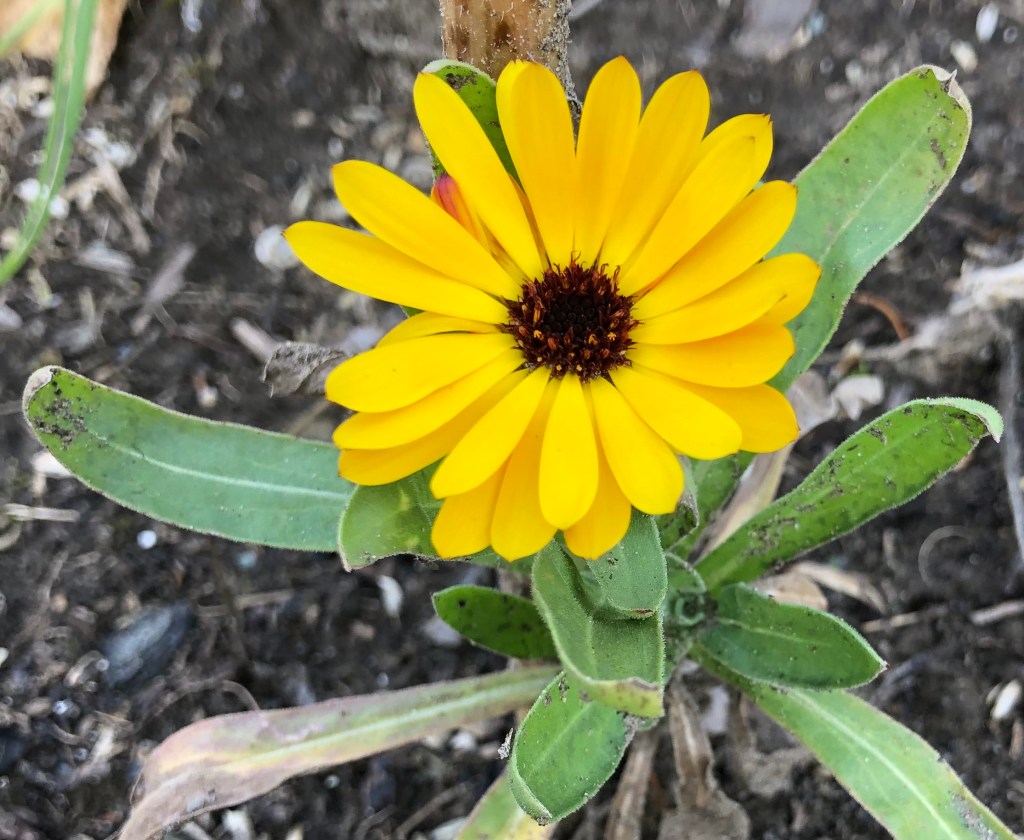
Calendula, such a pretty word, such a marvelous little flower, still blossoming beneath the frost-killed sunflowers in my garden.

Late Sunday afternoon finds me piling fallen maple leaves around these beauties in my garden, tucking in the soil for a winter’s hibernation. There’s celery, yet, too, among the Brussels sprouts. As I work, I snip off celery leaves, dusting off sandy soil on the hem of my shorts. The leaves are slightly grainy in my teeth, but when push comes to shove (as life inevitably goes), I’d rather have tried my teeth on a little grit than none at all.

Here’s what happens in New England’s October: the shadows creep in before the day has finished. We all know these shadows are edged with cold, with the intimation of winter and wind, of snow and more snow, and the always surprising dazzlement of winter’s glistening beauty. I bake an apple crisp, listen to election debates on public radio, comb my cat. October.

At no other time (than autumn) does the earth let itself be inhaled in one smell, the ripe earth…

— Rilke

Green Apples.

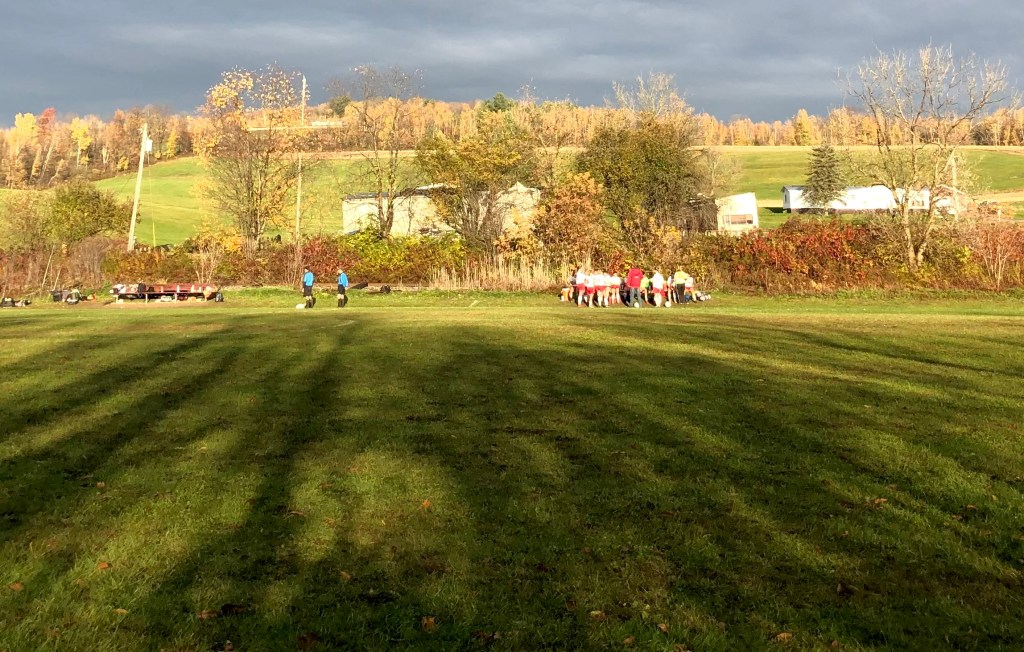
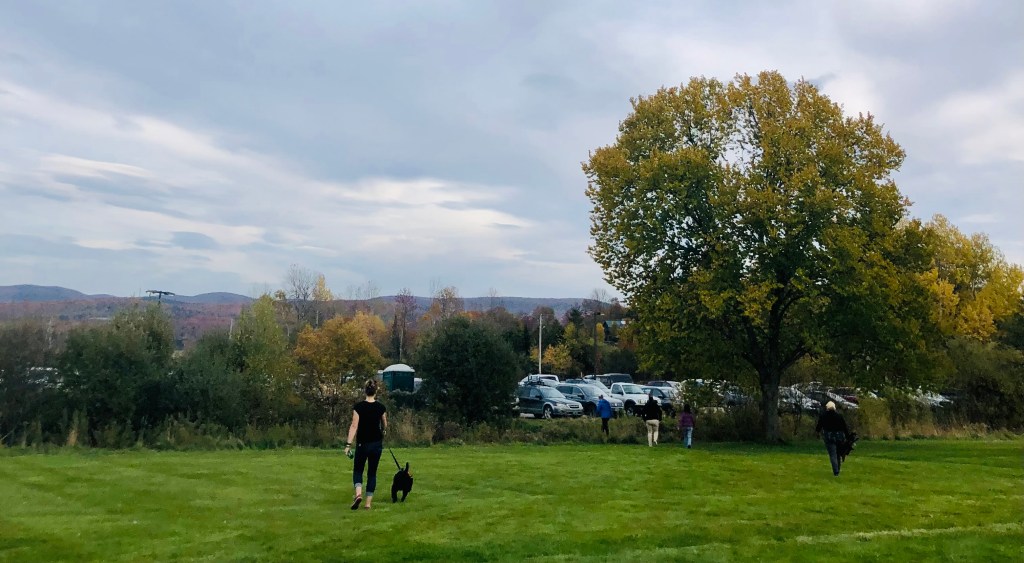
I flee work early with my daughter and her dog, to watch my younger daughter play soccer. Mid-October, and in my world everyone clamors to be outside as much as possible.

In the parking lot, a rusty white Toyota pickup sports a peeling bumpersticker with Joseph Campbell’s advice: Follow your bliss.

In my young woman days, I wholeheartedly championed this, easy-peasy, of course, I thought. Then I entered what seemed like a labyrinthian period of my life where the notion of bliss seemed facile and sometimes outright stupid. On this sunny afternoon, I chat with parents and strangers on the grass about little things — who’s started their furnace already and the merits of sprinkling cinnamon on hot oatmeal and is that the new superintendent with the coach?

As the sun heads down, the spectators pull on jackets. The wiser among us brought blankets. I find my hat in my car and loan my daughter my jacket. My youngest is a senior. Next year I won’t be here, clustered among the parents and grandparents, and so each game seems a bead on a counting game. On the way home, we stop at the general store for curried dumplings.

All afternoon I kept thinking of Ruth Stone’s achingly lovely poem “Green Apples.”

In August we carried the old horsehair mattress
To the back porch
And slept with our children in a row.
The wind came up the mountain into the orchard
Telling me something:
Saying something urgent.
I was happy.
The green apples fell on the sloping roof
And rattled down.
The wind was shaking me all night long;
Shaking me in my sleep
Like a definition of love,
Saying, this is the moment,
Here, now.

October Afternoon.

On my way back to Hardwick, I’m stopped in road construction on the County Road. While I wait for the steamroller, I glance at the passenger seat and notice my knitting has slipped from my bag. The project is a simple hat, and the yarn slid from the needles. To save my work, I lift the unfinished hat and slide the stitches back on the needles.

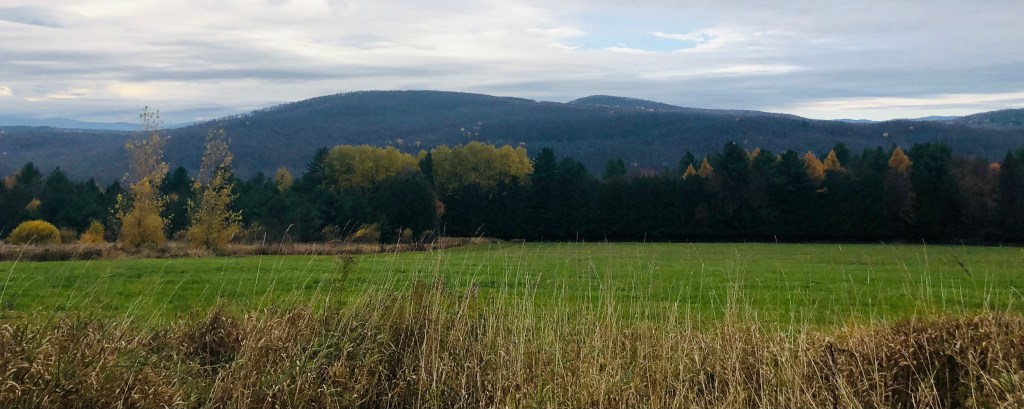
Just before my car hood, the woman in bright yellow holding a STOP sign leans against the pole. I turn off my Subaru engine, thinking of where I’ve come from and the high school soccer game where I’m headed. How quickly cold shadows edge in when the sun slips behind the mountains at this time of year. The mountains around the road dazzle with crimson and gold, but gray is visible in patches, too. Stick season marches in inexorably.

I’m at the town line somewhere between Montpelier and Calais. A few years ago, I sold our arch — the long firebox and pans used for making syrup — to a man who said he’d pick it up in a few months. His address was in this area. I promptly cashed his sizable check. He didn’t return. More than a few months later, I had sold the house, too, and my daughters and I were moving. I wrote list after list with things like pack canning jars and Salvation Army drop-off and get rid of Toyota transmission in shed. On those endlessly reworked lists, I added arch must be moved. While tracking down the buyer, I discovered an unspeakably sad thing had happened to his family a number of years before he wrote me that check.

I found him. He arrived with a friend and loaded the arch on a trailer. He and his friend were older than me, in a different phase of their lives than I was. They spoke kindly to my daughters.

For just a fleeting moment, still waiting for that steamroller to move, I remember that arch precisely. Stainless steel, black metal, the scrape of a shovel on firebrick.

The woman with the STOP sign appears at my open window. I expect her to chide me for daydreaming. Instead, she points to a nearby pond where a flock of geese have landed. The sun hits the sugar maples around the water. There’s so much in that moment — the clamoring and splashing birds, the stunning leaves, that crystalline memory, the sunlight and green yarn in my lap. The woman tells me, “Head on when you’re ready.”