Snowy Days.

Socked in by snow, I wander through the neighborhood where kids are usually outside. Two boys ride along the unplowed street, the back wheel of one bike just a metal rim, no rubber tire. The wheel leaves a trench behind the boy. The boys are talking seriously, their words muffled by snowfall. Down the hill, a little boy, maybe five or so, stands in his too-big snowsuit, mouth open to catch falling snowflakes. The moment feels intimate, as if I were staring through a window. I pick up my pace a little and keep on.

“One winter morning Peter woke up and looked out the window. Snow had fallen during the night. It covered everything as far as he could see.” 

— Ezra Jack Keats

The Mail is a Real Thing.

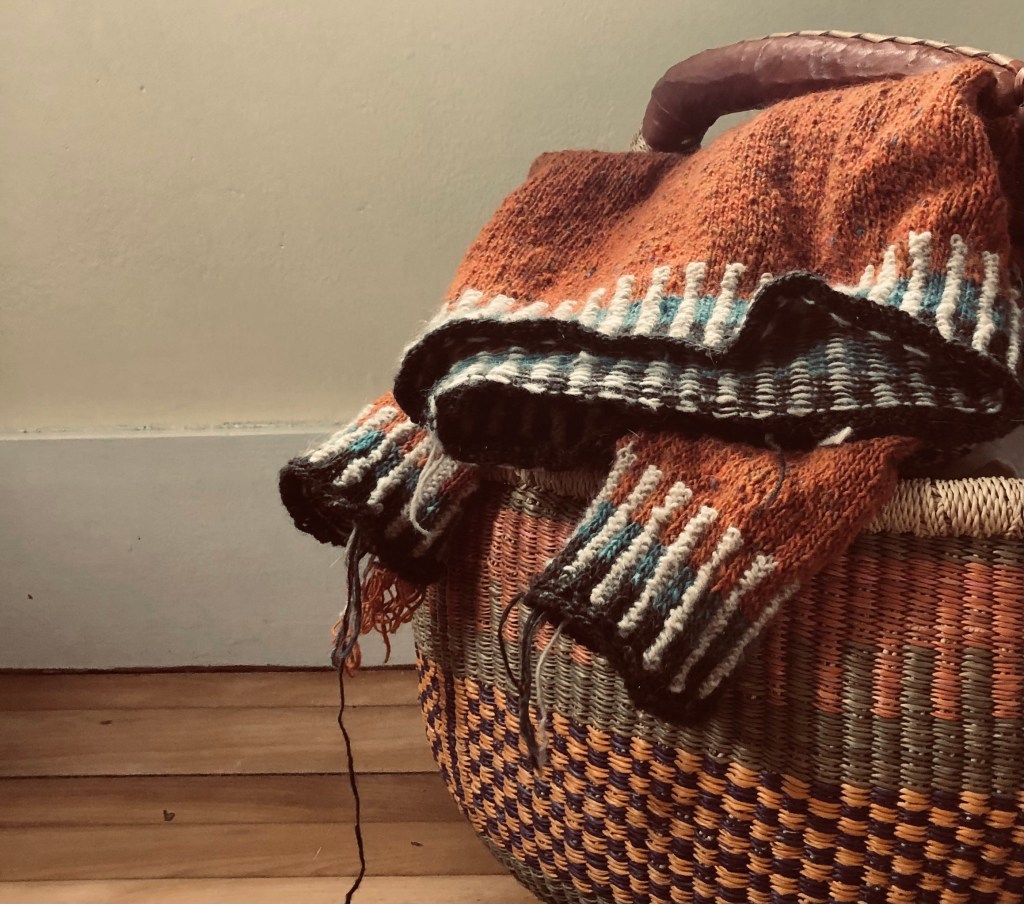
Our post office box is crammed with mail. It’s been a few days, and I tug the mail out to see what’s there. Late afternoon, the PO has a steady stream of locals, some shuffling, others rushing. I take my turn at the table in the corner, chucking away what I didn’t request and don’t want, the sale flyers and offers. I keep a holiday card and the electric bill, The New Yorker. While I wait in line for two packages, the woman beside me strikes up a conversation about knitting hats and then we’re in the world of cables and color and yarn weight.

The PO is in the post office’s standard squat brick building, not at all quaint or cutesy. When staff changed over a few years ago, someone planted a flower garden in the front bed. By late summer, I kept admiring the flowering elecampane, taller than my head, bristly and mighty, a flower after my own heart. Late July is a long way off, but still. Elecampane is lodged in my garden plan.

“No two people knit alike, look alike, think alike; why should their projects be alike? Your sweater should be like your own favorite original recipes – like nobody else’s on earth. 
And a good thing too.” 

— Elizabeth Zimmerman

Winter Koan.

I stop in at the former Hardwick Gazette building, now turned into the Civic Standard, an organization trying to figure out itself. An acquaintance and I stand at the windows in the building’s rear, staring down at the Lamoille, where ice feathers only along the edges. The water is low enough that the rocks are mighty in the rushing current.

I drink coffee and sit crosslegged on the couch, and we talk for hours. I finally vaguely inquire if we haven’t had enough of our own words, and then we go on and on again. The building itself seems marooned in the 1970s, and even in 1972 the building likely felt stranded in 1957. An old printing press hulks beside us. One of us has an Hungarian immigrant family, and our conversation inevitably weaves in the first half of the 20th century.

December in Vermont is as good a time as any to ponder the Zen koan chop wood, carry water in the pieces of my life. Sunlight on the living room floor. Kim chi and brown rice. Reading Ruth Ozeki’s The Face on the rug.

Sunday afternoon, light snow sifts down, the sweetest gift, its fresh cold sweeping away our stale human layers of mind and emotion. I carry in an armful of wood to feed our little stove for the night. The snowflakes melt in my eyebrows. Finally, I think, finally, a scattering of snow. Then I quit thinking, close my eyes, and listen to the falling snow.

“The past is weird. I mean, does it really exist ? It feels like it exists, but where is it ? And if it did exists, but doesn’t now, then where did it go ?” 

— Ruth Ozeki

The Beginning of Genius.

An acquaintance comes into work today to update the town’s website. We talk back and forth, little details here and there, the mechanics of putting the website together and how the pieces of democracy work: minutes and transparency. The public can and does come to Selectboard meetings with requests to move roads and complaints about cowshit spilled over roads. Our conversation tips into philosophical territory. Nearing the end of a challenging week, I’m drinking my 46th cup of coffee that morning and espouse that we’re in end-stage capitalism. Sometimes we behave very badly. Sometimes, not so.

I am not at all a Facebook fan, not a FB reader, but all week I’ve been dipping into the stories people have posted about Ray McNeill. So many stories, some from people I once knew very well. I lived in Brattleboro when I turned 21, completely alone in an apartment over The Shin La, a Korean restaurant still in operation. One night, I closed Céline’s Death on the Installment Plan and went out in the rain. Even then, I was a loner. I didn’t go to public places alone. But that night, the rain fell so hard I ran into Three Dollar Deweys. My friend Debi was there. In those days, she lived with my ex-boyfriend. She came up to me and rubbed my long hair with bar towel. We played darts for hours. The bar lights shone out into the falling rain.

“The beginning of genius is being scared shitless.” 

— Louis-Ferdinand Céline

Ray McNeill.

A few years back, I was walking into Montpelier’s co-op when a man walking out said, ‘Hey, you used to come in my bar all the time.’ He was Ray McNeill, a brewer and musician. In the 1980s and ’90s when I lived in Brattleboro, I spent many evenings at Three Dollar Dewey’s, the bar Ray and his wife owned, and then at McNeill’s when the brewery opened. This weekend, McNeill’s Brewery in Brattleboro burned. Ray McNeill perished in the total loss fire.

I’m not at all a fan of Facebook, but I’m included the passage below from Ray’s daughter Eve Nyrhinen. A passionate man, with a good heart, Ray is deeply mourned. And while, sadly, each tragedy is unique, this eloquent piece is reminder that decency and kindness endure.

I’m Ray’s daughter. I’d like to share some details and dispel some rumors about Ray Mcneill‘s death. He was told in June that due to the structural instability of the building, the fire department would not be able to send a crew in there safely if a fire were to break out. There hadn’t been a fire in his 30-some years there, and he had an extensive sprinkler system, so he chose to stay. Anyone who loved him knew that you couldn’t tell that man what to do.

He knew he couldn’t open the bar this winter, and he didn’t need to be there for construction (in fact, he was told the renovations would be easier if he moved out) so he booked a tiny beach house in Baja, and planned to drive out here to Reno to spend some time with his grandkids and then drive on to there. He drained the sprinkler system so the pipes wouldn’t freeze while he was gone. He had “a few more errands” to do, and there were storms rolling into the Rockies and around Reno this weekend, so he stayed a few extra days. It never occurred to anyone that it was unsafe for him to stay in his apartment after the sprinkler system had been drained.

The fire likely started from an old multi-port electrical outlet behind his TV, next to stacks of magazines. He was probably asleep when it happened, as he’d told several people he was going to bed shortly before. From the scene, it looks like he awoke to an apartment full of smoke and fire, and between the smoke and carbon monoxide he only made it to the top of the stairs before he collapsed. My understanding is that smoke and carbon monoxide poisoning makes a person giddy, happy, and unafraid in their last few moments, and I’d like to think that his death was like this, as peaceful as a death by fire could be. His body was not burned, and he was not trapped. It took at least 90 minutes for the fire department to break through the right part of the roof to sight him, and at that point they were certain he was dead. Due to concerns that the recently-burned and completely-soaked wood floor might collapse, they couldn’t risk a firefighter’s life to check. They even brought in an engineer to try to emergently assess the situation, and were told they needed to wait for a team to come in the morning before broaching the scene.

I was an EMT in college, and the one cardinal, inviolable rule was that you do not proceed onto a scene until it is cleared for safety. You cannot risk losing a second life. My heart goes out to the firefighter who had to climb back down that ladder and tell the crowd they’d done everything they could. As a doctor, I remember the names and families of every patient I have failed to save. Each one was followed by months where I tortured myself with alternate scenarios where they might have lived. The truth is, we do our very best with the information we have at the time. They didn’t know he was up there – none of us knew for sure, and there was some confusion at the scene about whether he was in Mexico already. Had they known, they still would have had to proceed in the same manner. I promise you no one in that fire station wanted my father to die. There is something called Second Victim Syndrome, which describes the way a doctor tortures themselves after the death of a patient they failed to save. I’m sure firefighters experience it too. I hope they are not haunting themselves with the what-ifs. Please extend your love and support to the Brattleboro Fire Department. They followed protocol. They made decisions that might have prevented losing a second young hero’s life.

The building was torn down immediately because it was a risk to the community. What if another fire had broken out? What if people had ventured in? Yes, they drove an excavator onto the main floor to demolish it, demonstrating that the foundation was sound enough for that, but their real concerns were the top floor and roof, damaged by fire.

And no, the fire department did not put things from the bar out on the sidewalk for anyone to take. They entrusted what could be saved to a few individuals, with my blessing, and those things are being stored until my sibling and I can go through them.

Our community is in mourning. I’ve heard rumors that my dad committed suicide, setting the fire because he knew the fire department wouldn’t go up there. I’ve heard outrage that the fire department didn’t “save him.” I’ve heard conspiracy theories about how they tore down the building to cover up their mistakes. These sensational fantasies and lies are not helpful to a small town dealing with a large tragedy. Please have some grace for everyone involved and the difficult decisions they had to make, with limited time, limited information, and high stakes. Please believe that everyone did their best, and extend your support to *everyone* involved. I know my dad would have.

Twelfth Month.

A woman steps out of Positive Pie on Main Street with a stack of pizza boxes and nearly bumps into me. Late afternoon, and a rainy twilight has gradually thickened all day. I’m walking home from a reading at the town Memorial building by an author who’s published a historical novel about Hardwick. Decades ago, when this town shifted from broke-back subsistence farming to the granite boom, the town fiercely debated the railroad construction (why let in the outside world?) and the economics of electricity and streetlights. Now, not so many years later, the tracks are torn up, the roads paved, the granite empire crumbled.

This afternoon, the streetlights are on early, the colored lights glowing at this junction of routes 14 and 15.

The woman with the pizzas asks me to open to her car door. I step off the sidewalk curb, breathing in the scent of garlic and bacon. Before she gets in the driver’s seat, she stands for a moment overlooking the colored lights and river. “December,” she remarks — that’s all — and then gets in and drives away.

In the brick courtyard, the kitchen staff is getting high, wearing t-shirts in the strangely balmy air. December: this descent into the amorphous darkness with no clear edges. Long after the stranger has disappeared, I stand beneath the building’s overhang while rain falls and light ripples across the wet world.