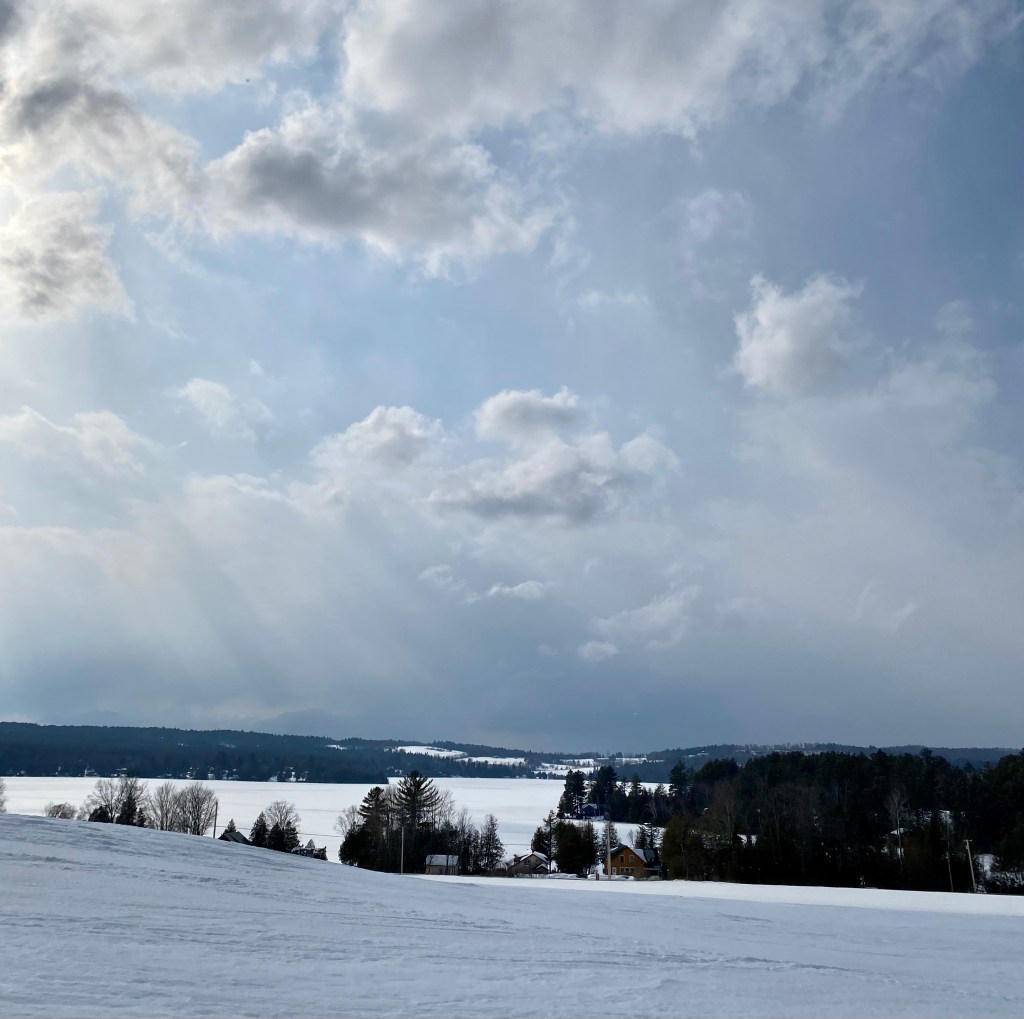
Reasons…

Rainy afternoon. I wander through the neighborhood where I once considered buying a house. Someone else lives there now. With new paint and two rocking chairs on the front porch, I need a moment to recognize the house, to remember the kitchen door I went through, envisioning in those days how my life might bend.

These years, walking by, I’ve watched the vehicles’ license plates change from Maine to Vermont, a tricycle appear, a front step break, two hydrangeas expand in the front yard.

April: season of mud and rain, snow and patience. Some reasons are obvious. Snow vanishes first on south-facing slopes, but other patches around us aren’t so readily knowable. Why does snow cling to some fields and not others? Quickly running water beneath, perhaps, the softening of what our human eyes can’t see, the knowledge gained only by years of our wandering footsteps.

So it goes. April, thaw, brown to pea green.

The world begins at a kitchen table. No matter what, we must eat to live.

The gifts of earth are brought and prepared, set on the table. So it has been since creation, and it will go on.

We chase chickens or dogs away from it. Babies teethe at the corners. They scrape their knees under it.

It is here that children are given instructions on what it means to be human. We make men at it, we make women.

At this table we gossip, recall enemies and the ghosts of lovers.

Our dreams drink coffee with us as they put their arms around our children. They laugh with us at our poor falling-down selves and as we put ourselves back together once again at the table.

This table has been a house in the rain, an umbrella in the sun…

From Joy Harjo’s “Perhaps the World Ends Here”
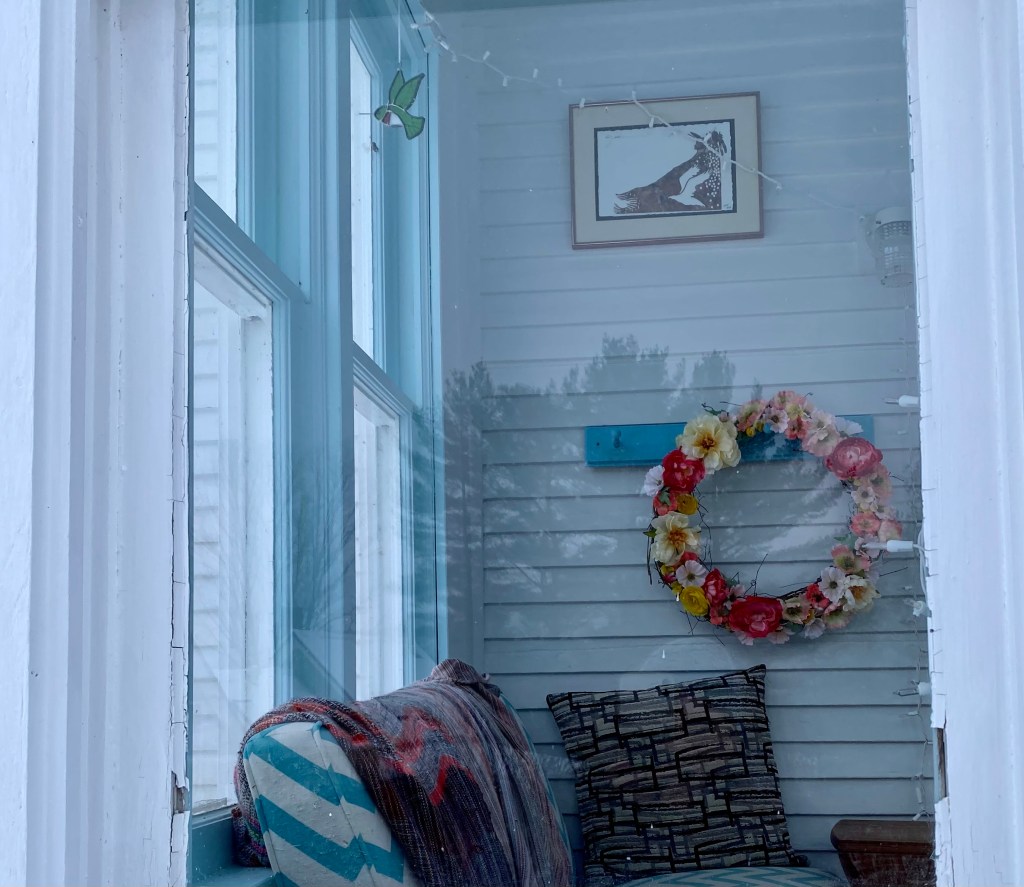
No one owns the mud, either.

As the snow melts, the mud comes up. A friend says, But it’s so dirty. I think, Bring on the dirt.

On a sunny afternoon, I disappear early, head out to those secret places where I know the redwing blackbirds sing. There’s nothing I can hold in my hand, nothing I can pocket to bring home and leave on the kitchen table for my daughter, no sign of where I’ve been or what I’ve done, save for the mud that sheds from my boots on the door mat. That, too, is my affair. I sweep it up and empty the dustpan over the back deck.

“Advice from Rock Creek Park”

What will survive us
has already begun
 
Oak galls
Two termites’ curious
self-perpetuating bodies
 
Letting the light through the gaps
 
They lay out their allegiances
under the roots
of an overturned tree
 
Almost always better
to build than to wreck
 
You can build in a wreck
 
Under the roots
of an overturned tree
 
Consider the martin that hefts
herself over traffic cones
 
Consider her shadow
misaligned
over parking-lot cement
Saran Wrap scrap in her beak
 
Nothing lasts
forever not even
the future we want
 
The President has never
owned the rain

— By Stephanie Burt

March. Flowers.

At the co-op, the words are: dirty March. So much snow, rain, the deep ooze of mud, what feels like the very faraway promise of green. Returning home, the teenager has burned herself reading on the back deck. One cat let the other eat his dinner and yowls plaintively, furiously, at household injustice. Stove ash and common dust have invaded the house. Sunlight spills through the windows onto the floor.

March: the season of radiant joy, sullen unhappiness. I lie awake and wonder about my own private death: next week, next month, or four decades from now? I decide the only reasonable course is to bargain for forty more years on this planet, and inevitably take what comes.

Thursday, the day dawns with the scent of loosening mud. The rain slides in. Midday, redwing blackbirds.

A good day for a poem:

Flowers, by Cynthia Zarin

This morning I was walking upstairs
from the kitchen, carrying your
beautiful flowers, the flowers you
 
brought me last night, calla lilies
and something else, I am not
sure what to call them, white flowers,
 
of course you had no way of knowing
it has been years since I bought
white flowers—but now you have
 
and here they are again. I was carrying
your flowers and a coffee cup
and a soft yellow handbag and a book
 
of poems by a Chinese poet, in
which I had just read the words “come
or go but don’t just stand there
 
in the doorway,” as usual I was
carrying too many things, you
would have laughed if you saw me.
 
It seemed especially important
not to spill the coffee as I usually
do, as I turned up the stairs,
 
inside the whorl of the house as if
I were walking up inside the lilies.
I do not know how to hold all
 
the beauty and sorrow of my life.

Wood.

Friday, the fire in the wood stove gone cold, I shovel out the ash and discover two honeycomb boxes. I’ve been cleaning this stove for three years now, but I’ve never taken these pieces apart. The manual cautions me to be gentle. So I’m gentle.

The first essay I had published in a slick magazine, Taproot, was for their Wood issue. In those days, we burned countless cords of wood every year, for the few cords in our house to the many more to make maple syrup. Wood was far more verb than noun in our house; we did wood.

In my wooden house, whose floor joists in the basement still have ribbons of bark, on my maple floor, I empty ash and soot and creosote into a metal sap bucket. I kindle the fire with crumpled newsprint and ripped cardboard. The cats sprawl on the rug, satisfied as the heat suffuses our house again.

The late afternoon is raw and damp. So much snow has buried us in. I ski on a section of former railroad bed where I’ve never gone before, up a long slope fenced in by a cedar forest. There’s no one around, not a dog walker, not a snowmobiler, just me and the crows. At a crest, the valley below opens. I’m above a large dairy farm dug deeply by barns and fields and family generations into what had once been forest.

The sun has melted a section of trail to slush here. A cold wind blows down from the north. I stand here for a bit, stamping slush from a ski, then I turn, too, and head back through the forest.

Stone House.

All night, wind howls around our house. I give up the charade of sleeping and pull out my library book. I’m in the final pages of Meredith Hall‘s memoir about growing up in New Hampshire, Without a Map, and I’m in no rush to end her story, close the cover, and return the book.

At my feet, my little cat lies awake, thinking cat thoughts, in a cat circadian rhythm of his own. The Ides of March howl in fiercely. All day, the wet snowstorm has swirled around us. My wet boots lie beneath the wood stove. Our house banked in by white and the ash bucket melting dirtily into the path where I’ve left to cool, its embers to burn out and die.

Somewhere in those hours before dawn, I shake flat the wood stove’s embers with the ash shovel and lay one, two, more pieces of wood on the flickering coals. In the dark house, the little cat follows me downstairs, curious about breakfast but not insistent.

I think of what I’ve read that day, about a stone house built nearby in the 1800s from a single boulder. A curious endeavor. Take this stone, cut it into pieces, and make a home. In the darkness, the wind rakes over our house, hurls over my snow-submerged garden plot, and whirls over the town cemetery.

“The past lies beneath the surface, intransigent truth. Remembered or not, what we say and do remains, always.” 

— Meredith Hall

Flattening the Road.

I drive home in a pouring snow, remembering when we bought a Toyota pickup years ago, and I drove with four-wheel drive, how the road suddenly flattened out. I’m driving my daughter’s car. In Hardwick, I stop at the auto parts store. Her right wiper is torn. I’ve known the person my daughters call The Auto Parts Man for years. He opens the wiper packages on the counter and then puts on his coat and heads out in the snow and replaces my wipers, too.

It’s the last day of February, and he says he’d rather winter just quit. He laughs and shrugs.

Nonetheless, for the moment, my windshield is clear.

This hill
crossed with broken pines and maples
lumpy with the burial mounds of
uprooted hemlocks (hurricane
of ’38) out of their 
rotting hearts generations rise
trying once more to become
the forest

just beyond them  
tall enough to be called trees  
in their youth like aspen a bouquet  
of young beech is gathered

they still wear last summer’s leaves   
the lightest brown almost translucent  
how their stubbornness has decorated   
the winter woods

— Grace Paley