Post-Flood, More Rain.

Nearly a week into Vermont’s floods, I’m surely not the only one in this town awake at night, listening to rain through my open windows. Lush, lush, our world is. Sunday, I trim the rose bushes that thornily cover a window, then discover moss creeping towards the house. I snip and scrape, then dash inside beneath a sudden downpour.

Sunday, I walk along the Lamoille riverbanks, silty and sandy where the river rose far above its usual path. Red metal lies in twisted sheets, remnants I’m guessing from the motel that tumbled into the river. Twisted towels and clothing, tires, a stepladder are jammed into tree trunks and roots. Cassette tapes of bible stories lie in a puddle, oddly more or less intact. Down the river, smoke churns into the sky where a flooded sawmill has burned debris for days.

There’s an odd kind of quiet hovering around here. What I’ve witnessed is shock and disbelief, a heady kind of euphoria to fix and repair, and now a sodden dullness, the earth as drenched as I’ve ever seen it. My pink poppies have blackened before they’ve bloomed.

We keep on, of course. Our beloved capital city, Montpelier, hoes and bleaches. Word goes around and around about passable and impassable roads, who needs helps, who’s yet marooned by great rifts in the earth.

In the late afternoon, I buy poppyseeds at the co-op and pay off my tab. The staff is out-of-sorts there, too, grousing about a broken cooler and the mud we’re all tracking in. Rain falls, quits, but the day doesn’t cool. I bake a cake and listen to someone on VPR talk about the Buddha. In the evening, that fat woodchuck darts among my gardens. A flock of starlings scatter on the lawn. Robins and rain. The daylilies are brilliant, the flowers poet David Budbill called coarse and beautiful.

As I said, it’s coarse and ordinary and it’s beautiful because
it’s ordinary. A plant gone wild and therefore become
rugged, indestructible, indomitable, in short: tough, resilient,
like anyone or thing has to be in order to survive.

David Budbill

Putting the World Back Together, Again.

By Thursday, I’ve lost track of days. A kind man stops by the town office with plates of cookies, still warm from the oven. I’ve been up for hours and hours by then, some working, some staring out the window at the dawn pushing up over the mountain, a spill of pink that widens into gold.

I haven’t been flooded. I know no one who’s injured. Yet, all around, the torn-up world, the folks who are seeking dry shelter, clean clothing, the next meal. The roads are our arteries, and slowly, gravel load by excavator sweep, the world is being put back together.

Thunderstorms and flash floods are in the forecast. Through all this, there’s the subtle underlying sense of how quickly the world turns.

Stores warn of early closings. We’re in this place I recognize immediately, almost giddy, slightly horrified, where people let down their guard, laugh at things that maybe aren’t that funny. Slowly, wrapping order around chaos.

“Water symbolizes the whole of potentiality – the source of all possible existence.”

— Mircea Eliade

Water, Water.

These days, I’m working in a town clerk’s office, Greensboro, Vermont, population approximately 827. With summer folks, the population swells to three times.

Yesterday, the phone rang all day. We propped the door open, and people wandered in with questions.

Can I get to Craftsbury? Which roads are out? I have a dump truck; want me to haul fill? I’ve lost everything; do you have extra clothes, shoes, blankets?

Selectboard members set up a triage system to patch roads where anyone was stuck. Farm roads were prioritized for milk trucks. All day long, Vermont Public Radio updated us. Montpelier, beloved capital city, is underwater, threatened by a dam where waters rose precipitously.

Late afternoon, the selectboard chair rummaged for leftover potato chips from the July 4th celebration. By then, the sun had emerged. The July day was hot, redolent with blooming roses. I had my own petty worries: my car was low on gas, and I’ve kicked a front brake repair too far down the road, and I’ll need to find a mechanic stat, and who I’ll find isn’t yet clear to me. Later, I’ll call my brother and talk about my parents while weeding my neglected garden. For some time, though, we stood in the parking lot, breathing in sunlight, waiting for a contractor to look at one of the town’s paved roads that’s severed in multiple places, the asphalt broken into multiple chunks. When could he get here with an excavator and put that back together?

A friend drove up and told us about mutual friends in a nearby town. They had been out in the stormy night. Travelers on I-89 had been diverted off the interstate and wound up driving through the backroads of a rural town they didn’t know. By flashlight and headlamp, in a driving rain, water roaring down hillsides, the residents directed the strangers to a safe haven, where they weathered the night.

Vermont Floods.

Remains of the Inn by the River, Hardwick, VT

My friend who lives near a dam takes shelter with us. While she gathers her things in her house, I wait in my car, staring up through the closed sunroof in my Subaru, mesmerized by the rain, the rain, the rain.

Shortly before nightfall, we walk downtown where the water flows around houses, through the community gardens, and drowns the t-ball field. A crowd gathers beside the Lamoille River. At first, I think the storm has turned to thunder, a booming and smashing, and then I realize the roiling river is filled with boulders and tree trunks. I’ve been following and watching the rise and fall of rivers for years now, lived on back roads that have washed out, cautioned my daughters never to drive over running water.

But this.

The river is alive. The river rises like a wave, brown and frothy, taking precisely and entirely what it wants.

Home again, safe in our house on the hill, the rain pours down. Hope you’re all well and safe out there, too…. More info about my state can be found on VTDigger.

No Going Back.

July 1: I’m driving on a back road to a nearby town where there’ll be the traditional New England small town Independence Day festivities, when I suddenly realize I can no longer see the road before me. The road dips down and then rises up. I know this, because I’ve driven this road so many times. I know precisely where to swerve around the persistent pothole where the stream runs under the lowest point of the road. But the rise is hidden in smoke.

The day marks a line for me, a place I won’t forget. I’ve been here before; this is familiar territory. I remember the precise afternoon I knew I would severe my marriage. Likewise, today, it’s clear to me that this smoke, in what will likely be one unimaginable variation after another, will remain.

Nonetheless, I go on into the day, watch the parade with an old acquaintance and we catch up about kids, ruminate about our old college days. I talk to a woman who’s built a house of cans and bottles and tires. She asks me to stop by sometime. Heck, who could pass that up? Of course I will.

Then I’m back home again, working, working, on this third book, taking it apart, sewing it back together, phrase by phrase. I wind in how it feels to walk along the edge of a lake that may not be frozen and thread through the Himalayan blue poppy, a child’s nightgown, pebbles under a clear running stream. I’m after those same old things: how to salvage order and beauty from chaos and destruction and despair. A river of sadness is not the torrents of despair.

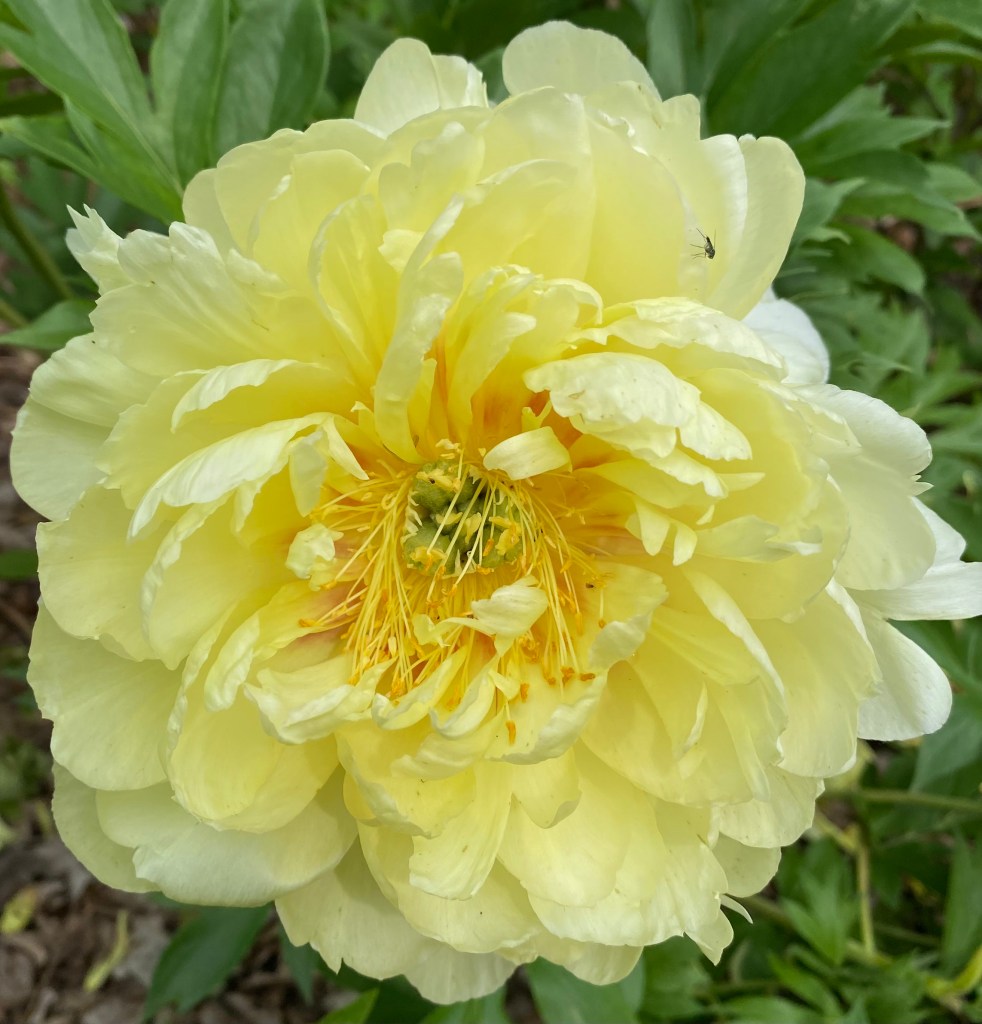
Swim. Bartzella peonies. My neighbor leaning out her door, green curlers in her hair, saying hello.

Wildfire Smoke, Vermont.

Smoke from Canadian wildfires suffuses our world, the briefest intimation of so much happening so far away. Sunday afternoon, I crouch in my garden, weeding, while talking on the phone to my brother. When I stand, the sun is a pool, the hue of fresh blood.

Later, before twilight, we swim with a friend, the smoke like a mist. On our way home, my daughter and I drive up the hill across our town, to the hillside where we often walk and look for the sunset. It’s after eight, but these are the longest days of our Vermont year. The sun is utterly absent, swallowed up in smoke and humidity, the light meager as November.

This, she says, is not good.

The following morning, our air clears. At dinner on our porch, a light rain patters. We keep eating, talking a bit here and there, lacing together our days. As for the humidity, I keep thinking…. bring it on. The myriad leaves and blossoms reach out, sucking it up, summer in all its messy intensity.