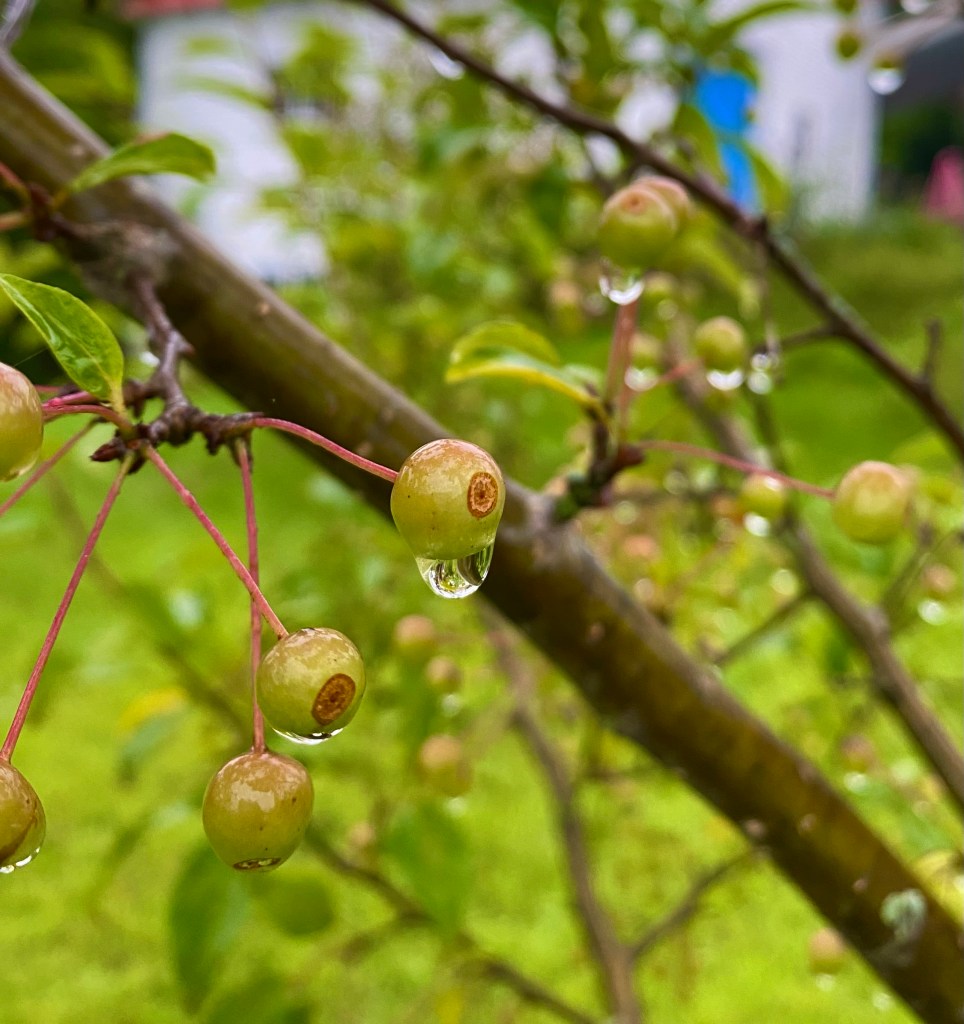
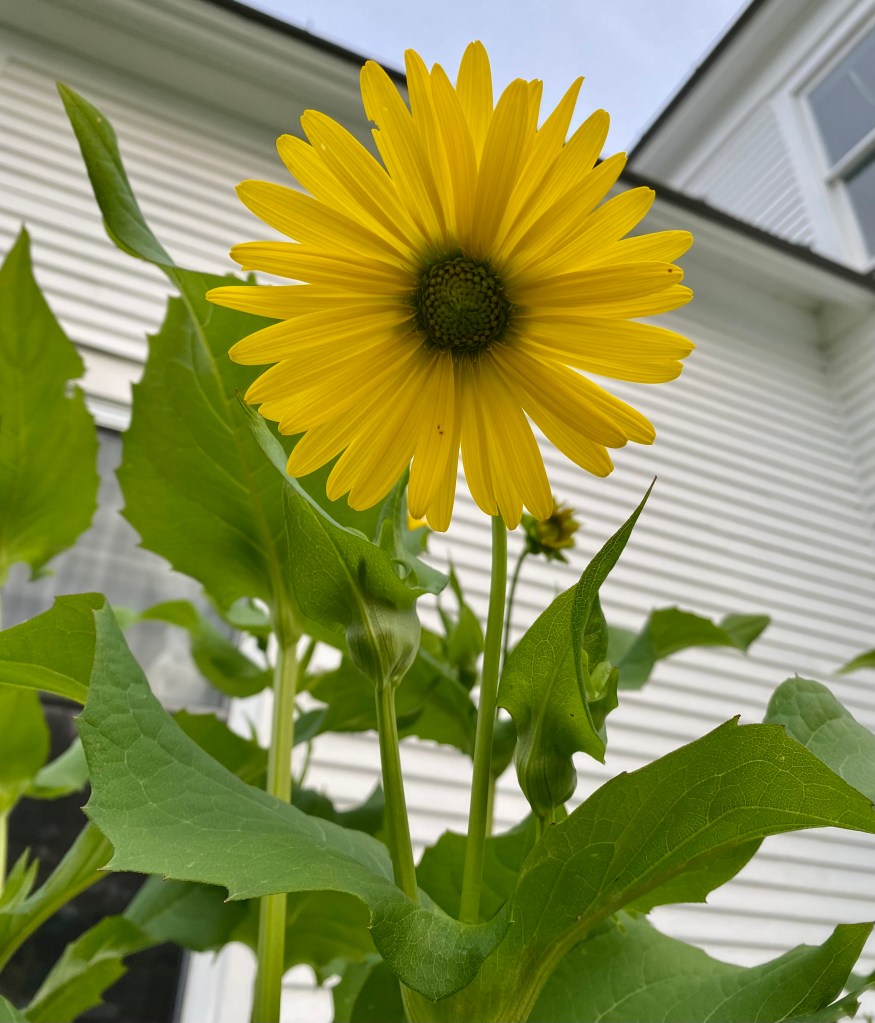
August Gloaming.

The foxes that denned behind our house did not return this year. A neighbor who lives around our hillside shares that she saw a kit earlier this summer, and we speculate that the fox family set up summer quarters nearer her. It’s all speculation, neither here nor there.

Who has returned are the turkey vultures, roosting in the pines between our houses, reliable as the rain this summer.

Mid-August, and the kids are trickling back to school. A friend texts me that her son is headed into his senior college year. I remember when this kid was born. He used to come to our house and stand on a kitchen chair and bake cookies. In this soggiest of summers, still time unspools inexorably. In the evenings, we sit outside and watch the sunset sprawl crimson, the mosquitoes drawing drops of our blood.

The pollinators suck at my small garden’s calendula, gold and orange. A few years back, I sowed a few seeds. Gone wild, the calendula reseeded rampantly, nestling against tomatoes, among cucumber vines. I haven’t the heart or will to pluck a single flower.

It rained for three days straight, a relentless steady rain that kept up its monotonous rhythm day and night, there being no periods of waxing and waning or moments of imperceptible brightening…

— Mary Hays, Learning to Drive
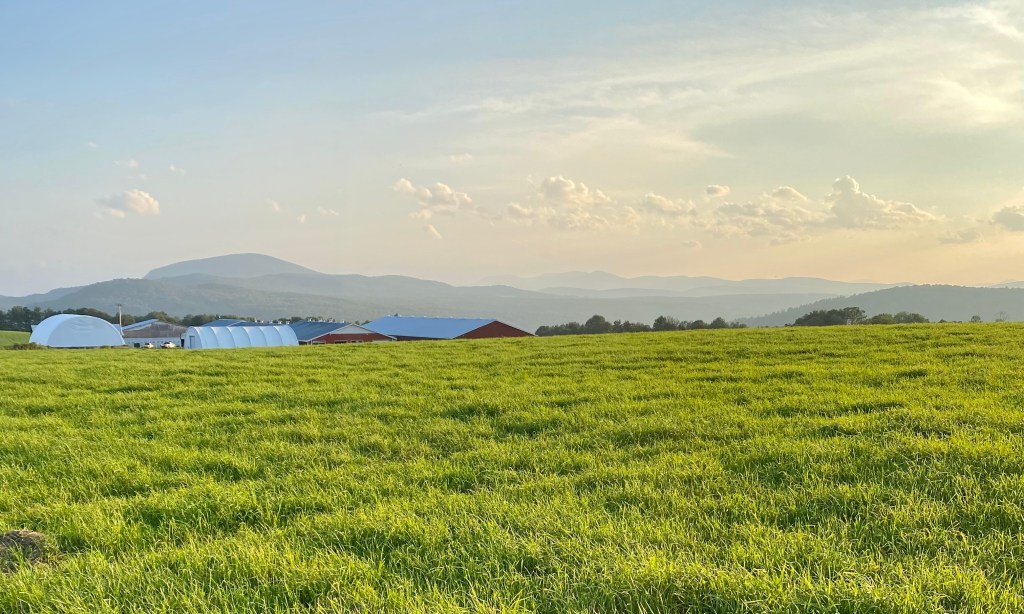
Go on and wonder.

I skip out halfway through a Selectboard meeting and take a backroad home. Since the floods, I haven’t driven these dirt roads. The roads are back together mostly, with rocky channels on either side of the steepest places. At the road’s highest place, I pull over.

August light.

I’d started that morning in jeans and a sweater, working on my back deck while rain splattered down, the morning large with a cold damp breeze that made me wish for socks in my sandals. This evening, I’m wearing a sundress again.

All summer long, we’ve been collecting complaining about the summer in Vermont. First, no rain. Then, too much rain. I have plenty of firewood left from the tepid winter, and then burned fires into the summer.

The evening spreads out radiantly. For this moment, I’m in no rush to head anywhere, so I park and walk down the road a short ways, crickets sizzling in the hayfields. A pickup rolls slowly down the road. The driver, an acquaintance, stops, and we chat for just a moment, about the particular green and blue surrounding us, then he glides away.

Light in August. My father bought me a used copy of Faulkner’s novel for a dime in a used bookstore. I was a teenager, a fanatic of Tolstoy and Dostoyevsky, those immense Penguin paperbacks that were so gratifyingly fat. I kept that copy with me for so many moves, thousands of miles, and I’m guessing I have that version yet, crammed on my bookshelves.

Faulkner’s world is the complexity of past and present, the world jammed against our faces right now, floods and fires. This morning, again, a crimson dawn, curls of fog in the blue valley. My east windows need washing. Get on this, I think, get on this…

“Wonder. Go on and wonder.” 

— Faulkner

Post-Flood, the Chaos.

I keep writing about this flood, because the flood’s marked our summer: before and after. I’ve written that our house was spared (thank goodness, thank goodness), but the pieces are all around us. Immediately post-flood, such an outpouring of generosity, and then, the predictable, the wearing down, the exhaustion, a growing sense of uncertainty. Rain falls and falls. We can no longer ignore that the summer has been wet and cold. And yet, how selfish it feels to complain, when we are in the Shire of Vermont.

My own saga unfurls publicly in the wake the flood. The property my ex-husband owns is posted for a tax sale; it’s been six years since he paid more than pennies on this bill, sovereign citizen that he is. My name is posted in the tax sale, that the Court removed my name from the deed in our divorce. I’m drawn into his life again, the facts of my life bantered about with people I know and those, I’m sure, I’ve never met.

The property is valuable — 92 acres with a large sugarbush. In the midst of this, someone I know from long ago phones me. The morning is dark, and I haven’t turned on any lights. His words are so kind it’s like sunlight in this gloomy summer. There’s no resolution here, no possible decent outcome. I will likely never speak to my former spouse again. I’ll never own this property. And yet, my life will hopefully go on and on, for decades yet. For these timeless moments, I drink in that unbidden kindness, let it fill me. I feel it within me, the possibility of how my life might turn.

And, because it’s August, one of my favorite Hayden Carruth poems, August First.

Late night on the porch, thinking
of old poems… The sky
is hot dark summer, neither
moon nor stars, air unstirring,
darkness complete; and the brook
sounds low, a discourse fumbling
among obstinate stones….
I wonder what became of
purity. The world is a
complex fatigue. 

“Distrust everything, if you have to…”

As a firm believer in clotheslines and keeping my bills low, we don’t have a clothes dryer.

In past rainy summers, with children in cloth diapers, I spent time in laundromats on Sunday mornings before selling maple syrup at a farmers market.

After a span of rainy days, I eventually break down (again, this no-dryer commitment might be simply stubbornness or gratuitous ego, pushed far beyond rationality) and load two dryers in the Hardwick laundromat. I bring a book and read on the porch of the Inn across the street. Behind the Inn, the Lamoille curves through town. On the river’s other side, a house burned earlier this summer. Now, what remains slides down the bank, piers of a narrow porch first, the back clapboard wall soon to follow.

Unintentionally, I’ve chosen busy Friday afternoon, and the intersection is jammed with traffic and pedestrians. I’m reading about schizophrenia and crime, about madness and civilization, and I keep looking over my shoulder at that empty house and its unanswered question of what’s happening here?

Eventually, I close the book, walk across the street, and fold our clothes warm with the dryer’s heat. Beside me, a little girl and her father study the line of dryers. She’s wearing a dress with bunnies. Seeing me, she pulls out her skirt. “Pink,” she offers.

I nod and answer, “Great-looking rabbit,” and then I head home.

Wait, for now.
Distrust everything, if you have to.
But trust the hours. Haven’t they
carried you everywhere, up to now?

— Galway Kinnell

Getting Lost & Found.

There’s that old saying You can’t get there from here, which in Vermont means, It’s not easy to get there, but use your wits and you can. Yesterday afternoon, leaving for a Vermont town I’d never visited I hedged bets on the map, avoiding the route that I guessed had wash-outs and detours yet, and headed down two-lane blacktop through villages where hydrangeas are just beginning to bloom.

I was invited to read with Alexander Chee at the Meadow Meeting House, a righteous 1830s former Baptist Church. The ceiling was stenciled in original colors, over straight-backed wooden pews not designed for the listeners’ comfort. The entryway has two wood stoves. The black pipes extend over the pews before exiting. That would have sufficed for heat.

By chance (or maybe not), Alexander Chee and I each read about spaces — churches and homes — particularly apt in that lovely building that had its own generations-long story. It’s a question that fascinates me: how do we hold the past and also make our lives anew? The question links inexorably to the physical places where we live.

Afterward, in a sunlit house surrounded by gardens and apple trees heavy with fruit, I met a woman who’s the daughter of a long-ago friend of my father. Our conversation pulled me back to my college days. (How would I ever explain that I first fell in love with rural Marlboro College lying in fields, awestruck at the undiluted Milky Way and constellations?)

Driving home, threading my way back along unfamiliar roads, I had the strange sensation I held that afternoon and that conversation in my ribcage. Outside of my town, Hardwick, I had a long wait at a temporary red light on the broken highway. The asphalt washed down the Lamoille River. I stood up and leaned out my Subaru sunroof. In the gloaming, I saw how the river had cut a new course, its old path a great swath of boulders.

In the cavern of my ribs: wildfire smoke. The stories of my past, that afternoon, the future, too.

Promising Sign.

Mist lies on the valley these mornings, indicative more of mid-August than this tail-end of July. 2023, the Vermont year with scant summer, thus far.

Nonetheless, on a ravishingly beautiful Sunday morning, we walk along the rail trail beside the Lamoille River. The trail is closed due to the flood’s multiple wash-outs, and there’s no bikers, but by foot and dog paw the walking is easy enough. The debris along the river is appalling. Two by fours with outlets lodge in treetops. We follow the silt and gravel, studying the way the river lifted, changed its course.

This morning, thrush chortle, and the cicadas hum their midsummer serenade. Distantly, across the river and hayfields, traffic grinds along Route 15. Where we stand, my daughter and I would have drowned, three weeks ago, as the river howled and smashed its way west, and then north to the sea.

Now, easy-going end of July.

I glean a washed-sparkling piece of white quartz, half the length of my thumb, in the shape of Vermont, and slip it into my pocket. I’d written exactly this rock and shape and size into the beginning and end of my novel. An auspicious sign — imagination incarnate — or hopeful dreaming at least.

…. Last, I’ve been generously invited to read at Meadow Meeting House, Corinth, Vermont, with the esteemed Alexander Chee, this Wednesday, August 2, 4:30 p.m. Please come if you can.