Storytelling, or What to Learn From a Ten-Year-Old

Smugglers Notch perches high up in Vermont’s Green Mountains, a haven of enormous, tumbled boulders. We hiked up to pristine Sterling Pond, then the children played in the caves at the trail’s origin. On a lichen-covered boulder, high up above the road, my younger daughter claimed her house. She invited me in, and, like any proud householder, showed me the hemlock stoutly growing in the midst of her living room. Out of the rock, she said, this tree grows.

When it comes to storytelling (and it’s all storytelling) I often tell my students that we need to be dumb like animals. Storytelling itself is primal. It’s the way we’ve always come to understand the world around us–whether recited around a campfire, or read aloud in an East Village bar. And so it stands to reason that in order to tell our stories, we tap into something beyond the intellect–an understanding deeper than anything we can willfully engage. Overthink and our minds scramble…. Our minds obscure the light. We second-guess. We become lost in the morass of our limited consciousness.

– Dani Shapiro, Still Writing
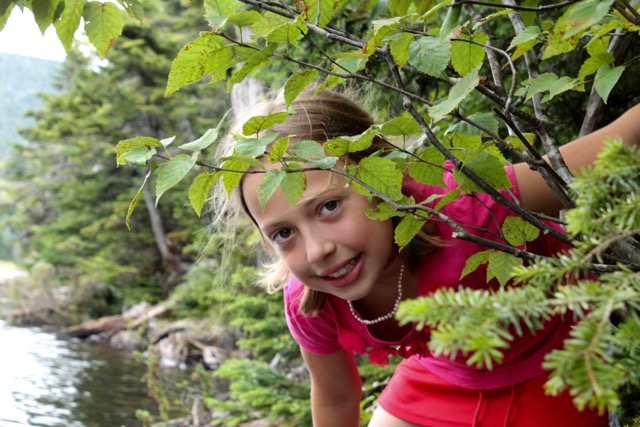
Photo by Molly Blume S.

Photo by Molly Blume S.

August 9, 1945

At a particular juncture this year, although I increasingly make my living from words, I became, quite simply, fed up with talking. I wanted action. Action infused with intentionality, with great thought and empathy, but action.

This summer, with my nephews’ extended visit, I determined to alter – in at least one small degree – the course of our lives by action, to swing the pendulum one minor stroke toward happiness. A raw truth of myself is that the outer dark of despair, of pain’s gnashing teeth, the fiercely cold howling winds of evil, hover perpetually just an arm’s length from my own outstretched fingertips, those turkey vultures I keep writing about silently soaring. There’s not a bit of schizophrenia in this worldview, not one jagged bit of insanity, not one curl of my toes over the edge into any abyss; our world is not a two-dimensional plane where grief can merely be rubbed away for the wishing.

The children are tucked into their beds, sleeping the slumber of children who have played and swam and biked together, all day. Bickered and made up and told each other stories, their faces scrubbed clean, their hair scented with lake water and wood fire smoke, at ease.

To every thing there is a season, and a time to every purpose under the heaven:
A time to be born, and a time to die; a time to plant, and a time to pluck up that which is planted…
A time to rend, and a time to sew; a time to keep silence, and a time to speak;
A time to love, and a time to hate; a time of war, and a time of peace.

— Ecclesiastes 3:2

DSC01125

How Time Shifts, or Doesn’t

In Hardwick, Vermont, today, a woman approached me and said, I know you. As she spoke, I realized she had worked, over ten years ago, at State Street Market in Montpelier. Although that market had long since closed, and I had only rarely gone there, she remembered me with a small child. She said, Your little girl was so darling.

I listened while this woman unwound her life for me, spinning from a broken, unhappy marriage to touring as a circus cook, then living in a Buddhist retreat. Her face gradually rubbed into familiarity as I remembered those days from so long ago, my daughter’s warm hand in mine, walking among the high shelves of that market, in a place I remembered as sunny. I had repeatedly purchased a few particular things: yeast for root beer I brewed in gallon jugs and sold at a farmers market, umeboshi vinegar, a carob-covered rice cake for my daughter. The hippiest, strangest collection. How she would laugh at this now.

While this woman leisurely told me her story, I missed my little girl, my ruby-lipped merry child, the world that seemed often merely the two of us. Listening as the woman told me of her cancer and surgery, her own healing, I thought of how my eyes often catch on my daughter these days, this tall and lovely young woman still suffused, chock-full, with that vibrant, radiant energy, yet blossoming into a flower with myriad, distinctive layers of petals. Within, though, that small child is folded within her being, as that younger woman with the packets of yeast in her hand is meshed through my own womanhood.

Unlocking the bookstore door this morning, above Hardwick’s Main Street in the clear blue sky, nine turkey vultures circled, near enough I saw their tail feathers flickering in the breeze’s constant motion.

On Columbus’ first encounter with the new world…

…he said that it was such a joy to see the plants and trees and to hear the birds singing that he could not leave them and return. He says that this island is the most beautiful that eyes have ever seen.

Photo by Molly Blume S.

Photo by Molly Blume S.

August 6, 1945, 8:15 a.m.

It’s a wonder I haven’t abandoned all my ideals, they seem so absurd and impractical. Yet I cling to them because I still believe, in spite of everything, that people are truly good at heart.
It’s utterly impossible for me to build my life on a foundation of chaos, suffering and death. I see the world being slowly transformed into a wilderness, I hear the approaching thunder that, one day, will destroy us too, I feel the suffering of millions. And yet, when I look up at the sky, I somehow feel that everything will change for the better, that this cruelty too shall end, that peace and tranquility will return once more.

Anne Frank
June 12, 1929 Frankfurt
March 12, 1945 Bergen-Belsen

IMG_1532 Peony photo by Molly Blume S.

Courage

Driving along the interstate the yesterday, I looked up at blue heron winging its oddly graceful way, silently above the rush-hour pavement. This strange bird, who always reminds me of its ancient, prehistoric ancestors, set me thinking of what I’m writing, where turkey vultures circle and ascend, silently, reappearing over and over in this novel, a wordless image of mortality.

On this drive home, the sprawl of Burlington thins gradually, and with relief  I cross over the Morrisville border where the farm fields spread out, and Mt. Elmore appears to my right, my familiar blue companion. I was still thinking of those vultures and that solitary heron when the rain began again, hurling down in handfuls as I alternated through patches of downpour and sunny spots. As I drove out of Morrisville, up the hill towards Elmore, the rainbows appeared, two great arcs, iridescent beyond belief, their tails not tucked neatly behind the mountain, but seemingly almost right before me: they seemed so near I could practically pull over, sprint into the woods, and discover their mythical ends. I parked on a dirt road and jumped out. The rain had already ceased, and only the green still shimmered its glittery glow. The other colors had already faded and paled, wicked away into the clouds.

I stood there watching the rainbows disappear into nothingness. The rain had muddied the road and swept a coolness over the day’s heat. The crickets sang weakly, as if they neared sleep.  The wet soil and tangled weeds along the roadside emitted a briny scent that reminded me of a place in Maine where we had once been happy. I wondered if the fall was edging in there, too, this place where I would never return.

The last miles home, I thought of those things–heron, vulture, rainbows, the Maine ocean and sky. The next morning, I told my younger nephew I had seen a double rainbow, and he asked, A double rainbow? Are you sure?

Yes, I said. I’m sure.

Let it not be said that in passing through this world
you turned your face and left its wounds unattended.
Instead, let it be said that when your friends
cut open your chest to partake of its courage,
a loon was calling.

–– Janisse Ray

IMG_3628

Photo by Molly Blume S.

The Running World

We just started hiking down from the firetower on Elmore Mountain when a storm blew up. Descending quickly, my older daughter led, and I followed last. As I rounded a curve in the narrow, rock-strewn trail, the side abruptly dropped away into gray clouds. On a decent day, a sweeping view of the lake below and the mountains in the distance opens out at this point. This afternoon, an immense wave of rain blew toward us. My nephew, just ahead, turned around and shouted, It’s beautiful!

All down that trail, we hurried, the trees bending over us, dark and dripping as a Middle Earth cave, the mountain alive around us: so much water.

From Julia Shipley who read at The Galaxy Bookshop tonight:

TWO EGGS

This one the color
of my shoulder in winter,
and this one, my shoulder in summer.

No seam no pock no
porthole, smooth as oil.

The surface curve:
just the tip and a buttock,

silent as a horn in the trunk,
how many times can we give

what’s formed inside us–
Never? Always? Once?

Photo by Molly S.

Photo by Molly S.