Pieces of Writing, Things of Life

Twice this summer, as I’ve driven along the Vermont interstate, a blue pickup has swung out in front of me at the same exit, a man at the wheel, but what caught my attention both times was the Greek omega symbol on its side, leering up at me like some distant memory of high school science. As a writer, I can’t help but think, That needs to wind into my book.

One keen advantage of writing is that, while I’m often half-blind, at times I’m tuned in razor-sharp, wondering in what way the universe is patterning around me, with this truck and this omega so near I could stretch out my arm and grasp its curve. Perhaps the deeper advantage of this is that writing forces you to look, and look hard at times, for meaning and relevance in the world.

Writing a scene the other morning, I realized a female character, in a dim kitchen, held an ear of corn from her garden and was abstractedly picking the ear apart, peeling loose the husk and each strand of silk, bit by bit. Inside, she discovered those gleaming, uneven rows of kernels, new as milk teeth. Would she eat the corn raw? Steam it? Offer it to her stepdaughter? Heave it in the compost? Chuck it out to the chickens?

The things of the world we live in matter. It’s different to wear acrylic or hemp, to eat fast food hamburgers or brandywines from the garden, whether your house has walls of glass or hardly any windows at all. Neither, perhaps, good nor ill, but the things that return into your life might not be wholly arbitrary. What’s near to your hand might be there for a reason.

The simplest pattern is the clearest.
Content with an ordinary life,
you can show all the people the way
back to their own true nature.

–– Tao Te Ching

IMG_7906

Photo by Molly S.

How Things Grow

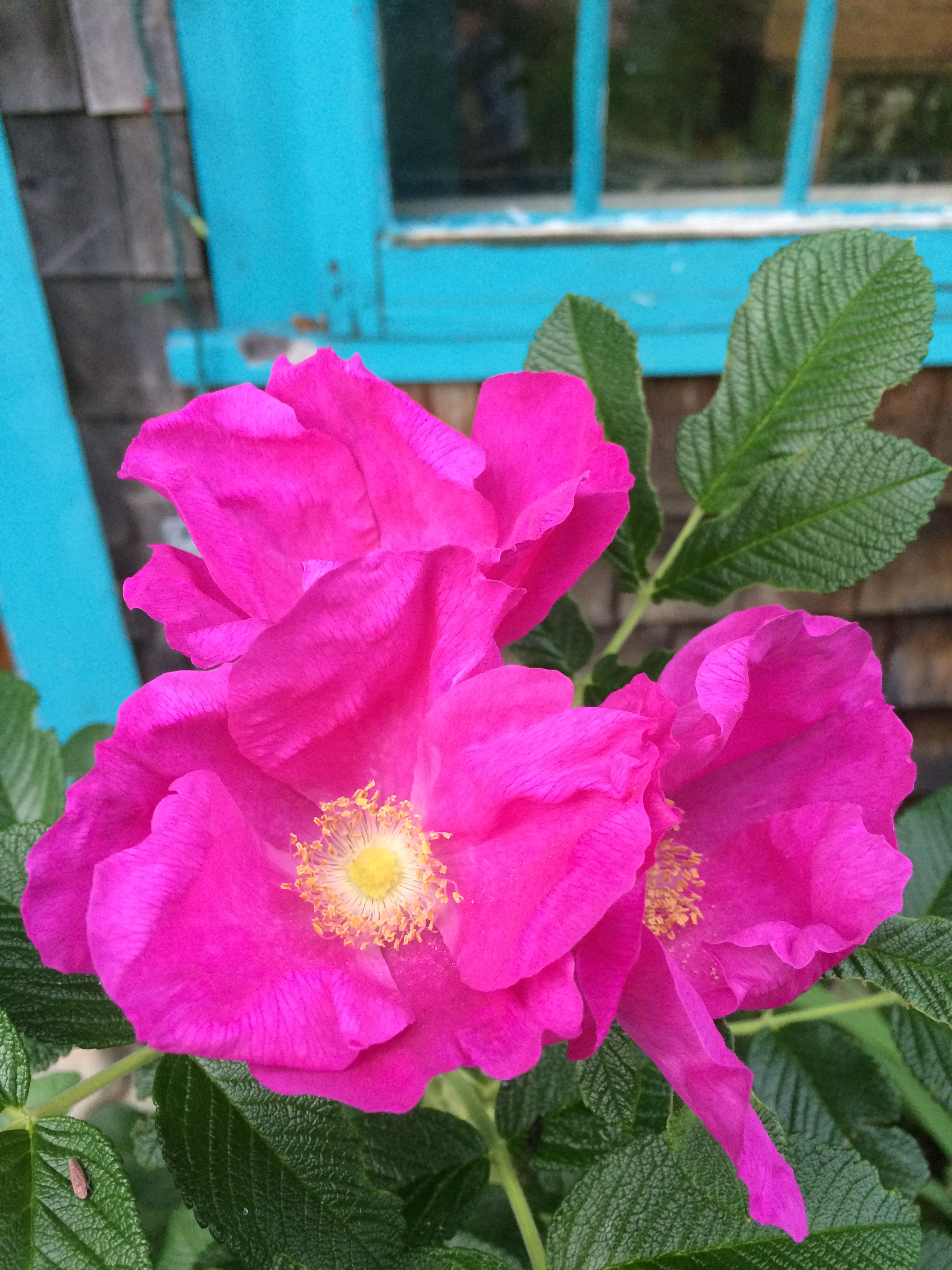
Early this spring, I planted a rosebush beside the back door, in some attempt to transform a little bit of our cedar-shingled house into a Red Rose imbued cottage. Gardening brilliance was wholly lacking. The rose bush has thrived, blossoming profusely, and yet again. In this poor Vermont soil–out of stone and sand and clay–deep glossy green emerges, rose hips fatten, tender petals perfume the air. In and out I go, sometimes all day, and this fragrance rises up to greet me.

He sendeth sun, he sendeth shower,
Alike they’re needful for the flower:
And joys and tears alike are sent
To give the soul fit nourishment.

–– Sarah Flower Adams

IMG_2461

Parenting a Teen and Writing a Novel

My long-time friend and I went canoeing and swimming with our kids today. The ten-year-old girls immediately ran for the beach, swam the entire time, and never put one toe in the canoe. The two teenagers, a him and her, swung the heavy canoe off the car and confidently carried it to the lake. How the heck did this happen? These two kids I once held on my lap while they shared goldfish crackers? After a dutiful swim, they preferred to sit on the beach–forget romping in the water–and talk.

There’s a fiction phrase–a willing suspension of disbelief–which, the further along in parenting, the more that seems a truism for life. I expect to be in the teen years for a good long while yet, and I could say it’s interesting, but, in fact, it’s darn mesmerizing… among a few other adjectives, too. But when these teens were ten-years-old themselves, I could never have believed they would become so full as people, so funny, so wry, and with legs sprawled everywhere. Here I am, I thought, in that perpetual rough draft of my life, garnering more material.

What you are aiming for (in writing a novel) is willing suspension of disbelief, and the first person who must suspend disbelief is yourself. Some beginning novelists have more disbelief than others, but even if your burden of disbelief is heavy, the only way to suspend it is to keep adding sentences to the ones you have already written.

–– Jane Smiley, 13 Ways of Looking at the Novel
…. Or, I take this to mean, in other words, keep on trekking:  parenting and writing.

DSCF9673

Stormy Seas, Human Choice

Years ago–not that many but still a number–I worked at a business owned by a decent man who was in forties then, and his life was falling apart, in just about every way. He and I spent a great deal of time working and talking together, and at one point, he remarked that the lives of everyone he knew then were falling apart.

I rather blithely replied that my life was not falling apart.

When I think back on myself in those years, I imagine myself as a clipper ship, strongly-built, straight-masted, confidently sailing through sunny blue waters, a fine wind in my sails. I had no idea in those years that boards would spring loose, the ocean harbored darkness and flesh-eating creatures, that sails would rend in a deadly storm. How could I have known that if I sailed far enough, careless without a map or compass, the seas would freeze solid and shatter my wooden hull?

While the footprint of my life is yet on West Woodbury Road in Vermont, the geography of my life now has unfolded and unfolded yet again, into a landscape that extends beyond the garden’s button zinnias and life with small children to the territory of disease and betrayal, of human cruelty and despair:  the realms that as a youth I naively believed I could witness but not sully myself by partaking in. Perhaps the real folly of youth is to believe you can refuse the chalice of human suffering.

As a young woman, one of my beloved books was John Steinbeck’s East of Eden, an enormous novel about the human ability to choose between good and evil. I still have that paperback copy my father gave me one Christmas, marked up in pencil in my girlhood handwriting. Like Walden, that book has arced through my life.

Walking with my daughters and the neighbors this evening, the rural air was rich with the scent of freshly-cut grass and hydrangeas in bloom. The air was warm without cloying, and all around us was the summer’s growth, wild and intertwined and beginning to brown up at the edges and curl with the end of summer. Overhead, the stars came out in the deepening blue sky, a single glimmer at a time.  How sweet it was, with the children happy, but the dark was falling in, and I took my children home.

I believe that there is one story in the world, and only one. . . . Humans are caught—in their lives, in their thoughts, in their hungers and ambitions, in their avarice and cruelty, and in their kindness and generosity too—in a net of good and evil. . . . There is no other story. A man, after he has brushed off the dust and chips of his life, will have left only the hard, clean questions: Was it good or was it evil? Have I done well—or ill?

― John Steinbeck, East of Eden
IMG_8763

How Things Spiral: the Crabby Woman’s Garden Entry

Today: by late afternoon, a day of complete frustration. Early at my laptop, I rewrote pages that made no sense, spelled specify wrong, sent an angry email to an innocent person I had to balefully retract, became enraged over a request from a friend I could never fulfill, filled out paperwork that marked a new low in the bureaucratic world for me, screwed up so badly at work I wept….. and that’s merely scratching the surface of this day.

To salvage, I went running before dinner while my daughter biked, and we met up with a neighbor who was strollering her two little kids. I’m very crabby, she immediately told me. Hey, me, too.

Later, we walked through my garden, and she cut handfuls of lemon balm and sage and mint, basil, and a fistful of hydrangeas. Her little boy ate sun golds. My garden, which has withered and died in entire beds this season, rampaged wildly in others, so neglected I’ve despaired–my garden. Yet, snipping these great handfuls for her, a cacophony of sweet scents wafted around us, and I realized what strange and unexpected beauty rose from my patch of earth this year.

After dinner, my daughter biked to her friend’s for trampoline jumping, and his mother phoned and apologized for sending my child home late. They kept laughing, she said. I had just walked into the kitchen with my dusty feet and my skirt full of tomatoes and peppers. One by one, I laid these fruits on the table. Fine, I said. Let them laugh.

This tiny seed
do not belittle:
red pepper.

–– Basho

IMG_2360

Elmore Mountain/Photo by Molly S.

Look for the Humble

Recently, my younger daughter told me the word humble saved Wilbur’s life. Shouldn’t I know the ins and outs of Charlotte’s Web by now? While I’m no kiddie lit devotee, this is one of my most favorite books, ever. But this single word, humble, saving a pig’s life? What a neat way to envision the book. Sure, Wilbur was humble, and, true, Charlotte knew this, but she used what she had at hand, a scrap of paper and an adjective with potential. What a writer!

Someone once advised me to use what’s at hand. That’s keen advice, for living and writing. Take what’s at hand: a sparrow in a current bush on a broken branch, or a hole worn in the elbow of a favorite sweater. What’s the potential? A woman with a hole in her broken heart, revealed as her fingertips fray that unraveling yarn and tear at a callous on her skin.

Humble might have saved Wilbur’s life, but the word was spun into his world by the writer.

By the end of the eleventh century… the previous silver standard, founded on men’s violent and sporadic activities as Vikings, had been replaced by the homespun standard, based on women’s peaceful and steady work as weavers.

–– Nancy Marie Brown, The Far Traveler: Voyages of a Viking Woman

IMG_2331

Young Woman at Work/Photo by Molly S.