Rust


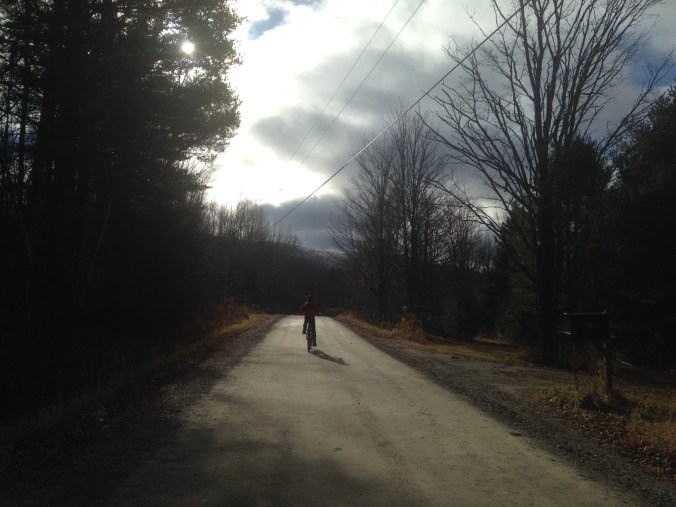
With so little snow and a great deal of sun, we spent some time walking through the neighbors’ fields today. When they bought the property, they dragged out all the abandoned farm machinery, the wheels and gears, and lumped it together on an old cement slab. The collection had been in the weeds for God knows how long, and doubtless it’ll remain clustered together, gradually rusting, accumulating leaves and the odd fallen stick, for a stretch of unknown eternity, too.

Unlike Robert Frost’s birch fences that rotted in three foggy mornings and one rainy day, machinery, having changed the landscape in such profound ways, slowly returns to the earth fleck by fallen fleck. This machinery has done all the hard moving it’s going to do.

I can’t but think there’s some odd comfort in even the mightiness of steel and internal combustion going the way of all things: that all the driving power of industrialism will yield to entropy, that the earth in her slow and patient way will fold back around the fortresses of men, and eventually have her way.

In known history, nobody has had such capacity for altering the universe than the people of the United States of America. And nobody has gone about it in such an aggressive way.

— Alan Watts

FullSizeRender

Spinning Planet

Almost immediately after a children’s play at the Craftsbury Library tonight, my daughters ran outside. Was it the weirdly warm December weather? The joy of seeing a long-time friend? I sat on the back porch slouched in a rocking chair, watching the sun sink behind the Lowell ridge, listening to ten-year-old hysterical laughter.

My teenager appeared, and we were all crazed, wandering around the church, the gazebo, the war memorial. As the dusk steadily pressed down, the children raced across the Common. At the far end, I saw the white-painted fence, and nothing of the children but a smear of a red coat.

Spring fever? In December? In a world rapidly turning upside down? With my teenager, our conversation often seems one long meandering line of history, of the bloody business spanning centuries. But the world turned upside down is inescapable in this mud-season December, with my laundry hung out to dry on the clothesline.

The girls lay on the grass, and I teased them, Make snow angels. Christmas is coming! I pressed the toes of my boots against one of the girls’ feet. This same girl bequeathed me these boots a few years ago, when she had outgrown them. Having walked through some serious living in these boots, the sole under my right foot has split, a crack where water from the thawing earth bled up through my sock, soaking my skin.

In the twilight, she was laughing. How’s that for a composition? This glossy-eyed girl, giggling in the shifting bits of remaining light, ruddy-cheeked with gorgeous health, hair unraveling in a braid, her back and shoulders pressed into Vermont sod while overhead the constellations merge into view, and our planet spins steadily, on and on….

Out of the night that covers me,
Black as the Pit from pole to pole,
I thank whatever gods may be
For my unconquerable soul…

— Invictus

IMG_0374

Woodbury, Vermont

Broken Hearts

Via my lousy cell phone connection, I had a conversation with a person I’ve never met who’s writing a review of my novel. Almost immediately, he told me, You broke my heart. What was I to make of this? I never intended to break anyone’s heart, least of all through my writing.

But is the book broken-hearted? Of course. It’s adult fiction, about a woman and a family. Broken hearts are the way of the human world.

As I write this, my own two daughters are drawing at the kitchen table, the teenager unfolding practically before my eyes into her own young womanhood, the ten-year-old wearing her skis at the table, longing for the excitement of snow, ready to try her mettle. When they were little toddlers, I kept anticipating I’d figure out this mothering thing, that our life would settle down into some kind of pattern, maybe even get a little boring. But my children kept changing that. Oddly enough, the kids kept growing. It wasn’t enough to crawl; they had to walk, then definitely run. At one point, my older daughter surrounded herself with board books, kicking back on our scuffed pine floor with stuffed animals. Now, she read a fat C.S. Lewis grownup book this autumn, hard and philosophical.

All good writing (and I hope my book fits somewhere on that scale) is about loss, as loss is braided into our lives. Of course, I want my daughters to love, and love well, whom and what they love. And yet… I can’t help but wish, admiring these girls surreptitiously, learn from little pieces of loss, my darlings, know them truly and well, and be blessed with long and sweet life.

When we were children, we used to think that when we were grown-up we would no longer be vulnerable.  But to grow up is to accept vulnerability… To be alive is to be vulnerable.

— Madeline L’Engle, Walking On Water

IMG_0388

Hardwick, Vermont


December

Spring, now so far away, comes with an urgency in Vermont, a breaking up of frozen roads, hail that reluctantly gives way to rain, coltsfoot – the first flowers – that thrust up through the gnarliest of patches: roadsides and where the gravel is beaten hard.

This season, too, comes with its own severity: every day, a little less light, a little more dark. What are the words I drag with me as I enter this season? Forget gray. Discard dimness. This is a world turned upside down, where the snow-covered ground exudes light, the trees pull in on themselves, myriad creatures put their heads down to sleep. The night sky is studded with white quartz. The clouds sink down into the earth. The garden rests. My callouses mend.

We have come too far together toward the end now
to fear the end. These nights, I am no longer even certain
I know what the end means.
— Louise Gluck
FullSizeRender

Hardwick, Vermont


Galaxy Bookshop Reading & Rain

Freezing rain. Enough said. I drove home early from Burlington at that gnarly 33 degree temp, listening blankly to NPR while thinking unrelenting gray. The children were delayed on the bus, held up behind an accident, and I kept thinking, Who’s with my children? Our dirt back road was sheened over with ice.

Nonetheless, I read in our bright and cheerful bookstore tonight, with my crowd – some new folks, some people I’ve known for years upon years now – so graciously pulling on their raincoats, leaving their wood stoves, and braving our elements. A fitting setting for reading this novel, so suffused with volatile weather and darkness, seasonal change. Writers, a teacher, a carpenter, mothers, librarians, farmers, the children’s bus driver, my fellow booksellers: thank you. And, my little daughter noted, chocolate cake to boot.

Deep in the night, I slid into my boots and coat and hat and out the kitchen door, hurrying down the frozen, rutted up path, then veered off that and ran into the field. Under my boots grew the winter rye, still green and pliable despite the winter hammering in.

Lines from Hidden View

FullSizeRender

Elmore, Vermont/Photo by Molly S.

Sunday: Math Homework

One embarrassing aspect of my parenting that keeps rearing its ugly head is my abysmal understanding of math. Or, as my brother might phrase it, the complete and total absence of even meager understanding. My daughter, grappling with variables and graphing, asks for help, and then is reduced to querying, How did you get through calculus anyway? Or are you lying about that?

As I was flanked on either side by math luminosity in my older sister and younger brother, headed up by my PhD-in-physics father, skipping out of math wasn’t an option for me… and yet somehow I always felt in Prob & Stats class like I was the dog with its head hanging out the window, tongue flapping, dreaming of distant rivers to swim.

Hence, my humanities path.

Now math returns to me frequently (often on Sunday evenings). With something approaching horror, I heard my daughter claim her teacher doesn’t want to see her math work, merely the answers. What? I demand. Show your work was a cardinal rule of my student life, along with always use a pencil, these dictums wound so deeply into me I can’t abide the thought of breaking these basic rules. That’s tantamount to crossing a street with your eyes closed. My daughter looks at me with complete exasperation, fully ready to do just about anything else.

While I admit Solve for x still runs a chill up my spine, I have learned a few things since those trig days. My advice: begin with what you know. Scope out your variables, size up your know-how, and savvy up a plan.

Almost all good writing begins with terrible first efforts. You need to start somewhere.

— Anne Lamott

IMG_0379

Elmore, Vermont