Sisters

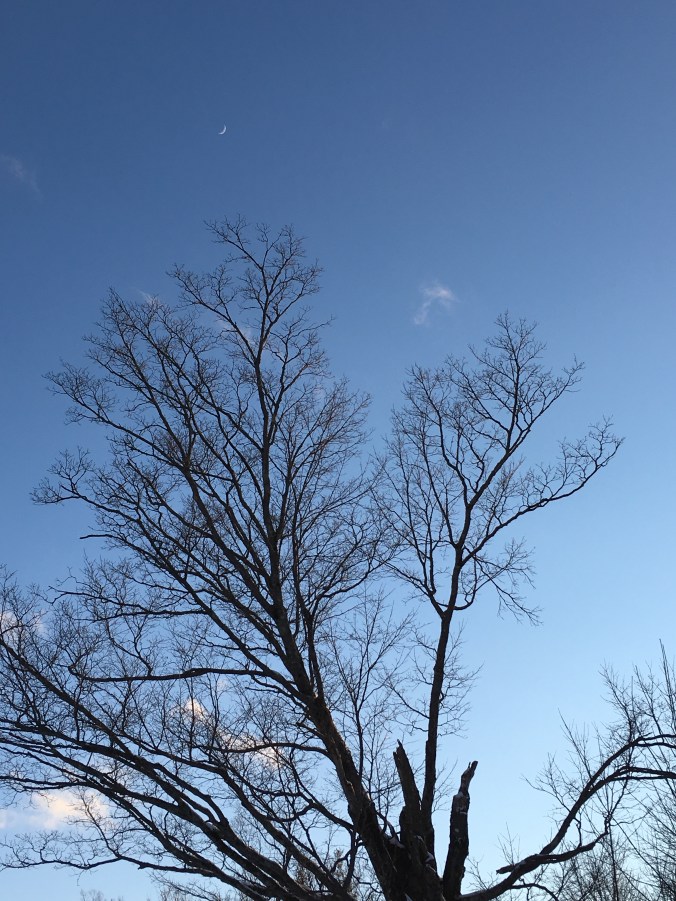
This evening, my older daughter got out of the car in our driveway and exclaimed, This is my favorite kind of moon! Inside, the little girl who had played a basketball game was ravenous. The girls had picked me up from a school board meeting, and the younger one, eating dinner in front of the wood stove, asked why a woman had said, Well, you two are definitely sisters. What does that mean? the younger girl asked.

What does bind a family together? Much more than the shape of a nose, or the hue of hair. Even more, I think, than a keening affinity for the moon, or a struggle to bend art. Our life is composed of many material things: our house, our garden, endless meals and piles of shoes, but also the things we can never hold in our hands. The way we argue fiercely at times but always apologize, how the younger girl laughed so happily this morning when I sleepily put a cup of coffee in the fridge. Oh mom! The way we desire for each other the kind of happiness where you can lie back and let that happiness hold you.

It was the sibling thing, I suppose. I was fascinated by the intricate tangle of love and duty and resentment that tied them together. The glances they exchanged; the complicated balance of power established over decades….

–– Kate Morton, The Distant Hours
IMG_0203

February, Vermont, 2016


May the Road Glaze Up to Meet Us….

No school today, due not so much to snow but to ice. While I was gone most of the day, literally sliding on Barre’s sidewalks, the kids were home. With great gusto, the teenager plowed the driveway, while the ten-year-old teamed up with the neighbor boy. In the afternoon, the boy’s mother and I went walking. I’m reading Rebecca Solnit’s Wanderlust: A History of Walking right now, and I realize my deepest conversations with this woman have been along our mutual dirt road.

Our relationship began before either of us had kids, meeting for the first time along the road when it had washed out in a summer storm. We have now stretched through births, illness, carpooling, innumerable passing back and forth of cake pans and eggs.

And yet it is always the road where we return. Today, with the road’s center sheer ice, she walked on one gravelly edge, I on the other, and we spoke across this narrow road. Back at my house, in the rain, the children had built a couch of snow complete with footrests. I watched the two children later from the kitchen windows, sitting on their mitten-made couch in their bright hats and snowsuits, chatting.

This constellation called walking has a history, the history trod out by all those poets and philosophers and insurrectionaries, by jaywalkers, pilgrims, tourists, hikers, mountaineers, but whether it has a future depends on whether those connecting paths are travelled still.

–– Rebecca Solnit, Wanderlust: a History of Walking

IMG_0698

February, Elmore, Vermont


Day of Hearts

In When Breath Becomes Air, recently posthumously published, Paul Kalanithi acknowledges the irony of his devastating cancer in his thirties; Kalanithi, a neurosurgeon unbelievably gifted in a multitude of ways, had striven to understand mortality before his diagnosis, to parse what dying meant.

Is it true that our lives circle back? As Joseph Campbell wrote, the greatest challenges we face are those we would never willingly encounter.

Kalanithi must have been an extraordinary man in many ways, but particularly in the exquisitely graceful way he never diminished or belittled individual suffering while also acknowledging that suffering is an integral and unavoidable aspect of living a human life. The book is suffused with a pursuit to understand our world and yet marvel at its infinite mysteries.

In the end, it cannot be doubted that each of us can see only a part of the picture. The doctor sees one, the patient another, the engineer a third, the economist a fourth, the pearl diver a fifth, the alcoholic a sixth, the cable guy a seventh, the sheep farmer an eighth, the Indian beggar a ninth, the pastor a tenth. Human knowledge is never contained in one person. It grows from the relationships we create between each other and the world, and still it is never complete.

Paul Kalanithi, When Breath Becomes Air

FullSizeRender

Mid-February, Vermont, 2016


Icicles as Building Materials

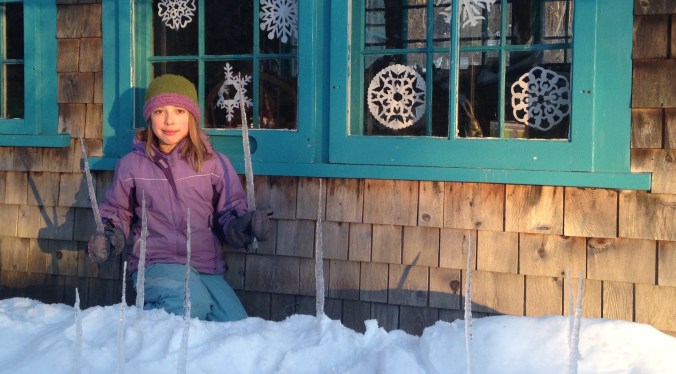
This afternoon, my 10-year-old daughter studiously collected all the icicles that she could reach from the house’s eaves. She then began her winter project of icicle house-building. The icicles have been slim pickings this year, and not for lack of interest. She cajoled her older sister, who had just returned from running, to stretch up and grab a few more.

Returning from a walk, I stood on the road, listening to my daughters at the house, discussing the different colors of ice. This weather, so pure and cold, reminded me of those long walks I took in those last few weeks before my first daughter was born. Every afternoon, I’d bundle up – me and the unborn baby I carried – and walk in what I remember as an especially sunny and cold winter. More than anything, I was most curious to meet this baby, to see this tiny person’s face: my child!

Our relationship has long since grooved into the varied terrain of mother and daughter relationships, far deeper, far richer, far more full than I ever could have imagined, sprawling beyond any cliched confines.

I have one daughter emerging into young adulthood, the other enmeshed deeply in the middle of her childhood. In the end? Who knows? How will these girls look back upon these years? But I hope they remember the loveliness of these ephemeral ice creations.

I do not miss childhood, but I miss the way I took pleasure in small things, even as greater things crumbled. I could not control the world I was in, could not walk away from things or people or moments that hurt, but I took joy in the things that made me happy.

–– Neil Gaiman, The Ocean at the End of the Lane


FullSizeRender

Mid-February, West Woodbury, Vermont

New Hampshire’s State Lunch (a little known fact)

Although I’ve lived in Vermont for almost all my adult life, I grew up across the Connecticut River. Growing up in New Hampshire, not only did we meet all the candidates, we met all the sub-candidates, too – anyone who was remotely interested in running for president showed up not only in our small town, but in everyone’s small town. Some students set off a smoke bomb in our high school just before Reagan arrived with his secret service entourage.

The best thing about the New Hampshire primary is that intractable streak of curmudeoniness that runs through the state. Voters in my town expected all candidates to have coffee in Linda’s Diner. You didn’t vote for a no show, and you didn’t take excuses. The second best thing about the New Hampshire primary is that it’s just more fun. It’s happening.

I remember (and this was many years ago) standing on a street in Manchester waiting for Jesse Jackson. Behind us, one newsman complained to another, New Hampshire in January! It’s always freezing, and you have to walk forever to find a pay phone!

The rest of us managed to make do.

In New Hampshire the state lunch is a submarine sandwich with a tub of coleslaw.

– Donald Hall

DSC01072

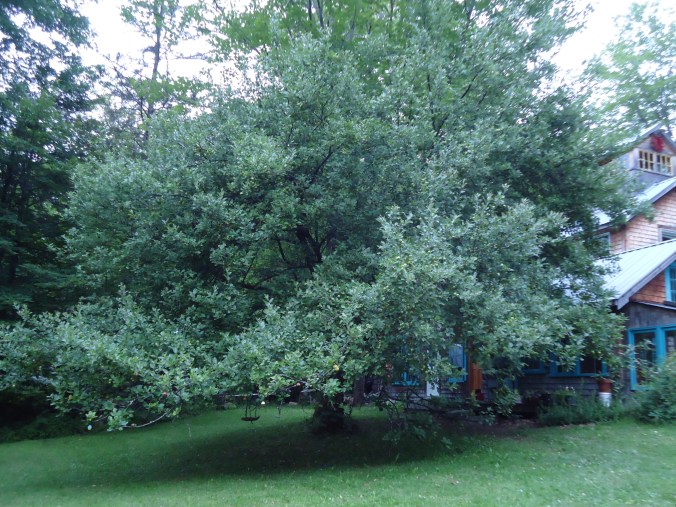
This was summer….. 2015


Another Brick in the Wall….

Today I visited a high school that reminded me of the high school I attended, and I remembered just how badly I wanted to dismantle that building, brick by brick. I wanted windows. I wanted to lie beneath leafy trees. I wanted to hike up behind the athletic fields and wander into woods I hadn’t explored.

So at 18 when I enrolled in a tiny Vermont college at the end of a paved road, where an old farmhouse housed the administrative offices and classrooms were in a former hay barn, I knew I was in the right place. The first night I slept there, I fell asleep staring through the window at the crystalline stars.

I’ve tried many paths with my own daughters, from private school to homeschooling to public school, and perhaps the one thing I learned is not follow what your own adult peer group is doing – that initial impulses are sometimes dead-on – and that if you’re feeling penned in, look for the egress, or at least a window sash to open.

Education is not the filling of a pail, but the lighting of a fire.

William Butler Yeats

FullSizeRender

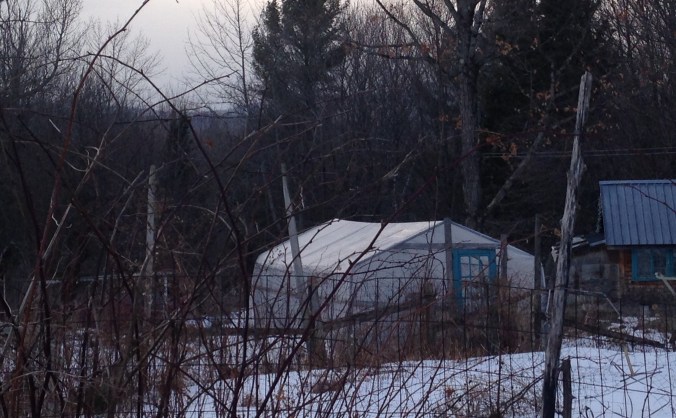
February garden, Vermont