Town Meeting Day

Vermont Town Meeting Day, upstairs in the elementary school gymnasium, with the kids running riot downstairs in the darkest reaches of the basement, daring themselves to enter the unlit corner around the boiler.

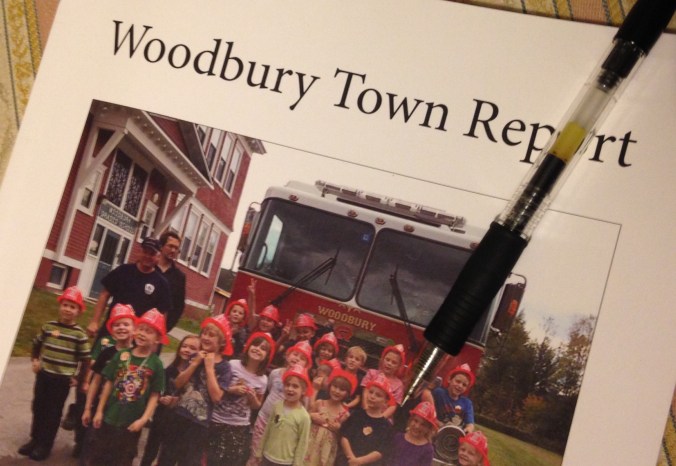
By discussion and voice vote, the town’s yearly business was transacted today. Here’s what we discussed: fire truck lease payments, the school budget, derelict buildings, whether to pave the upper part of the Cabot Road. At times tedious, riveting, and funny, town meeting has an odd quality of mimicking life and is one of the perks of living in a Vermont town. Where else can you stand up and make an impassioned to plea to keep your small school and have neighbors clap? Where else can you also hear about cement culverts and drainage and which garbage bins in the cemetery need emptying? The people are generally civil, the coffee and homemade lunch unlimited, and you can bring your knitting. 

Let us never forget that government is ourselves and not an alien power over us. The ultimate rulers of our democracy are not a President and senators and congressmen and government officials, but the voters of this country.

– F.D. Roosevelt
 

FullSizeRender

Trees, Rugged Earth

My brother has a stash of panoramic vista hikes in his terrain. This visit, we hiked up Jockey Cap in nearby Maine, an enormous round igneous rock practically in the town of Fryeburg.

At the top, we saw extensive Lovewell Pond, the substantial White Mountains to the west, and the flats of Maine where the land begins to stretch to the sea. The sole snowy peak, in this end of February, was Mt. Washington. From that height, in this too-warm winter, the earth appeared dull brown, even the blues of the mountains washed out under the brilliantly clear sky. Down below, we saw a conical pile of road maintenance sand, a Dollar General, a series of strip malls, traffic inching along the highways: not the earth in her shining majesty and glory, but hard-worn, patient, enduring.

At the crest, a pine tree no taller than myself grew stubbornly from the rock. My daughter and I knelt near its roots, our bare fingers over the hard curled wood searching for traces of soil. None. And yet this tree ruggedly remains, flourishing, seemingly against all odds.

SEEKING REST

Late night, dark night,
the house hums around me.
… High wind
swirls the stars around me.

Closed and still,
I hear and say the names
that do not stay in place
when night has found me.

Everything is shifting.

– Ellen McCulloch-Lovell

FullSizeRender

Fryeburg, Maine

Travel Into Places Familiar and Unfamiliar

Yesterday, the girls and I left Vermont – currently a giant slew of ice and running water –and drove over the Connecticut River into New Hampshire’s White Mountains, an ancient granite range. At the crest of the Notch, I stepped out in the blowing snow and snapped a photo, the temperature not much above zero. In the backseat, the little girl pressed against her teddy bear. I drove down the steep switchbacks, listening to music, the girls quiet, while the temperature soared and the snow that shrouded the pass lifting and disappearing.

For years, I’ve impressed on my daughters to make a mental map of their world as they go. Memorize road signs; note the position of the sun, rivers, cairns; remember your turns. And yet, more than our perceptions of places falter. A few years ago, with our daughters, my husband and I returned to the mountainside  where we had married. We hiked up this once-familiar area and could not find the field of our wedding. The mountainside, a former ski area, had not been mowed for years, and the field had been reclaimed by scrubby thickets. In the end, we found what we were seeking, completely altered but for the shape of the earth: a flat knoll and a once-upon-a-time drop off now concealed by emerging birch.

These ancient mountains are all of this: familiar to me through swimming and river rock collecting and backpacking into the peaks, and so infinitely mysterious, ever-changing, miraculously beautiful. And, this morning, sunny.

….to see beyond boundaries to the subtle heart of things, dispense with names, with concepts, with expectations and ambitions and differences. Tao and its many manifestations arise from the same source: subtle wonder within mysterious darkness. This is the beginning of all understanding.

Lao Tzu (c.604 – 531 B.C.)

FullSizeRender

Franconia Notch, New Hampshire


Hearth

This morning, the house grew cold as I let the fire in our wood stove dwindle. When it was nearly dead, I pulled apart the stove pipe and stretched my arm deep down its throat to loosen the rattling creosote. With a shovel, I removed the ashes from the stove, then vacuumed the damper vents at the back, so the air will flow again. In the baffles at the top, I reached between the metal and fireproof insulation and pulled out handful after handful of silty, warm brown ashes, silky as kittens. I kept thinking of Megan Mayhew Bergman’s story “Housewifely Arts.”

This evening, after a day of snow and freezing rain and sleet, our hearth is rich with heat again, the children sprawled luxuriously on the rug. One of the interesting aspects of writing is a tendency to turn things upside down and inside out. Our stove is not merely a source of heat, but also consumer of wood and air, creator of ash, its lungs linked to the chimney funneling through our house. I once spent the greater part of an afternoon with a heating specialist who explained the inner workings of a nearby hospital, the channels of electricity and oxygen and water and waste, the circulatory system of an enormous building, generally unseen but vital.

Maybe it’s a day like this, when winter relinquishes its hold reluctantly, hurling ice at our windows in fury, that brings us back to our hearth again, gratefully.

There is no need to explain to our daughter the death of her first dog. Poppy, better than any of us, understands the urge to have what you must have. She can still wring what she wants from the world. It has listened to her cries and delivered. She still trusts the raw pull of desire. One day it will tear her away from us, take her down a dirt road to a place she does not recognize, and there she will make her home. Away from everything she understands, and close to everything she wants.

– Megan Mayhew Bergman, “The Two-Thousand Dollar Sock”

FullSizeRender

Winter Garden, Vermont, 2016


Sisters

This morning when my older daughter left with friends, the younger sister watched her drive away as sadly as if the sun and all its life had departed, leaving only me, a distant and chilly star. The younger child’s first word was “Ma” – not a Ma for mama, but for her sister, Molly. Molly’s first word was mama and only mama, but her younger sister began with Molly and has pretty much defined her world from the sun of her sister. As the Inuit may have a 100 words for snow, the child had a multitude of variations of her sister’s name.

Hence, me – her mother – the distant star, or maybe at least the moon sailing by.

As the younger child added words to her repertoire, her words had a curious -y at the endlike coldy. Gradually, I began to realize Molly so deeply suffused this child’s world that even her emerging language evolved out of her primal interest in her sister. The truth is, I’m glad to hold my moon position, steady with my own unwavering gravitational pull.

Of course my girls bicker; of course they argue; of course at times they quarrel over things I find hideously unimportant like bagels; but at one thing I can count on is that they’re always watching the other’s back.

You know full well as I do the value of sisters’ affections; there is nothing like it in this world.

– Charlotte Bronte


FullSizeRender

Woodbury, Vermont

Before Dawn, Children Sleeping

In On the Banks of Plum Creek, Laura’s beloved rag doll, Charlotte, is given to a spoiled neighbor’s baby. Charlotte had been a Christmas gift Laura’s mother had made her, and the girl sorely misses her doll. Later, she discovers her beloved doll, discarded and frozen in an iced-over puddle, and fiercely reclaims her. This all takes place in the chapter “The Darkest Hour is Just Before Dawn,” when Laura, her sisters, and mother are without Pa, and in need.

This morning, in my own pre-dawn house, while everyone was yet sleeping, I thought of Charlotte again, and how I’ve returned to that image all through the varied years of my life, looking for treasures to mend in frozen puddles. Sometimes I wonder where my own daughters will be, years from now, all grown up, enmeshed in families of their own. What have I made or given them that they would rescue from sleeting rain and mud? Something dear, I hope. Something beloved.

Darling Charlotte lay in her box under the eaves, smiling with her red yarn mouth and her shoe-button eyes. Laura lifted her carefully and smoothed her wavy black-yarn hair and her skirts. Charlotte had no feet, and her hands were only stitched on the flat ends of her arms, because she was a rag doll. But Laura loved her dearly.

–– Laura Ingalls Wilder, On the Banks of Plum Creek

IMG_0711