Stormy Spring Fever

Not only the children have spring fever; I’m afflicted, too. In this rainy afternoon, the children are outside, equipped with boots and splashed bright cheeks.

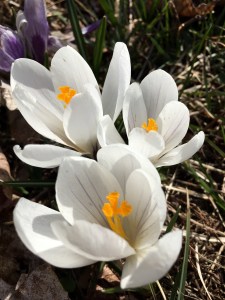
In the woods, the rain lessens. Green trout lily leaves sprinkle the forest floor profusely now, although the coltsfoots’ golden blossoms are folded up, napping away the deluge. In the cold, damp earth, my freezing fingers tugged free a few of my garlic sprouts, their pale white roots clinging deeply in the soil, winding around rouge pebbles. I chopped their savory greens and tender shoots for a salad, a taste of liquid chlorophyll, I imagine.

This is the season of secrets unearthing – last fall’s decaying fungus belly-white, frog eggs fattening near the pond’s stippled surface, the children too big for last year’s summer clothes.

We need the tonic of wildness…. At the same time that we are earnest to explore and learn all things, we require that all things be mysterious and unexplorable, that land and sea be indefinitely wild, unsurveyed and unfathomed by us because unfathomable. We can never have enough of nature.

– Henry David Thoreau, Walden

FullSizeRender.jpg

Woodbury, Vermont

Rave On

For days, I’ve inhabited the post-root canal world where a sledgehammer banged my jaw. This morning, my young daughter made me coffee and noted, You’re laughing. You must be coming back to life.

This first of May, a steady rain is muddying the woods, jamming the streams near to full, washing clean every bit of green in the garden. Bring it on, I think: frog eggs, emerging salamanders, the ephemerals untangling from the matted forest floor. New England winter is spare, stripped down to straight lines, but spring is all wild, unfurling mightily and messily.

Yesterday, in my broken tooth stupor, I drove to Montpelier to hear poetry. Dede Cummings, of Green Writers Press, read Birches extraordinarily well in that quiet, sun-filled room. Like numerous people, that poem has risen many times in my life, from the first I read it, in 8th grade, to most recently a few summers ago, when my friend Tim Smith had my daughter read it aloud before dinner one gorgeous Colorado evening.

This afternoon, my body unknotting from pain, the neighbors’ boy turning ten this very day, the children enmeshed in their imaginative worlds, our kitchen filled with the fragrance of baking cinnamon, I think, what sheer luck to live in a world where Birches is possible. What sheer luck, this down-pouring day.

So was I once myself a swinger of birches.
And so I dream of going back to be.
It’s when I’m weary of considerations,
And life is too much like a pathless wood
Where your face burns and tickles with the cobwebs
Broken across it, and one eye is weeping
From a twig’s having lashed across it open.
I’d like to get away from earth awhile
And then come back to it and begin over.
May no fate willfully misunderstand me
And half grant what I wish and snatch me away
Not to return. Earth’s the right place for love:
I don’t know where it’s likely to go better.

– Robert Frost, “Birches”

IMG_1085

May 1/Woodbury, Vermont

Rough Draft

The ten-year-olds are at their fort building again; odd pieces of plywood have been scavenged, a long 2×6″, silver spray paint glistens a joyous arc in this early morning dew. The project is all rough draft. No terminal point of placing Ma’s china shephardess over the mantle will ever occur. Lacking the need for a finished project, the kids’ creation is all joy and curiosity. Could these old pallets be used? A split hose?

At select moments, the daughter opens her door and invites me in for a tour. What do you think? she asks. What more can I do?

And then: Pull up that bench I made. Sit down and enjoy.

So many of us fail: we divorce our wives and husbands, we leave the roofs of our lovers, go once again into the lonely march, mustering our courage with work, friends, half pleasures which are not whole because they are not shared. Yet still I believe in love’s possibility, in its presence on the earth….

Andre Dubus, Broken Vessels

FullSizeRender

Photo by Molly S.

Here.

In the internet world, hardly anyone ever writes where they live. Who claims to be from Maple Falls, Washington? Or Ivy, Virginia? On my hillside, in West Woodbury, Vermont, the trilliums have pushed up but are folded over, awaiting warmth to spread their velvety petals. This afternoon, the sun shines undiluted, while the maples host those raucous robins.

In this April’s Poetry Month, I’ve heard Vermont poets read about desire and loss and joy, and about drinking cold sap, cedar waxwings huddled in a snowstorm, hand-churned ice cream, lost rings….

All this violence: wars and cruelties…
now as always
back to the beginning of time….

Yet and still every day the sun rises,
white clouds roll across the sky,
vegetables get planted and grow,
and late in the afternoon someone
sits quietly with a cup of tea.

– David Budbill, “Little Poem Written at Five O’Clock in the Morning”

FullSizeRender.jpg

Woodbury, Vermont, April afternoon

Hope Springs

Some unexpected events in our thawing patch of Vermont:

  • dinner guests of chatting children eating grilled eggplant and chicken wings, with gusto
  • exquisitely beautiful poems read at the Galaxy Bookshop last night – and adult companionship, too
  • clouds of frog eggs, knots of trillium blossoms, profuse sunshine and clothes drying on the line
  • a rotten tooth mended

But hope is not about what we expect. It is an embrace of the essential unknowability of the world, of the breaks with the present, the surprises. Or perhaps studying the record more carefully leads us to expect miracles – not when and where we expect them, but to expect to be astonished, to expect that we don’t know.

Rebecca Solnit, Hope in the Dark

FullSizeRender.jpg

Brattleboro, Vermont/Photo by Molly S.

Slow Learner

At breakfast at the hotel, my ten-year-old is mesmerized by fruit loops. I’ve never tried those, she says, looking at the rainbow bits yearningly.

Go for it, I tell her.

Nearing the end of the milky bowl, she lays down her spoon and comments that Cheerios are better. Those colored rings have failed to hold up to their promised joy. It’s a loss she takes easily, mere observation. When her older sister was that age, I would have leapt forward to fill that moment: disappointed with a cereal? Try this. Or this. This time around, I let it lie. It’s the slightest sadness, and I just let it be. Second time around, I let her keep that sadness for herself.

That evening, she floats on her back in the hotel’s pool, then raises her dripping face and smiles radiantly, sparkling clean, thoroughly happy with buoyancy. I can’t help but stretch for her chlorine-scented hand, and then we flip over and float again, together.

Bring on winter, bring on

disease, & rot & fracture,
because the more broken

we become, the more music
we can spin out of our bones.

– Stephen Cramer, Bone Music

FullSizeRender.jpg

Woodbury, Vermont/April/Photo by Molly S.