E.R. Visit

Doubtlessly, I talk too much with my teenager, as if I can fortress a wall comprised of vowel and consonant around her. Yesterday took an unexpected curve when she had a knuckle stitched up in Morrisville’s ER. Dark thread; alabaster skin.

In hours of waiting, just once I asked her to look at her gauze-wrapped knuckle. I asked, Do you see what my words mean?

This girl pushing-hard-toward-womanhood said one word: Yes.

Yes. A word overspilling with meaning, used in manifold humdrum ways (is it raining yet? do you want more kale? would you wash that laundry?) and then, in that afternoon, between the two of us – mother and daughter –that word arched between us in the clearest possible manner, resonating with all our 17 years together.

Do you see what I mean? Yes.

That yes acknowledged the misery of the present ER, the unwieldy bulk of the past, and yet that yes joined us, mother and daughter. Yes to my love for her, and yes in her acceptance of my love.

Parenting books are chock-full of advice, both decent and downright dumb. Seeing my daughter’s hand x-rayed, with her long elegant bones, ethereal in beauty, hidden beneath the bloody tear of her flesh, pulled me down into that near wordless place where only a few things matter.

Rain began falling as I drove home around Elmore Lake too cold for swimming this late in the season, and the autumn leaves golden and crimson on the familiar mountain. My brother, home with the 11-year-olds, holding up the pieces of my domestic life, had texted a request for paper towels and beer. My daughter and I stopped at the small Elmore store, where years ago this girl had eaten her first grape popsicle. My friend had carefully split that frozen treat in two equal halves for two 2-year-olds. She had used a plastic toy saw as a tool.

Going that final stretch home, I drove slowly, the two of us eating chocolate chip cookies and talking.

Where you stumble and fall, there you will find gold.

– Joseph Campbell
img_1793

Summer of 17, Greensboro, Vermont


Ah, Céline….

When I was 21 and writing my undergraduate thesis in philosophy, I supplemented Kant and Plato, naturally, with novel reading, a truly great human pleasure. From a friend, I snagged a copy of Death on the Installment Plan – arguably one of the best titles ever. (How could anything more accurately sum up human existence?)

I remember lying on a mattress in that apartment in Brattleboro, with the enormous windows open to Main Street below, unscreened, street dust drifting in over the mahogany sills. Living alone in a gorgeous old apartment building, with bustling town life below, was new to me, and I was new to life myself then, the world of my womanly life barely unfurling.

I must have spent hours reading Céline, in that college-age life I had then, devouring that book with a passion. I’ve read many authors whom I’ve loved and admired and wanted to emulate. Céline is Céline; no one else. What raw joy to read that book for the first time. Early this morning, me and the scampering mouse were awake, and I was reading Hanya Yanagihara’s A Little Life, in that inimitable world of the novel. Yes.

Here’s a sentence I read this morning:

…things get broken, and sometimes they get repaired, and in most cases, you realize that no matter what gets damaged, life rearranges itself to compensate for your loss, sometimes wonderfully.

– Hanya Yanagihara A Little Life

And then Céline:

That’s the hatred that kills you. There’ll be more of it, so deep and thick there will always be some left, enough to go around…it will ooze out over the earth…and poison it, so nothing will grow but viciousness, among the dead, among men.

– Céline, Death on the Installment Plan

fullsizerender

The Kitty Cat Boots

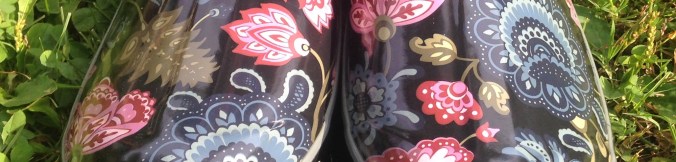
Hardly anyone knows this, but when my younger daughter was 2, her older sister and I bought her a used pair of pink rubber boots with kitty cat faces on the toes. These boots gave incredible joy to this blond-haired little girl, and she wore them until the boots were actually in shreds. Today, she wears her first adult boots – with flowers, of course – but yet fully woman-sized, larger than my own feet. The girl’s been walking around all afternoon, admiring these boots, marveling at the size of her growing feet, a bit mystified at how this happened.

A very much desired and longed-for younger sister, this girl was graced with an exceptionally long cosseted period, carried on her sister’s back and hip long beyond the time most children are required to walk by themselves. While her older sister began speaking well before her first year, the younger daughter had a prolonged echolalia phase. I had been told to record those singing syllables, lovelier than a hermit thrush’s song, but even then I knew that dear sound rang in our ears merely in passing and had the sense that to let that fleetingness go.

Enjoy the flowers on your boots, lovely one.

When voices of children are heard on the green
And laughing is heard on the hill,
My heart is at rest within my breast
And everything else is still…

– William Blake, “Nurse’s Song” (Innocence)

fullsizerender

End of One Road….

After a summer of chaos and bitter heartbreak, tears, the Vermont state police, too many times through the county courthouse’s metal detectors, I crashed my car yesterday. The impact came at slow speed, and when I got out of the car, I knew instantly I was uninjured. The woman in the car I hit also assured me she was fine.

I stood on the road, my vision caught for some reason at the sun shining in the canopy of an immense maple nearby. I stood staring upward for a moment, admiring the brilliant September afternoon. In every sense of the word, I had been driving blind, the inside windshield of my car smeared greasily, never tended to, and I had been crying. I hadn’t seen the woman who was at a standstill, until after I hit her. By sheer grace of luck, I had managed not to hurt this stranger, and then she spent three hours sitting in the grass with me, infinitely patient. This morning, an apple pie bakes in my oven as a meager gesture of my gratitude.

My publisher, Dede Cummings, describes herself as a glass-half-full woman, a feature I’ve tried to emulate. That afternoon, my glass foamed over. All the things I had held coiled so tightly within me – my daughters’ well-being, lack of childcare, too many demands for money and too little lucre – released from me when I stepped out of that crumpled car. Standing on the road, I felt strong, resilient as a birch sapling, and immensely calm, expansively alive as the nearby hayfield. Oddly, I had been returned to whom I was once, soles on the ground, my eyes sparkling and full of sunlight.

It had been a very long time since I had hoped for more than that my daughters and I accept and endure their father’s apparently unbreakable descent into a place where we cannot reach him. In that brief moment, I realized we would thrive, too, that our lives would unfold further in a vibrant tapestry, and the goodness of the world was, truly, yet at my hands, there for the taking. The world hadn’t turned its familiar back to me.

In my novel, the moon in all her various faces – crescent, gibbous, cloud-strewn – appears repeatedly as a talisman to my main character. Yesterday’s geometry of sunlight descending scattershot through leaves, dusty road beneath my clogs, and the  September afternoon with its darting dragonflies wound together as my own unbidden talisman.

I never accomplished what I intended that afternoon. That evening, the moon rose full, the hue of spring-grass-tinged cream. O, sweet lady moon, traversing her patient path across the heavens. We slept with the windows open to the night, moonbeams moving across our cheeks as we slept.

Come, see the true
flowers
of this pained world.

Bashō, On Love and Barley

fullsizerender

Woodbury, Vermont

Interlude of Merriment

My daughters are like me this way: a difficult week? Pack lunch and retreat into the woods.

Yesterday found us hiking along a series of cascades, then walking barefoot through a shallow, boulder-strewn stream. Among mushrooms, we walked on cushy pine needles in a shaded forest. At the end, chilled from swimming in the mountain stream’s pools, my car didn’t start, tossing me that curve with its recurring electrical problem.

In those two hours we spent by the side of a not-well-travelled road, at some point I began laughing at everything humorous and absolutely not-humorous in our lives, verbally listing, and once I began laughing, I laughed so hard I sat down on the graveled roadside. More than any words, my daughters found my laughter exquisitely reassuring.

In times of acute family duress, I’ve laughed with my siblings and father until tears have run down our cheeks. The people I am most aligned with (whether I know them well or not) wield the same two practical tools I return to, over and over: the inherent (and physical) need for comedy and an awe of beauty.

Afoot and light-hearted I take to the open road,
Healthy, free, the world before me,
The long brown path before me leading wherever I choose.

Henceforth I ask not good-fortune, I myself am good-fortune…

– Walt Whitman, Song of the Open Road, I

fullsizerender

Bingham Falls, Stowe, Vermont


The Void and Story

One of the more harrowing experiences I had recently was offering up testimony in a county courthouse. In a large, wood-panelled room with no windows, separated from the landscape I know and love – my children and the dark-green mountains where I live, the world of singing crickets and flower petals easily frost-bit, the sky sprawled infinitely overhead, I was asked to give my story.

What’s in each of our own, unique stories, anyway? Breath, thought, memory: words from my larynx spun from the slender bends of my ribcage. To return to David Hinton’s Experience again, while speaking I realized how keenly our stories are presence surrounded by absence. Into this unknown world, I told my story of fear and love, my presence filling that space. In this 21st-century American world, we’re accustomed to defining ourselves in terms of our acquisitions: degrees we hold, a dwelling, occupation, the clothing we choose each day, political beliefs we cherish, whether we raise our own meat and vegetables or buy boxed foodstuffs at Price Chopper. Pushed up the against the razor’s edge of the void – through illness or a turn of misfortune we’ll all experience – we’re left with only a body created from carbon and calcium, and the immaterial thread of our story.

Our stories, always imperfectly told, are not a reflection or mirror of who we are. The stories are who we are. Hand-in-hand with telling our stories is that persistency of doubt. Is this true? Is my story worth telling? For a writer: why write, anyway? The answer, perhaps, may be as simple and raw-edged as this: because at our hearts, we are but the conjoining of body and story. In the face of the void that courthouse morning, my story hooked into strangers’ stories, as my story now weaves into yours, and yours winds into others.

In Chinese with its empty grammar, Absence appears as the space surrounding the ideograms, and ideograms emerge from that empty source exactly like Presence’s ten thousand things – a fact emphasized in the pictographic nature of ideograms, and no doubt the ultimate reason for that pictographic nature. Indeed, the ideograms are themselves infused with that emptiness, as they are images composed of lines and voids, Presence and Absence…

David Hinton, Experience: A Story


fullsizerender

Elm Street, Montpelier, Vermont