Hardwick Postcard #1: Start Here

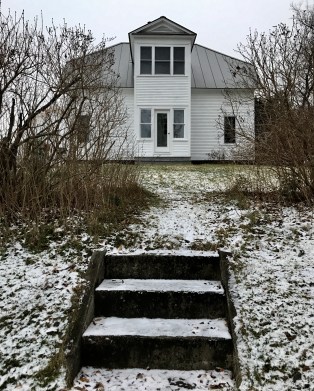
The front steps from our yard to the street reflect a time when people walked more. These days, the walkers in town are mainly kids and adults who, for one reason or another, don’t drive.

When I closed on the house, my older daughter was a high school senior who hardly seemed to attend school, so she came, too, on a hot and sunny June day. We’d known the sellers for years, and, as the closing was slightly delayed, we had some time to laugh. The electric company was switching out the poles in front of the attorney’s office, and the power was going to be shut off. We had a back-up plan to move across town, as modern closings need electricity, and  we tossed around the idea of using the library’s wifi on their front stone steps.

Afterwards, my daughter and I walked around the empty and freshly-painted house. Roses bloomed under the front windows that somehow, in all my examination, I had failed to see.

We hadn’t moved one thing in, still walking around barefoot in the sunny rooms, when a car pulled into the driveway. The woman, who was about my age, had grown up in the house. She was with her husband and their teenage daughter, and they had driven a very far distance for a relative’s graduation from the local high school. When she was a teenager, she told me, her future husband came and sat on the front steps with her, courting. From those steps, there’s a view down into the valley of the village and a trapezoid of the reservoir between the curves of mountains.

We walked through the house. She took pictures and told me stories. They live now in the middle of this huge country, and they wouldn’t return to Hardwick for many years. In the driveway, we shook hands, and then they drove away.

Sometimes the stars align. What a piece of luck to begin living in this house with the stories of a family who had lived here for over thirty years and loved this house and this place. In the few minutes I spent with this couple, I knew they had their own share of misfortune – and love and goodwill.

For a writer – and maybe for everyone, really – stories are manna. That afternoon, my daughter and I were no rush to move in. We opened all the windows and let in the June breeze, suffused with the scent of roses.

We shall not cease from exploration, and the end of all our exploring will be to arrive where we started and know the place for the first time.

– T. S. Eliot
IMG_0526.jpg

Dinner

The December my youngest daughter was two, snow fell every day – some days just the merest trace of flakes; other days, it snowed and snowed and snowed. By New Year’s Eve, so much  snow had accumulated on the porch and slid off the roof that I had to stand on a chair to see over that barrier through the scrim of visible window. I joked with my older daughter that we lived-in a snow dugout.

One midwinter day that year, I wiggled my toddler into her snowsuit and boots seven times, and then I thought I would never go outside again until spring – a nearly unbearable thought.

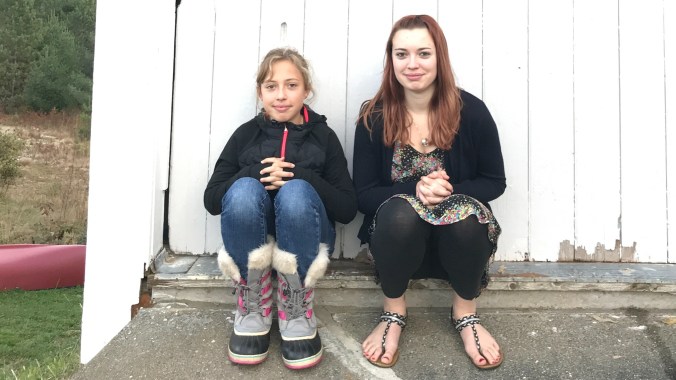
The girls come and go with their 12-and-18-year-old lives now. Driving home from work last night along the ancient Winooski, the river that’s flowed through the Green Mountains all through their glacial formation, I thought how one of the trickiest things for me about parenting has been how things constantly change. Baby sleeps through the night; now baby wakes every 30 minutes. Baby crawls, then runs.

And yet…. last night, my daughter who’s rooming at college, walked in while I was chopping cabbage and sat down at the table, hungry for talk and supper.

…one of the worst things about being a parent, for me, is the self-discovery, the being face to face with one’s secret insanity and brokenness and rage.

– Anne Lamott, Operating Instructions: A Journal of My Son’s First Year

Bright Spot

There’s nothing like a carful of laughing girls to whisk away despair. While the girls skied, I walked down to Big Hosmer Lake and sunk my hand in its cold water, thinking of my older daughter at 12 and how much she loved the rope swing on this lake. With an hour left, I sat in the touring center and sunk into my work.

Bringing in the cold and snow, the rosy-cheeked girls found me, chattering, hungry for the crackers in the car. All the way down the narrow valley from Craftsbury to Hardwick, I watched the remnants of daylight dwindle into pale rose, so glad we were headed to our warm house and leftover posole and the cats who would be mewling for their dinner.

12-year-old girls, laughing about falling on skis, listening to Christmas carols, exuberantly happy. I drove, listening, the girls’ merriment like a cloak around us, keeping night terrors away.

IMG_0414.jpg

Vermont Currency

My neighbor offers to pay me to stack her wood. I reply she can’t pay me, but I would stack it anyway.

The woman and I stand in her yard, looking eye to eye. I am inches below five feet. In her seventies, the woman seems both tough and fragile. She asks what she’s going to have to do for me – cook, is that it?

Without thinking, I say something that surprises me: Maybe you should just be happy with this? Why not do me a favor and allow me to do this?

She thinks this over – there’s an actual pause – before she agrees.

It’s an interesting and largely unspoken contract. She’s an attorney; I’m a writer. We’re each divorced. Both small and scrappy, accepting help is a reluctant relief.

The next morning, while I’m cooking noodles to pack for my daughter’s lunch, my neighbor appears at our double glass kitchen doors. I’m in trouble, she says.

I ask her in, cautioning her not step on a kitten.

She’s closing on her house at noon, and behind in packing. When my daughter heads to school, leaping the cemetery fence, I walk over to the neighbor’s and take a look. Then I walk back to my house and shout for my teenager to wake up. Your help is needed! In a bit, my long-legged girl walks over drinking a can of this orange juice she keeps buying, takes a good around, says, Hmm, and then, Where’s the packing tape?

A skilled packer, when we run out of cardboard boxes, she goes out to the woodpile, empties plastic milk crates, and loads those with the iron skillets. We pass a fat black marker back and forth between us, to label the boxes.

Written on my summer fan
torn in half
in autumn.

– Bashō

IMG_0352

Gold and Gray

In Vermont, November is knitting season, time to pull out your stash and see what might make a decent hat. This purple paired up with that long-ago blue from a child’s vest?

November is also the season of pulling the house finally tight against the winter, an odds and ends Sunday of mulching garlic and wrapping a glassed-in upstairs porch against the cold.

My 18-year-old and I left the younger girls crafting tissue paper flowers today and drove north up gray Route 16, flanked by patches of those golden tamarack torches. On a tip from Ben Hewitt, we were in search of doors, passing Crystal Lake, white-capped and as cold-looking as the Maine Atlantic.

Following directions, I stopped at the place with the dozer and knocked on a metal door. A man opened the door and said, Well, that’s a first, no one ever knocks.

I told my daughter, Bear that in mind. Don’t knock here again.

He was extremely genial and somehow in our conversation we went all over the place, from Vermont to the post office to Michigan, to a mother-in-law. Following him in a cavernous shop, against the back wall, he showed us gorgeous wooden doors, far better than I had imagined, with double panes, solid against the cold, and yet the kind of door that would let in streams of sunlight.

He asked how many doors we wanted, and while I said two, what I really wanted was to wander through that shop and see what-all was there. The doors, I had the sense, were just the beginning.

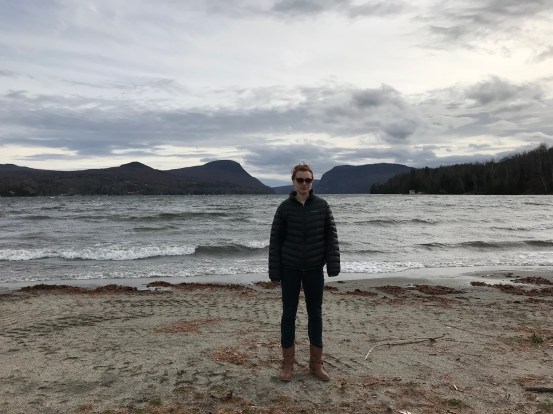
Outside, my daughter asked to go to Willoughby, just a few miles more. On this November day, time was suspended – somewhere in the not-yet-dark spectrum. The last time we had been here was a fine day of hiking and swimming with the cousins.

My mother recently remarked that it’s hard to believe my oldest is all grown up now – or nearly so. Sixteen years ago, I was driving around in an old blue Volvo, delivering syrup, while she chattered in the backseat and pretended to read the atlas. On one of my longest delivery trips, hopelessly lost in a tangle of dirt roads in Waitsfield, I pulled over, grabbed a handful of pebbles from the roadside, and she dropped them one by one into a plastic water bottle, emptied the small stones in her lap, and did it again, all the way home. Not so, now.

Sailors have an expression about the weather: they say, the weather is a great bluffer. I guess the same is true of our human society — things can look dark, then a break shows in the clouds, and all is changed, sometimes rather suddenly. It is quite obvious that the human race has made a queer mess of life on this planet. But as a people we probably harbor seeds of goodness that have lain for a long time waiting to sprout when the conditions are right. Man’s curiosity, his relentlessness, his inventiveness, his ingenuity have led him into deep trouble. We can only hope that these same traits will enable him to claw his way out.

Hang on to your hat. Hang on to your hope.

– E. B. White

IMG_1133.jpg

Lake Willoughby, Vermont

The Shape of A House

In the moonlight last night, with the stars overhead, my daughters and I walked up the hill to our house with a single window lit. Our former house, tall and narrow with a cupola, always reminded me of sailing ship, steady through sunny days and pelting sleet.

Our house now is square, its windows like eyes to the mountains and the valley. Entering feels like greeting the embrace of folded arms.

In the village at night, the houses are alive, even those sleeping with darkened windows. Enter our kitchen door and discover our white tin table strewn with hand-scrawled notes, hair ties, library books, a wooden car my child made, Halloween chocolates. What’s on the tables of all these neighbors, I wonder. Just how fine a photography mosaic all our tables might make.

“In a Station of the Metro”

The apparition of these faces in the crowd;
Petals on a wet, black bough.

– Ezra Pound

img_0193.jpg