Espresso.

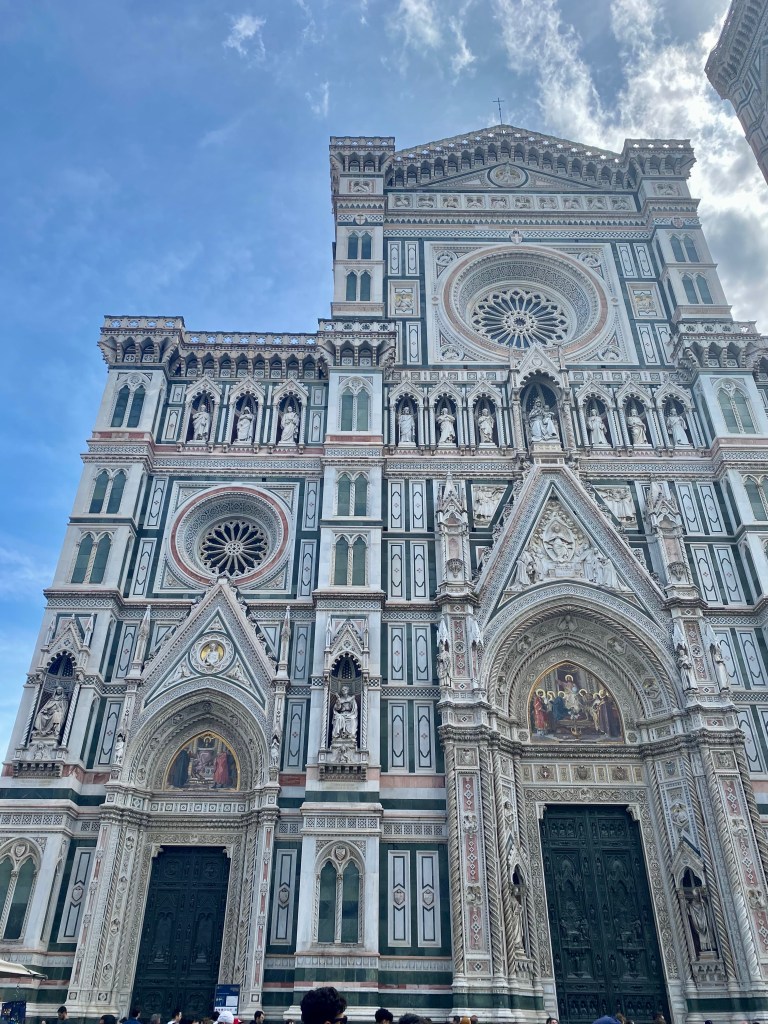
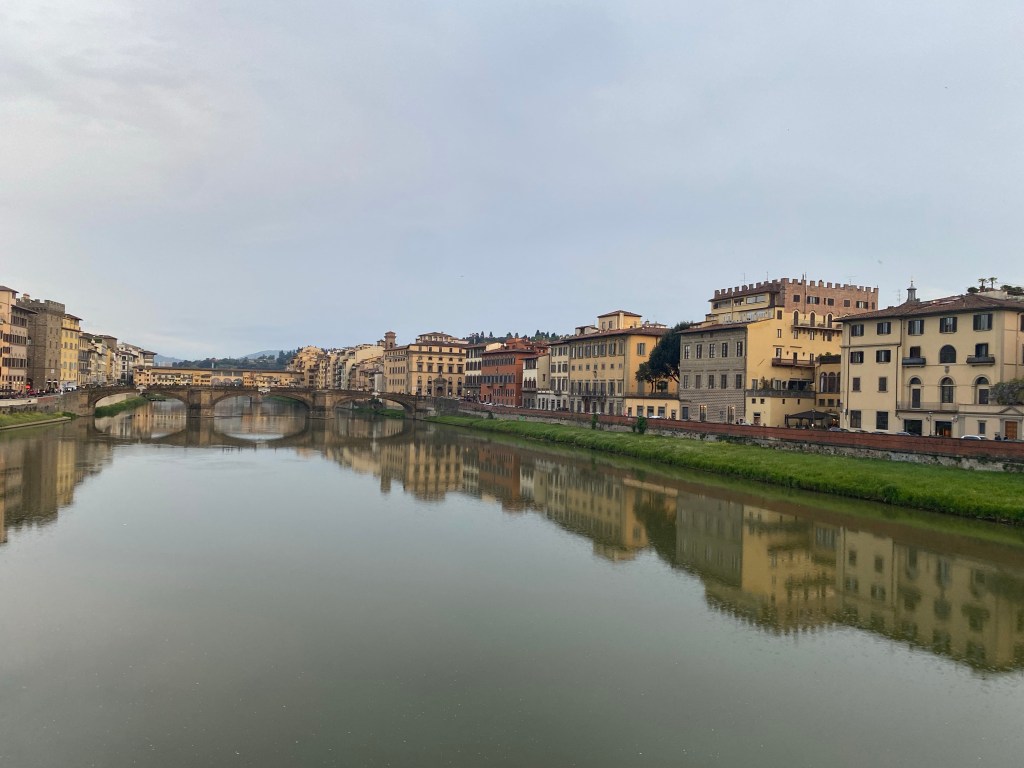
Florence is crammed with tourists. My daughter and I sit on a stone bench in the shade and watch pigeons and people. Midday, we climb stone stairs into the duomo while the organ plays. I’ve never been in a structure like this, such an awesome concert of art and size, art and music. My daughter whispers, You’re going to keep talking about the organ, aren’t you?

Later, we eat pizza. At our table, strangers strike up a conversation with us, give my daughter wine, offer shopping and college advice, and an espresso appears before me. I lift the tiny white cup and drink the brew.
Pigeons.

On the train to Florence, we strike up a conversation with a couple from Australia who are traveling with both their mothers. He’s interested in American universities and chats with my daughter about dorms and loans and degrees. He’s in banking. His wife works from home and hasn’t gone into the office in two and a half years. Sometimes, she says, she stands in the backyard and talks to the birds for company.

In Florence, our windows look over red roof tiles. Pigeons nestle in the ivy.

Cinque Terre, Italy

We leave our dear friends in Switzerland. That morning, we walked in the forest among mighty mountains with their cat.

In Italy, the trains are jammed. We enter the wrong car. In a mixture of languages, people pass luggage back and forth. Lemons bend down tree branches here. We eat creatures from the sea. Such a long way we have come, to this world of color and wisteria fragrance. Cats sun themselves on ancient stone walls.

Paris.

A very long way we have traveled, the youngest daughter and me, stocking up on new sights of very old places, and now headed to dear friends.

In this enchanting, beautiful city, we drink coffee and walk until our heels are bloodied. This enormous world. On a rooftop garden, we discover a snail in a rainbow of blossoms, watch a wedding.

Small Things.

Early April, hot midday sun, I spy a Mourning Cloak butterfly darting over frozen Caspian Lake. The water has thawed blue holes in sporadic places around the shore, but the snow still crumbles into my boots as I follow the butterfly. The butterfly darts into a stand of cedars and disappears. On this afternoon, how lovely the lake lies, just me and the boarded-up summer cottages, the rusting can used for worms or smokes emerging from its wintering over beside a porch post. The ice spreads out in varying ribbons of pale blue and pearl.

On my back through town, my boot avoids the first of miniature grape hyacinths, tiny buds and furled leaves emerging from gravel.

This spring day, Van Gogh is on my mind, his immense talent, troubled mind, these words: “Great things are not done by impulse, but by a series of small things brought together. And great things are not something accidental, but must certainly be willed.”

Monday.

A Whole Person.

Everyone has their own familiar paths and places. This empty stretch of interstate in the Netherlands between Vermont and New Hampshire my daughters and I have traveled countless times now, in all varieties of weather and moods. Now, so many years into this, one daughter is grown, the other on the cusp. My daughters look at my brother and me with a mixture of so many things — what, precisely, neither he nor I need to speculate. Laughing, he suggest to them that he and I equal a full person, our meager strengths and copious broken places complementary. I suggest, Maybe even a little more than one person….

I’m grateful to be invited to read and speak at the Cabot Public Library Tuesday, April 11, 7 p.m. in a real-life deal. Come if you can.

And — definitely worth a read — Matthew Desmond’s Poverty, By America.

Poverty was a relationship, I thought, involving poor and rich people alike. To understand poverty, I needed to understand that relationship. This sent me searching for a process that bound poor and rich people together in mutual dependence and struggle. Eviction was such a process.