Early April, hot midday sun, I spy a Mourning Cloak butterfly darting over frozen Caspian Lake. The water has thawed blue holes in sporadic places around the shore, but the snow still crumbles into my boots as I follow the butterfly. The butterfly darts into a stand of cedars and disappears. On this afternoon, how lovely the lake lies, just me and the boarded-up summer cottages, the rusting can used for worms or smokes emerging from its wintering over beside a porch post. The ice spreads out in varying ribbons of pale blue and pearl.
On my back through town, my boot avoids the first of miniature grape hyacinths, tiny buds and furled leaves emerging from gravel.
This spring day, Van Gogh is on my mind, his immense talent, troubled mind, these words: “Great things are not done by impulse, but by a series of small things brought together. And great things are not something accidental, but must certainly be willed.”
Everyone has their own familiar paths and places. This empty stretch of interstate in the Netherlands between Vermont and New Hampshire my daughters and I have traveled countless times now, in all varieties of weather and moods. Now, so many years into this, one daughter is grown, the other on the cusp. My daughters look at my brother and me with a mixture of so many things — what, precisely, neither he nor I need to speculate. Laughing, he suggest to them that he and I equal a full person, our meager strengths and copious broken places complementary. I suggest, Maybe even a little more than one person….
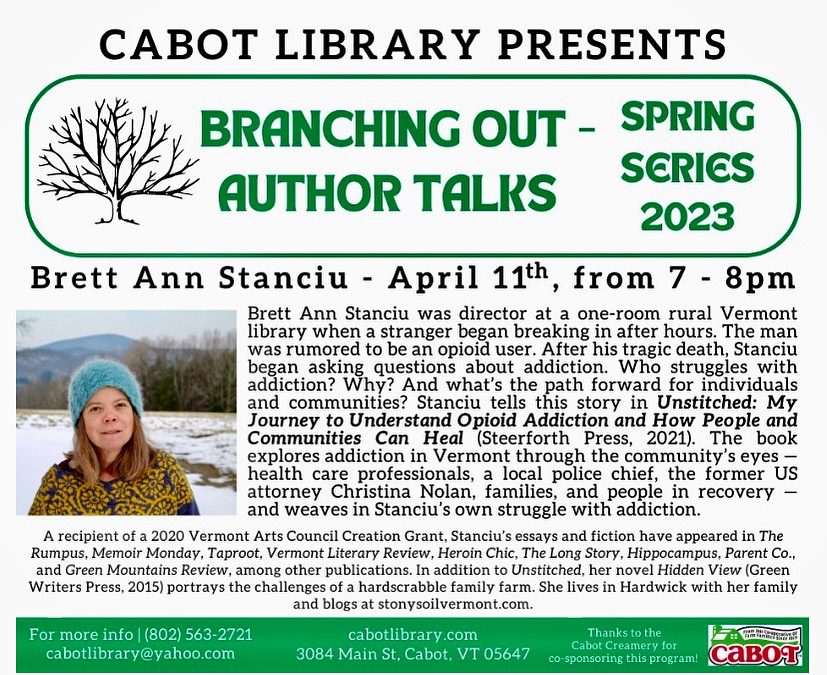
I’m grateful to be invited to read and speak at the Cabot Public Library Tuesday, April 11, 7 p.m. in a real-life deal. Come if you can.
Poverty was a relationship, I thought, involving poor and rich people alike. To understand poverty, I needed to understand that relationship. This sent me searching for a process that bound poor and rich people together in mutual dependence and struggle. Eviction was such a process.
Checking out at the co-op, an acquaintance says she has a question for me. I follow her outside, and we stand in the falling snow, she with her bags full and me with the tomato and yogurt my youngest requested.
Through the snow, the mural across the street glows its brilliant rainbow of colors. Across Vermont, murals have appeared in the past few years, not just in the usual suspect cities — Burlington and Brattleboro — but in places where art seems least expected: a parking lot, or the roadside field in Jeffersonville where cement silos are beautifully painted with an old man sowing seeds, a red clover blossom. Half a decade ago, driving with four young teenagers, I pulled over and we walked around and into the empty cement tubes. Springtime, we splashed through standing water in the hayfield.
Now, snow swirls around us, my favorite kind of drifting snow, magical and full of possibilities. We talk for maybe ten minutes, while I hold that tomato and a paper bag of granola, shivering, while people trudge through the snow around us, buying baguettes and greens and bottles of wine. We’ll find no answers in our brief conversation that picks up those knots of privilege and power, of pretense and betrayal. This far along in our lives, there’s nothing textbook here. The questions shape our lives, the little world where we live.
I suggest a sliver of a solution, a tiny change, a minuscule movement, a small slice of good. By then, I’m shivering fiercely. The night’s falling down, and my small household will be hungry.
It’s been awhile since I did a carpool or handoff along the road — once a mainstay of my life. Seems like I spent hours of motherhood waiting at some designated place. I leave early to have this little pocket of time, a few minutes, no more, to watch the sky darken. I bring a book, too, more out of habit than anything else.
Vermont highways are lonely and busy, with stretches of time where you can walk down the center line, and then times when you risk your life (actually) to walk those yellow strips. The girls are laughing when they arrive. I hand over my daughter’s gloves, warm from my car heater as I tried to dry out the wet remains of yesterday’s skiing. I stand talking, shivering in my sweater. I’m sweaty from skiing, and I’ve forgotten my coat. The girls are busy, busy, happy in a plan of their own, my daughter’s hair still in the braids I wove for her this morning.
The girls drive away. I head back to my car, sliding in my plastic-soled ski boots, and someone I’ve known for years pulls over and asks if I need help. Good lord, I laugh. Because our kids played together as toddlers, I feel I can start right in and so I do. I begin with the bathroom sink drain that I need to take apart, and how does anyone endure the college app process, and am I ever going to remember to clean the inside of my windshield, save for when the sun hits it and blinds me?
I’m really laughing by then, and she is, too. I lean against my car — again, shivering, shivering — while we exchange the usual kid and life updates of people who know each other but sometimes go years without talking. The cold air comes down in this sweet-spot crepuscular moment as the night slowly floods in. She leaves, and I stand for a moment, looking up for the first stars. Such little cares I’ve listed, the stuff of living, blessings more than grievances.
And then I’m on my way, too, leaving the river and road, at least for now.
With our household size decreased, so is our garbage. On a sunny Friday afternoon, I swing by the transfer station with two bins of recycling and a bag of trash. The roving raccoon who appears regularly outside my kitchen door, pre-dawn, apparently found a way into my barn and enjoyed the trash far more than I did.
At the transfer station, I interrupt a woman who’s eating her lunch salad. I apologize, and then I stand at the open window as we kick around a weather conversation for bit — flowers blooming in my garden and all. She tells me she’s headed to Florida next week — not for the winter, but to drive down her convertible and store it at her father’s house. Where he lives, he’s eight hours from New Orleans, eight hours from Nashville, eight hours from just about anywhere worth going. The trash business slows in the winter (something I’d never considered), and she’s looking forward to doing some traveling this winter.
I’m no fan (who is?) of consumption and trash, but the transfer station has a particular allure to me: so many stories here. When I moved from our last house, I negotiated with the transfer station owner about swapping used tires for metal, and what could he offer for two old pickups in the woods? We each held up our end of the bargain we struck.
A flock of juncos settled around my house this afternoon. While I folded up the laundry I had hung on the back porch, I imagined my acquaintance driving south, roof cranked down and the breeze in her hair, speeding towards her dreams.
On some nights, I still believe that a car with the gas needle on empty can run about fifty more miles if you have the right music very loud on the radio.
In the inky pre-dawn Next Mexico morning, my brother and I head back to the Santa Fe airport. He’s done this thing that somehow never hit my consciousness — rented a car like an Air BNB — which has been incredibly helpful. The sunrise spreads over the horizon, more golden than pink, while the three of us stand talking in the parking lot for just a moment. My brother hands over the keys, and then that’s done. The car’s owner leaves.
My brother and I have time. We can walk through the one-room Santa Fe airport in about three minutes — maybe six, including security. A half moon hangs above us. We kick around words for the phases of the moon, and he teases me, again, about what he claims is my overuse of the word gibbous in my first novel. As the wide Santa Fe sky morphs from black to blue, Orion fades.
On the short flight to Denver, my brother and I are separated by a few rows, each of us peering out the window at the Jemez mountains. We’re back in that enormous flow of airline travel, so many people going so many places, all that fuel and pollution eating up the planet. Not very long ago, people remained on the earth. But for these moments, suspended thousands of miles above the planet, I glimpse my brother and I as separate people but indelibly part of this great human stream, traveling to visit our old parents. Around us, everyone moves through their lives and stories.
The pilot ferries us above the mountains and through the clouds. As I walk into the airport, I say thank you, and I mean it.





 Stony Soil Vermont