The Might of Imagination.

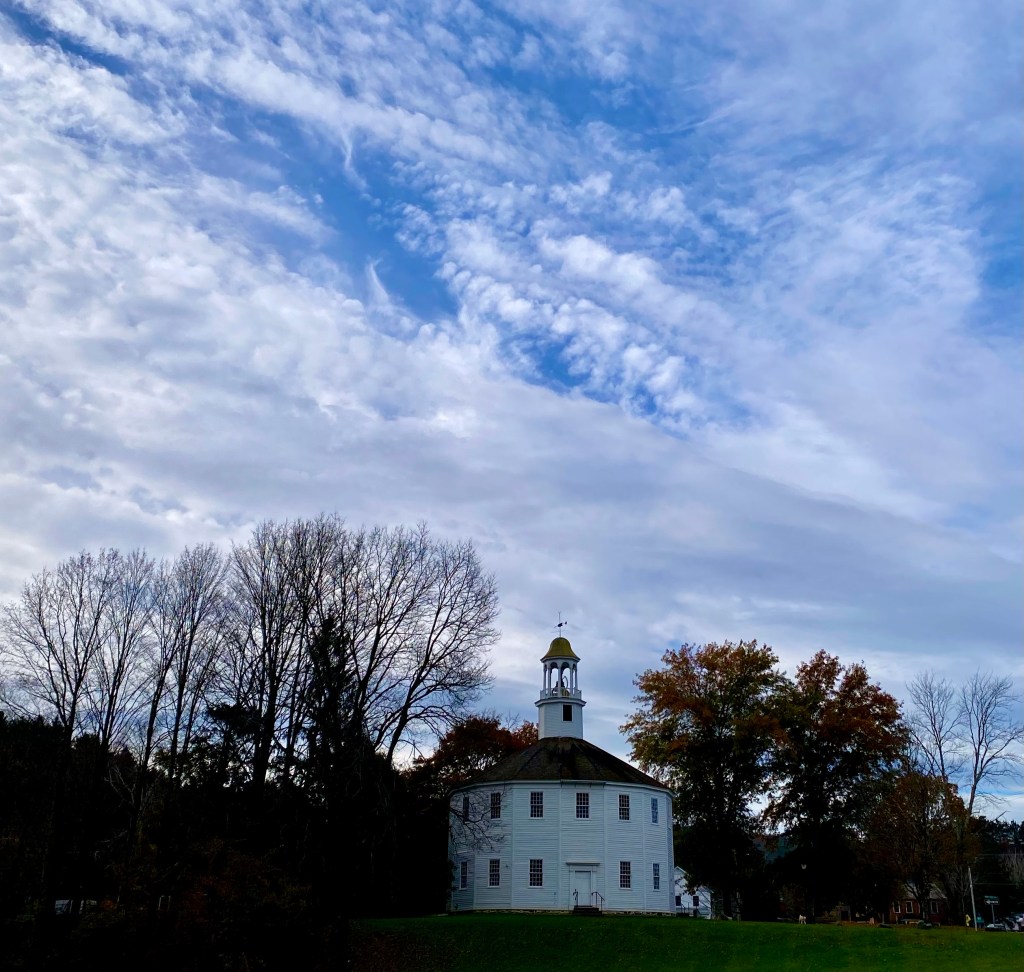
Round Church, Richmond, Vermont

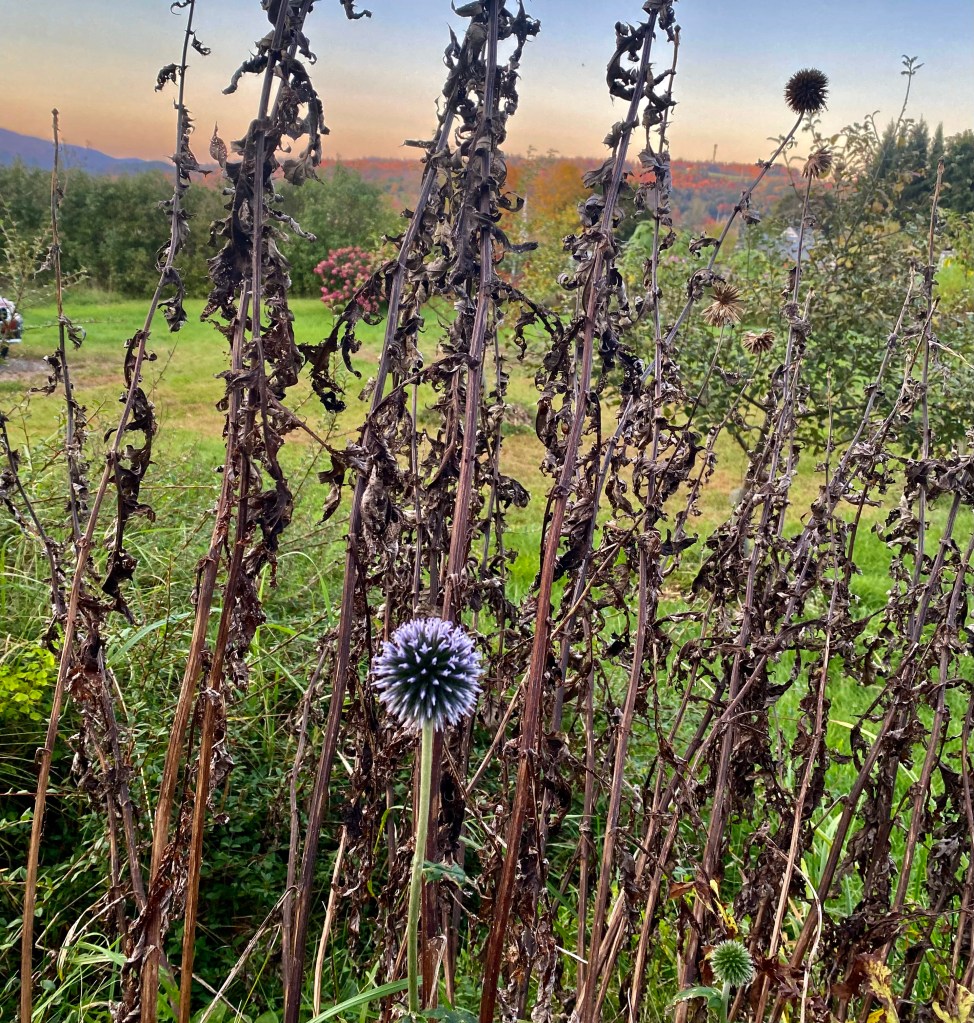
The geese fly overhead in great Vs, chattering in geese-speak as they align themselves, tugging their flock together. In my garden, I rip out the frost-blackened tithonia, the dry fronds of bachelor buttons.

The migratory geese are rhythm, nothing clichéd about their brassy calls. As I steadily work at my annual chores — burying more daffodil bulbs, the candy-like crocuses I’ll happily search for, months from now — I let my body do this work, my boots on the earth, a few spits of rain falling from the clouds, listening, listening.

In the town office where I work, stories surge through, as in any small town. Having lived through scads of my own drama, I know too well how the private seeps into the public, any truth strewn carelessly among chatter. For the most part, I endeavor to do my work and head out; yet, like anyone, I’m always listening, listening, wondering about motive and desire, curious about betrayal and courage, and the ineffable complexities of human behavior. In a conversation with a friend about a couple we jointly know, my friend said, For anyone who’s been following the story, this shouldn’t be a surprise… In a similar vein, I realize I’ve long been quietly following the story of the world where I live.

On my way to visit my daughter, I detour slightly and walk around Richmond’s round barn, shuttered up until dandelion season returns. The afternoon is especially balmy, sunlight bright even in the scarcity of November. I marvel at how mightily humans can create, mixing utility and beauty. How well we can do this.

“Sometimes it seems to me that, in the end, the only thing people have got going for them is imagination. At times of great darkness, everything around us becomes symbolic, poetic, archetypal.”

— Helen Garner
Starlight Walking, a Pause, a Choice.

Walking back from a library program after dark, I cut through the cemetery. The cemetery is unlit, and I’m walking slowly, staring at the Milky Way sprawled overhead, the enormous immensity of the cosmos. In the dark, I hear a cough. I haven’t been paying attention. At first, I think the cough has come from the person smoking on the balcony not far from me, in the house chopped into apartments at the dead-end road, or the people coughing might be around the gap in the fence surrounding the cemetery. I’m headed that way; the gap leads to the woodsy path that will lead me home. That particular place in the path often has trash – Little Debbie’s wrappers and empty Twisted Tea cans.

So here’s the thing: I’m not at all afraid. Despite the village around me, the night is deep. I’m well-hidden, so concealed I stand there thinking, staring up and seeing a shooting star.

I’ve written a fair amount about being a single mother, a broken half, the jilted family, the rage of abandonment. But it’s equally true that I’ve been single for so long now in a society that seems so devoted to coupleness, that I rarely speak of my solitary life. I know very few single parents, at all, for whatever reason. So this night, I do what I’ve taught myself all these years: I drink in my fill of starlight, that piercing Ursa Major hung over the black horizon of the mountains, let her drench me with her power. I make my choice and retrace a few steps, see my friend and her partner on the street below driving along in the dark, friends who would have happily given me a ride, had I asked. But these nights are still balmy and the bitter cold hasn’t set in yet.

The Pouring Glory of the World.

Saturday, I’m on the bridge in Winooski taking pictures of my daughters, in a strange, almost dreamy smoke-tinged sunset, the kind that’s become more par for the course than not these days. The river snakes through Winooski, a former mill town beside Burlington. Such effort has gone into this town, converting mills to upscale housing, the downtown bustling with restaurants that spread onto the sidewalks. My brother asks me if the town is on the rise. Wrong question, I think.

We’re at the end of a day of walking and sunlight. My brother owns a brewery, and so, while it’s been many years now since my drinking days ended, we’ve gone in and out of bars and breweries, and I’m reminded that the bars I once loved were such good places, full of the people and their stories, their weariness and joy, these things that have always tugged me.

Oh Vermont, my beloved state, in the gem of October. Walking through the woods with friends, golden light falls through the trees. Roads defined my twenties, mountains and rivers my decades after that. I’m well aware that living in Vermont, living in my hillside house with one foot in the village, the other hidden in a wild ravine, is a kind of undeserved luck. Yet the rivers, jammed with debris of broken buildings and busted vehicles, human junk, are a visible siren call of so much and so many things.

Sunday morning, we drink coffee and eat cornbread on my back porch, and solve, as my brother says, not one whit of the world’s problems. October: redolent of wet soil, broken leaf. Yellow and scarlet, a finale of gray. The month when the leaves will fall, the world open up.

From Jessica Hendry Nelson’s Joy Rides Through the Tunnel of Grief:

Wonder is accepting what we cannot control, which is damn near everything. This, the pouring glory of the world. It goes in all directions.

The 10,000 Things.

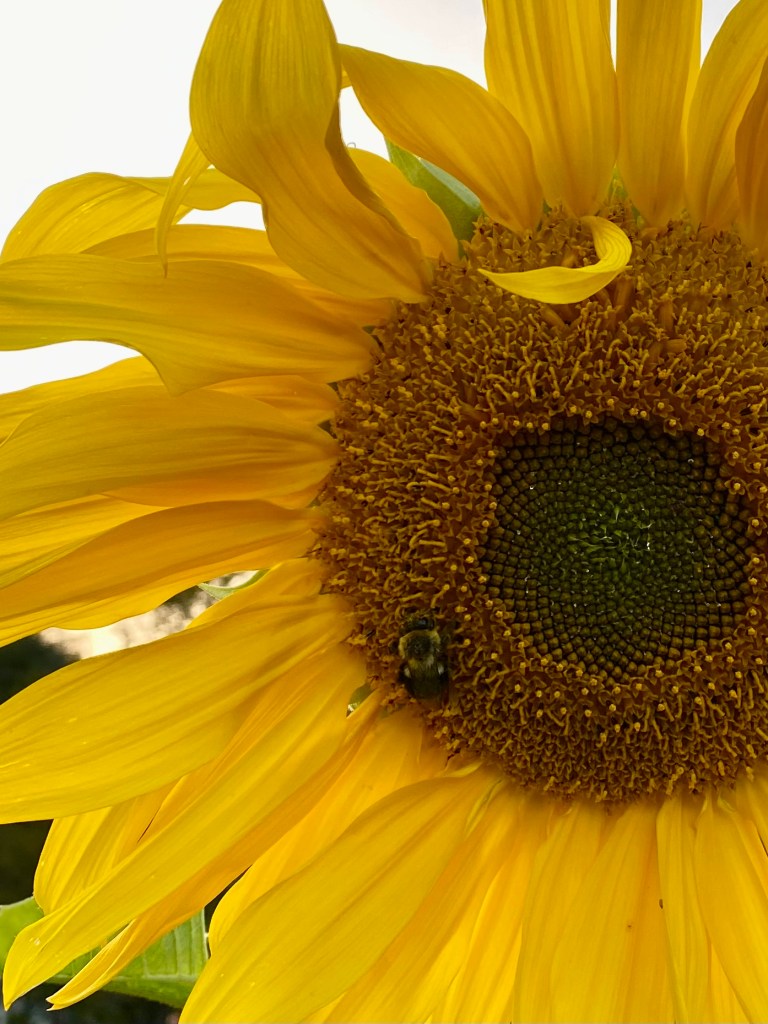
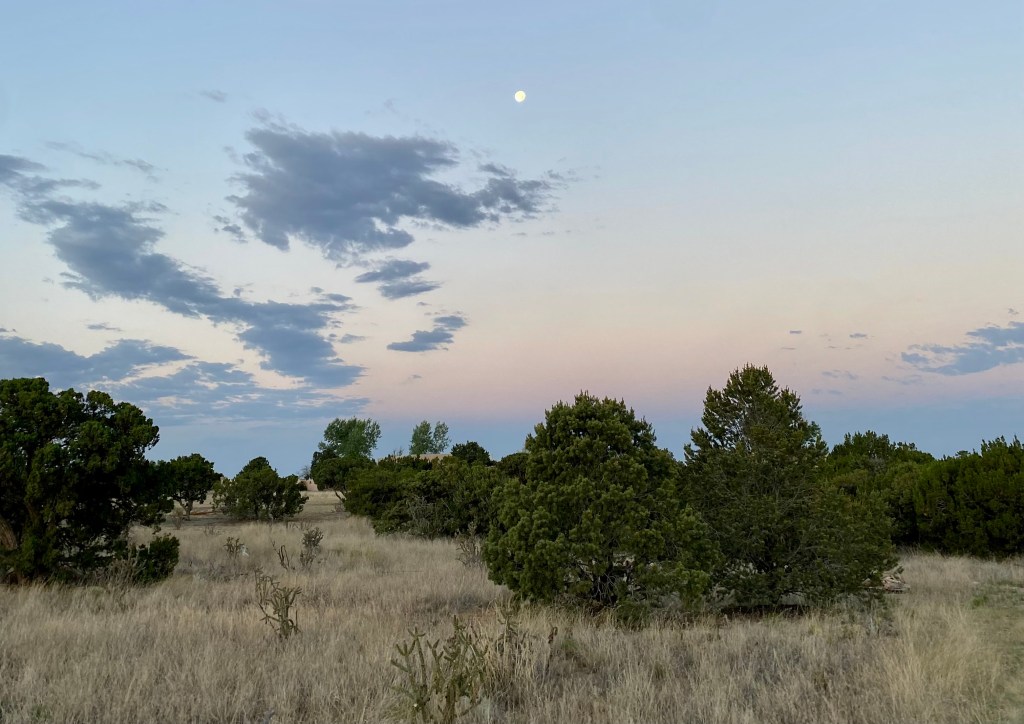
The last night I am in New Mexico, I can’t sleep, so I slip on my sandals and walk. The moon hangs over my parents’ house, luminescent as a giant drop from a sun-shot waterfall. It’s dark yet, a cool-nearly-cold breeze stirring the desert. No human wanders at this early hour. It’s just me and the singing crickets and birds, the sun pushing a golden curve over the black mountains, the desert stirring in a language I have no words for: the rush of lizards and hustle of rabbits, the sharp-eyed coyote and fox, the wild sunflowers silently bending towards the rising light.

So many pieces to this journey — from the shuttle driver who happily counsels a passenger not to rush as “we’re in the Land of Mañana,” to the flight to Chicago where the Brandeis student beside me whispers about her fear of flying, to the stunningly beautiful flight over the Great Lakes through voluminous white clouds. I keep thinking how unworldly, but that word is ill-chosen. Better said would be of this world. Then the brilliance ends as we fly into the soot of the Canadian wildfires. All through this day, I read Lily Brooks-Dalton’s The Light Pirate (the novel Ben Hewitt told me read), this novel about a family and the collapse of our world, and the brutal irony doesn’t escape me for one moment that as I’m mourning and fearing those sooty clouds I’m entirely part of this 21st century….

In Vermont, my daughters greet me with their 10,000 stories and cheerfully announce I’ve missed the two good kayak days through the lily pads. The humid night air stinks of diesel exhaust. In the parking garage, I strip off my leggings. My youngest drives out of Burlington, along the river through the Winooski Valley, and through the state capital. The girls tell me sunflowers are blooming around the statehouse, and my daughter’s dog fell off a dock into a lake (what clumsy dog does that?) and the swimming has been stunning in Caspian, the water perfectly clear.

My youngest tells me about exploring Burlington with her sister. She says she can’t believe how lucky she is to move there this fall.

In this dew-soaked morning, I realize I haven’t missed the hollyhocks’ bloom. Lucky.

…. Seriously, can’t recommend The Light Pirate enough.

Because everything is changing…. We should all be curious about it, because the way we live has to change, too.

— Lily Brooks-Dalton

Lonesome Trails, Amazing Views.

New Mexico is scorching hot. I’m visiting my parents for a few days, and even at nine, ten o’clock, the desert day hasn’t shifted to cool evening. The heat lies thickly. In Vermont, my daughter and a friend head to swim, as heat has moved into Vermont, too, bringing humidity and hail. In the hot desert, I think of the pond where they’ll swim, the cool clean water, the blooming lily pads like buttery jewels on emerald saucers. By dawn, though, a cool breeze rushes over the desert, under the moon.

I’ve spent nearly my whole adult life in Vermont, learning the names of wildflowers and trees, the rhythms of the seasons, how loons dive and surface, the brilliance of the Milky Way in January. In New Mexico, I know far fewer of the plants’ names, but the scent of the desert — the unmistakable piñon — is intimately familiar to me. My youngest years were in this country, so many hours spent in the red sand, collecting pebbles, white quartz. The scent — always near mystical with so much life in this vast space, from lizards to jackrabbits. Add to this, the sweep of the wind in the piñons and sage, that ancient breath.

“May your trails be crooked, winding, lonesome, dangerous, leading to the most amazing view. May your mountains rise into and above the clouds.” 

— Edward Abbey

The Pleasurable Stink of Wet Wool.

Rain begins spitting midday. I’m on a clearing-my-head walk through the forest, and the songbirds are crazily lovely, singing mightily away, simultaneously solo and in concert, and the flowers — my goodness — the flowers. The forget-me-nots trail me like loving, silent cats.

There’s a thousand things going on — that thickening rain, the myriad leaves in ovals and spikes, the blooms and the seed heads. I take the long walk back to civilization, emptying my mind as I go. When I return to the human threshold, there’s a little reluctance to head on back in… I stink of wet wool, the better for these minutes.