October: where are we going?

This weekend cleaves the summer, the marker where the light changes.

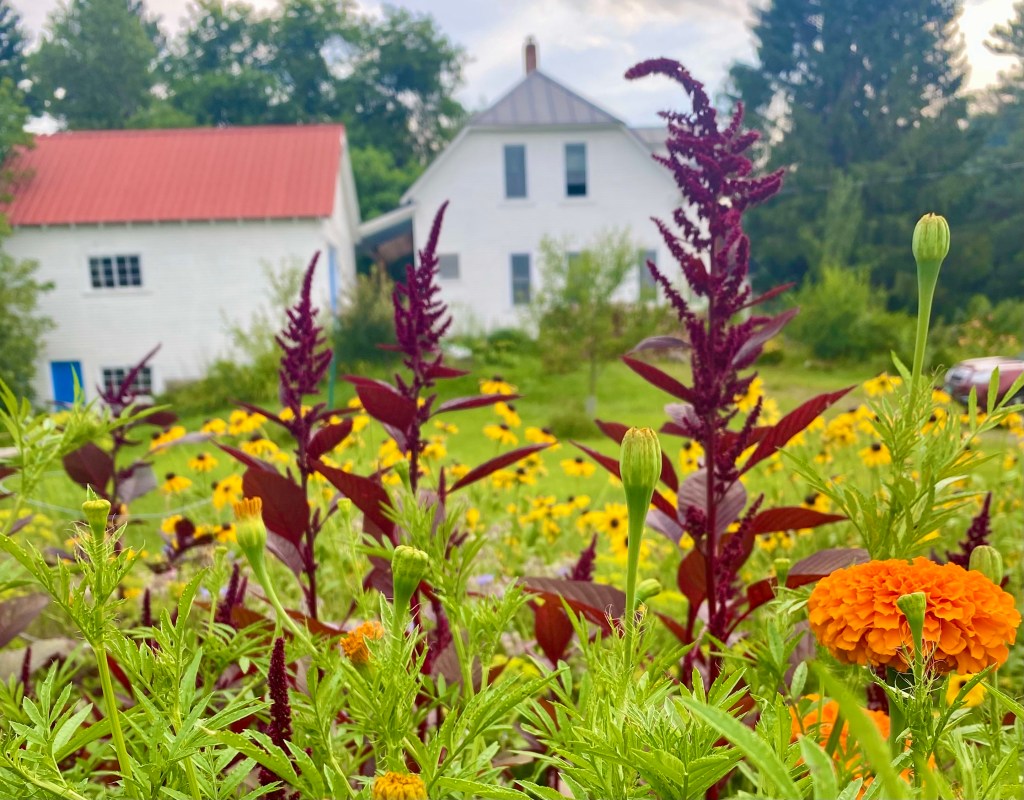
As the leaves drop, the light sharpens and thins. I’ve been here before, so many times, knowing full well how the sun will continue to dwindle. October is a season of brilliant contrasts: emerald hayfields, swaddles of mist, orange remnants of zinnias.

The season mirrors the human realm, too, such a lusciously lovely summer this has been. Now I yank out spent tomato vines, stow away my garden rake and hoe. I gather a handful of kindling, an armful of wood. So much winter, so far to go.

In the co-op’s baking aisle, I run into an old friend, and we chat while her daughter shops. I’m certain we mark different sides of the ballot, but our friendship is hard-tested, solid. Our conversation swirls. Through the window, yellow leaves scatter and leap in a breeze. I lean towards her, listening to a thread of her story.

Change of season is never the same. My youngest daughter tumbles towards womanhood, our lives shift, stretch. Within, always the constants, the long threads of conversation, the joy of the natural world, my ever-present marvel at the world’s flux: where are we going? why? Is it true that other people live these steady, predictable lives? Who knows?

Overhead, those geese, honking their way out of here. And us, here, for now at least.


Each fall in New Hampshire, on the farmwhere my mother grew up, a girl in the country, my grandfather and grandmother finished the autumn work, taking the last vegetables in from the cold fields, canning, storing roots and apples in the cellar under the kitchen. Then my grandfather raked leaves against the house as the final chore of autumn.

— Donald Hall, String Too Short to be Saved
“The apparition of these faces in the crowd…”

In the Albuquerque airport, I’ve tucked myself into a corner, editing a manuscript and drinking coffee, when suddenly I see the small airport is jammed. I pack up my things. In search of my gate, I ask a man if he’s headed to Chicago. “Houston. We’ve been deplaned from the tarmac, twice, and I’m pretty sure everyone here is about to have a nuclear meltdown.” Edging away, I hear a woman cajole her child to “let daddy figure this out.” The ruddy-faced daddy glares at a monitor.

At the terminal’s far end, I join an elderly couple (retired psychiatrists), a pediatric oncologist, and a mechanic who’s hoping to visit his mother before her open heart surgery. They tell me the news of Biden’s withdrawal.

Our plane has not arrived, and we step to one side of the swirling crowd. The oncologist shares that he’s been a fan of Biden. Such suffering in that family, he says; it changed him. The psychiatrists nod, listening. He tells us that his experimental research department received a flood of funding, but that’s all ceased now, with staff layoffs in anticipation of the election. He plans to retire in a few years and return to Botswana to volunteer. I don’t want to be dismal, he says, but the need for help won’t end.

We spy two pilots, admire their youth — but not too young — and gladly note they disappear through a door towards the tarmac. The loudspeaker voice informs us the pilots will have a short meeting with the cabin crew and then we’ll board. We’re not quite sure what that huddle is about — go team? keep the plane in the air? — and the oncologist muses that airports are one of the few places he’s experienced where strangers keep the social fabric together. No one, he tells us, says anything to strangers on D.C. public transportation.

That does not bode well, I think.

Just before we board, we shake hands and wish each other well. All these matryoshka doll layers in us: I walk down the ramp with the sign maker, who confesses his worries about his mother. Like a kind of magic, then, we’re in the air. Hours later, I land in Burlington, Vermont. Under a crimson full moon, I cross the street. The night sprinklers are watering a swathe of grass. All those dark miles of driving ahead of me. At home, the hydrangeas shine in the moonlight, boughs weighted with blossoms touching the ground.

IN A STATION OF THE METRO

The apparition of these faces in the crowd:
Petals on a wet, black bough.

— Ezra Pound

Hand-me-down mud boots.

These few days I’ve spent in New Mexico, my mother is a constant presence and absence. She’s powerfully here, in her sunny kitchen or in the stacks of empty flower pots in the garage. Yet, she’s vanished, too. All night, the desert breathes into this house, sage-sweet wind and coyotes barking and the robin songs here, too, like in my Vermont world. These days, the skies have been layered with lightening and sooty storms, golden sun, the blowing gritty sand that scours my skin to softness.

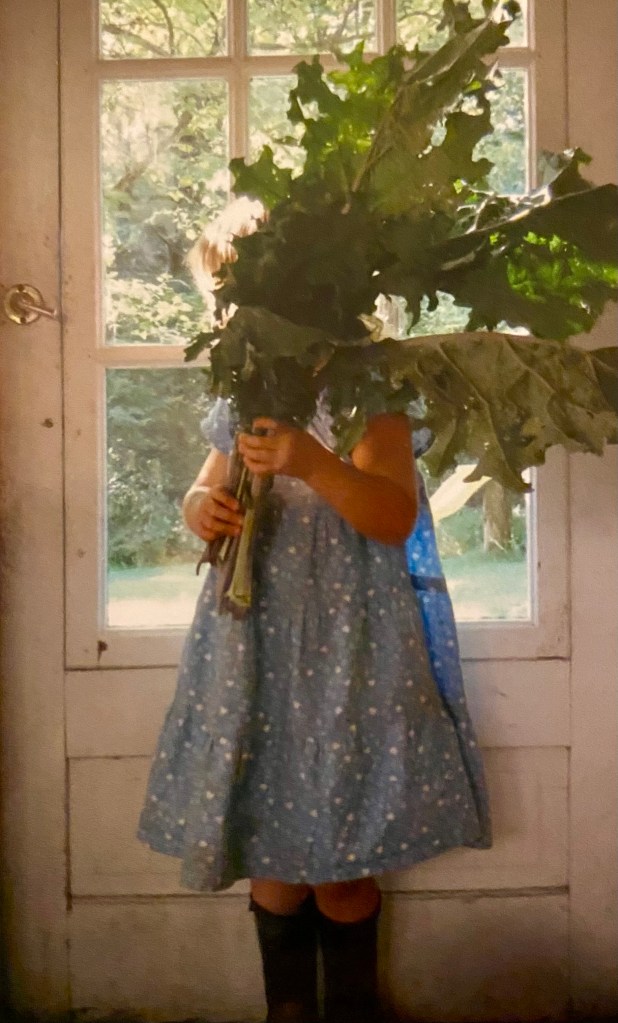
The world far beyond my small family’s sorrows teeters towards deceit and collapse. There’s no inoculation against any spiritual ailment, really. Measles, sure, but never the terrifying largeness of grief or rage, or losing safety or love. Which leads me back to the photo above, my little daughter as she was at our kitchen door, in her hand-me-down mud boots and a handmade cotton dress, carrying stalks of garden-cut kale. A reminder never to sentimentalize or diminish the rugged and real lives we live.

A Pretty Song

From the complications of loving you
I think there is no end or return.
No answer, no coming out of it.

Which is the only way to love, isn’t it?
This isn’t a playground, this is
earth, our heaven, for a while.

Therefore I have given precedence
to all my sudden, sullen, dark moods
that hold you in the center of my world.

And I say to my body: grow thinner still.
And I say to my fingers, type me a pretty song.
And I say to my heart: rave on.

— Mary Oliver

Human chaos, the desert.

Galisteo, New Mexico

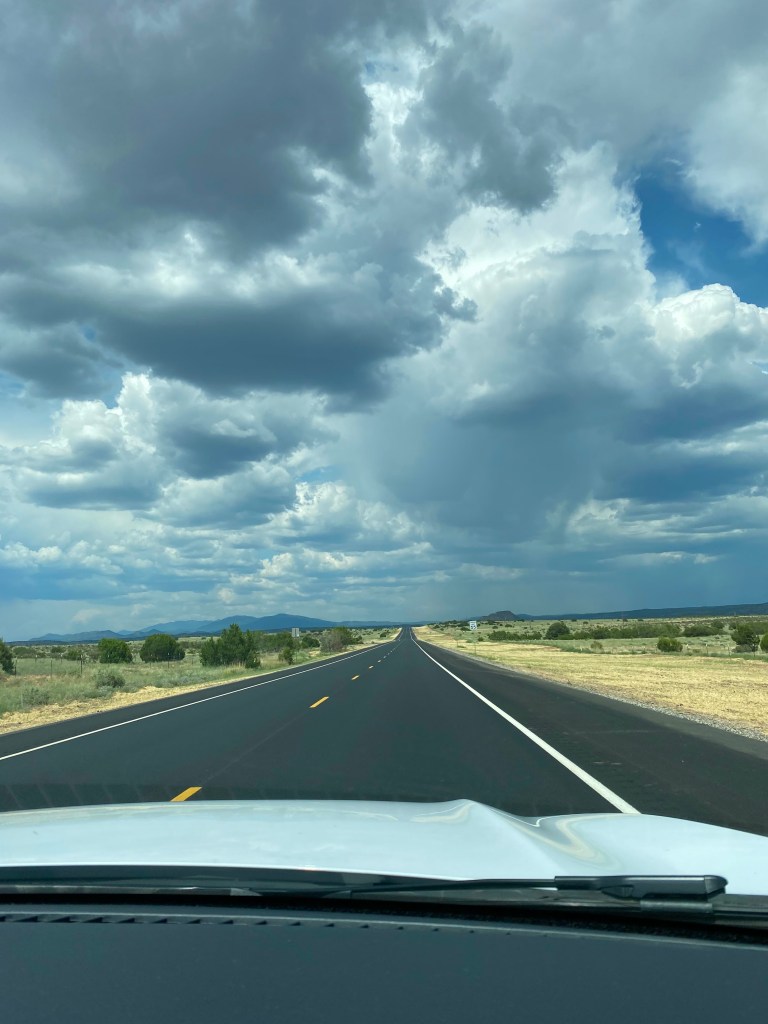
My daughter sends word of rain and more rain in our Vermont world. Meanwhile, on the other side of the continent, visiting my father in New Mexico, we’re amazed by the hues of green. The desert’s rainy this year, too. In the afternoon, I work outside while a storm blows in. In New Mexico’s wide skies, sooty clouds may lower and threaten and yield not a drop of water, blowing elsewhere, breaking or not.

In this quiet, edge-of-the-greenbelt place, news comes to us, the President now ill, an election teetering any which way. We do the everyday familiar things — drink coffee and eat dinner, play cards, talk about my mother’s recent death, about each one of us. After dark, the two girls and I stand outside in the dark in the cool rain, breathing in that ineffably sweet fragrance of the rain-damp desert. Wind shakes the junipers. Here, at fifty, I seem to be carrying a goblet of my life, the wind in the junipers one of the very first sounds I remember as a little girl, so many trips crisscross between Vermont and the desert, the enthusiasm of these young women with me who have seen so much of this world already, so eager they are for more, more of life. Later, when the girls are whispering and laughing in bed, the rain falling, the breeze blowing through the window, I feel that endless ancient desert around me, the calling coyotes, dwarfing for this moment even our human chaos.

Travel in Out-of-Everyday Places.

In the quietest hours of the night, driving by the twinkling line of Santa Fe’s lights in the immense desert, a crimson half moon cupped in the firmament like a bowl full of mystery, I have the strange sense of transmogrifying into a Russian novel. Maybe in part because of the Bulgakov novel from my sister crammed in my backpack with my laptop and half-written notebook, or maybe it’s my family story unfurling simultaneously at lightspeed and also breath by labored breath.

At the Albuquerque airport, the shuttle bus holds just me and the driver who says he’s from the Chicago suburbs. He remarks that I’m shivering and wonders how that can be, as I’ve told him I’m flying back to Vermont. I’m tell him I’m just tired. Perhaps. But the illuminated city and the airport floodlights and mundane directional signs for United and Alaska Air bedazzle my 3 a.m. eyes: there’s so much of the world, so many people and stories braiding and twisting, from the sweet simplicity of a child cradling a beloved doll to an old woman gasping her way to the end of her life.

The driver asks me about the church scene in Vermont. I rattle off about white steeples in every town. Driving incredibly slowly, he launches into his story of knowing that he wanted to be a better man but kept falling into sin, and then a page in the book of his life turned. I can see this is doubtlessly headed to a pamphlet he wants to hand me. Yet, as he speaks, I wonder what that really means: Knock, and Jesus will open the door.

Later, in the terminal, drinking coffee, I sit in a space crowded with strangers, all on their meaningful journeys. My heart swells full with so many things: the robins singing in my parents’ aspen, last night’s dream of wandering through a sugarbush, forest floor sprinkled with spring beauties, the luminous crimson bowl of the moon in the infinite darkness. Nature never builds a door. Maybe those doors and windows we’re forever using as metaphors are illusions.

The driver had forgotten his bag, so the pamphlet was a no go. I take his words and tuck the sliver of his story into my writer’s mind with the hard-boiled egg I’d split down the middle and shared with a young woman yesterday morning. While we ate, she told me about her son’s heart surgery, and the surgeons who saved the boy’s life. With my fingers, I sweep the eggshells into a pile on the plate we’ve shared.

Complex People.

I was on a Claire Dederer reading jag, stepping into her island home, soaking up her kids and her questions and her fierce writing. Witty, smart, edgy. Which led to me to the father of those children and his books. 

Bruce Barcott writes in The Last Flight of the Scarlet Macaw:

 “… a good portion of my life I believed that a law of benevolent action held sway in the world. This law maintained that if you did the right thing and worked hard, eventually things would work out; that the world generally tended towards fairness, decency, and wisdom. But of course the world doesn’t work that way. The people who learn that lesson through crushing experience and still refuse to bow to it astound me. They go on fighting, again and again and again. These people aren’t perfect. They aren’t simple heroes. They are complex human beings. And we need them. Because without them the world would be lost.”