The Swedish Word for Joy.

The dental hygienist tells me about fishing trips to Lake Ontario, sailing far out into the lake where the land was no longer visible. Like the ocean she tells me. You can’t do that in Vermont.

With her gloved thumb, she presses on my lower jaw, my source of infection and misery and a veritable hemorrhage of money. The December before the pandemic, an oral surgeon took a scalpel to my gum and cut. A few days later, my brother and his girlfriend arrived for the holidays. He grilled on the back porch and drank beer while I leaned against the clapboards. In the kitchen, my daughters and his girlfriend cooked and baked.

On his phone, we studied footage of China, closed up and quarantined, back in the days when we couldn’t envision our own streets and highways closed up, the border closed between Vermont and my brother’s house in New Hampshire.

In a world of enormous possibilities, that bone infection is currently on the down low. The hygienist tells me I wouldn’t believe the things she’s seen — fishing, and in the dentist’s office. On my way out, she cheerily reminds me about floss.

Here’s a 100-story of mine published this morning about happiness.

“The ability to tell your own story, in words or images, is already a victory, already a revolt.” 

— Rebecca Solnit
Early Hours

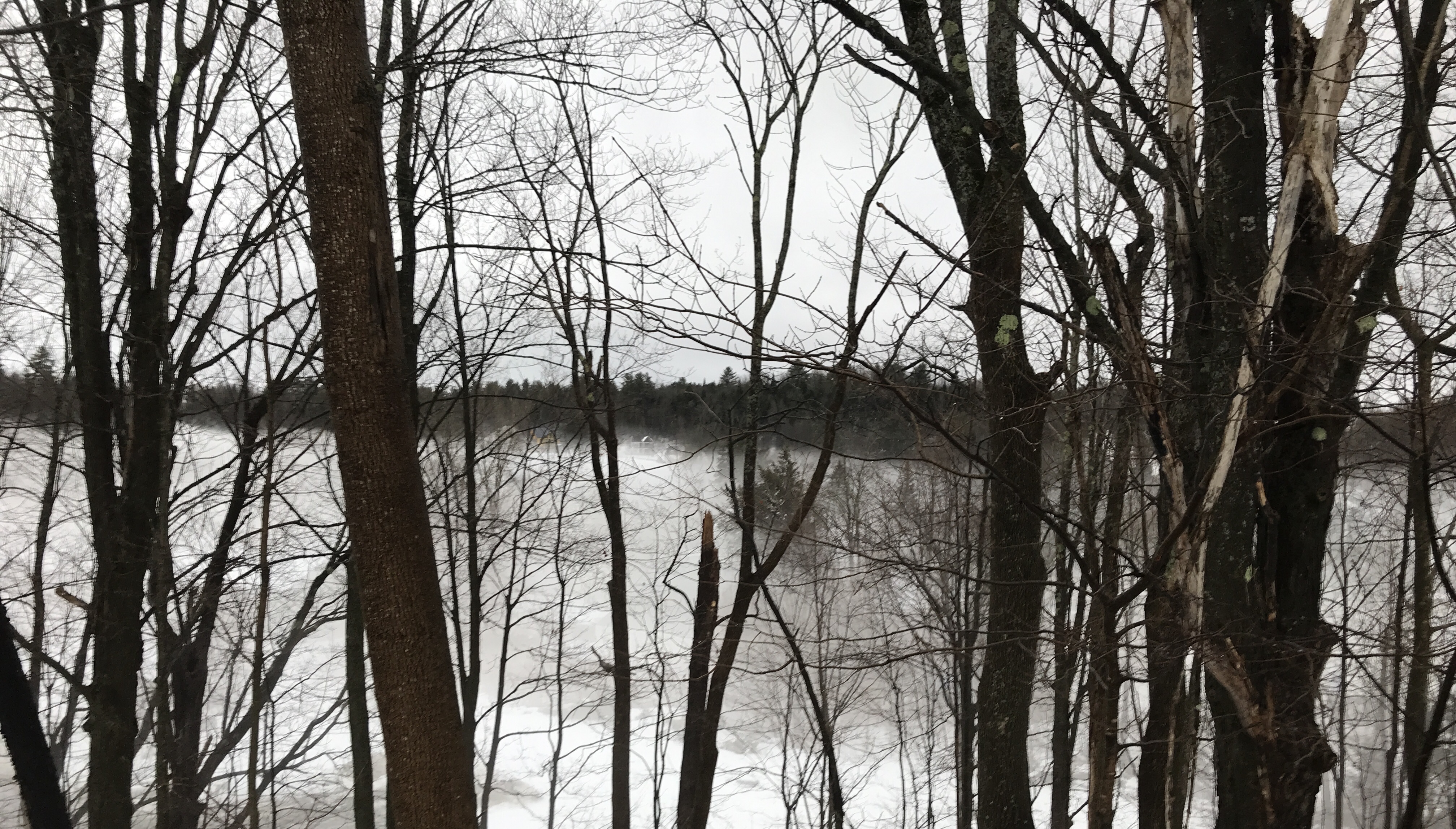
In the night, rain thickens to snow. Wind has washed away yesterday’s balmy temperatures.

The cats and I are awake hours before the girls, myself with that eternally running list and dialogue, the cats warm-pawed and hungry. Satiated with their breakfast, one lies on my legs, the other on my feet, while I read The Perfect Nanny, a book brutal and beautiful.

I parse Slimani’s sentences: How has she written this? How has she put this together? and wonder, Who of my library patrons would read this? 

Ice pelts the windows. Our house is blessedly warm, the kitchen filled with light.

She feels alone with the children. Children don’t care about the contours of our world. They can guess at its harshness, its darkness, but they don’t want to know anything more.

— Leila Slimani, The Perfect Nanny

IMG_0906.jpg

Mist and Clouds

Dinner

The December my youngest daughter was two, snow fell every day – some days just the merest trace of flakes; other days, it snowed and snowed and snowed. By New Year’s Eve, so much  snow had accumulated on the porch and slid off the roof that I had to stand on a chair to see over that barrier through the scrim of visible window. I joked with my older daughter that we lived-in a snow dugout.

One midwinter day that year, I wiggled my toddler into her snowsuit and boots seven times, and then I thought I would never go outside again until spring – a nearly unbearable thought.

The girls come and go with their 12-and-18-year-old lives now. Driving home from work last night along the ancient Winooski, the river that’s flowed through the Green Mountains all through their glacial formation, I thought how one of the trickiest things for me about parenting has been how things constantly change. Baby sleeps through the night; now baby wakes every 30 minutes. Baby crawls, then runs.

And yet…. last night, my daughter who’s rooming at college, walked in while I was chopping cabbage and sat down at the table, hungry for talk and supper.

…one of the worst things about being a parent, for me, is the self-discovery, the being face to face with one’s secret insanity and brokenness and rage.

– Anne Lamott, Operating Instructions: A Journal of My Son’s First Year

Specificity in Writing

Like many people I know, I cut my early reading teeth on Little House on the Prairie, and reading the new fictionalized version of Ma (er… Caroline) brings back the days when reading a chapter in a real, fat book was a very big deal.

The book is an interesting take beyond the troupes linked with each character – blue calico and blonde hair with Mary, a red dress and brown braids with Laura, Ma and the china shepherdess, Pa with the gun, baby Carrie and her beads, even loyal Jack warning his growl – into the grownup terrain of a woman in labor.

At the end, I remembered Jacqueline Woodson saying that she insists her writing students know all stories have a specific place and a time. Not long after the Osage left their land, here’s sometimes naughty, sometimes sweet little Laura taking one last final look at the cabin her father built in a sea of virgin grass, as their wagon rolled away.

The wagon lurched as Charles jumped down, then shuddered with the loosening of the rope at the back so that Laura and Mary could peep out through the wagon cover. For a long moment it was still. The Caroline heard Charles’s footsteps, receding instead of approaching. She did not trust herself to look forward again if she looked back, but she turned. Laura and Mary crowded the small keyhole Charles had made in the canvas. Past their heads, a narrow swath of the cabin was visible.

– Caroline, Little House, Revisited, by Sarah Miller

Hey, Kid!

The other evening I walked by a kid in shorts and a t-shirt crouched down in the mess of road construction on Main Street. What the heck? He was about seven-years-old or so, his hands on a thick stake with a blue triangle flag hammered into the bulldozed dirt.

The little boy was so serious that I stopped and looked back at him. Evening, the workers had long since quit, and no one was around except for cars and pickups on the road. The boy snapped off the stake, immediately put it over his shoulder, and walked down the road quickly.

Slow-thinking perhaps, I didn’t realize what the child was up to, until I saw his yet-serious face glance over his shoulder at the blue flag, and then his fingers came back and brushed the triangle, lightly, without lessening his speed.

The kid was working, doing serious stuff, holding up the veritable imaginative life of the village. So intent he never smiled, he hurried across the street and disappeared around a building, out of my sight.

When we are mired in the relative world, never lifting our gaze to the mystery, our life is stunted, incomplete; we are filled with yearning for that paradise that is lost when, as young children, we replace it with words and ideas and abstractions – such as merit, such as past, present, and future – our direct, spontaneous experience of the thing itself, in the beauty and precision of this present moment.

– Peter Matthiessen

FullSizeRender.jpg

Summer girl

Myriad Things

These summer days, I often work at home, awake and drinking coffee while the girls slumber, and the sun rises and slowly steams off the dew from our croquet patch, the garden, and the town’s rusted metal fence and cemetery beyond.

Yesterday afternoon, my daughter and I walked into the sultry town for another of my meetings at the town library. Some rouge patron had plugged up the basement plumbing, so I shopvacc’ed the cement floor while librarian lifted boxes from the spreading flood. Then we sat outside in the sunlight, nodding to patrons, while she answered my questions about the little library I manage. One patron returned three books, including the novel I’ve written. I restrained myself from quizzing, What did you think?

At home again, in the late afternoon, my daughter picked handfuls of cucumbers from our small garden. While we talked, I made a savory dinner the girls love – peppers, onions, herbs, sausage, tomatoes, rolled into bread dough, coarse-salted and rubbed with olive oil. While the bread baked, we worked in the garden, the half moon rising through crimson clouds over the peak of our house. She was chattery and happy. I love the evenings best, she said.

Poem (As the Cat)

As the cat
climbed over
the top of

the jamcloset
first the right
forefoot

carefully
then the hind
stepped down

into the pit of
the empty
flowerpot

– Williams Carlos Williams

FullSizeRender