Treasures of the Least Likely Kind

Rough-cut diamonds rain on Jupiter: we learn this at a planetarium presentation in St. Johnsbury.

Afterwards, my daughter and our friends walk out of the Fairbanks Museum — one of my favorite places with its collection of local and exotic: freshly picked flowers in season and an ancient clay vessel for wine, Egyptian mummies and Civil War paraphanelia.

And, a fantastic collection of Richard W. Brown’s photographs temporarily on-display, the real reason we had driven to St. Johnsbury that day.

When my younger daughter was three, we had the head rebuilt of a Volvo station wagon we had bought from someone who likely botched the original job and passed the vehicle to us. A mechanic far out on a back road in St. Johnsbury did the work. My three-year-old and I on a beautiful summer day drove along twisting back roads I had never traveled, and ended up at an enormous windowless garage with a single green door at one end. I knocked; no one answered.

Holding my daughter’s tiny hand in mine, I entered and walked through what seemed to be an Alice-in-Wonderland mechanic’s world of room after room of greasy engine parts. I found the mechanic, a man in his sixties, his face and hands permanently hued with that same black used engine oil, in the labyrinth. The inside to my Volvo’s heart he had wrapped in a cloth. He opened the cloth and showed me the shining silver.

I lifted my tiny daughter, in her yellow and red-flowered sundress, a hand-me-down from her sister. He showed my child the work he had done. He and I spoke for a bit, while I wrote a check. As I turned to leave, he noticed my daughter was staring at a tiny plastic horse on a cluttered desk and told me to take the toy for her. He said the horse had been there for a long time and must have been waiting for her.

In a borrowed car, I followed the dirt roads down to the river, then turned left, toward  home. My little daughter sat in the backseat, that horse clenched in one fist, staring through the window at the landscape passing by. In the back was that rebuilt piece of our car, wrapped in clean cloths.

That Volvo has long since passed out of my and daughters’ lives, in the endless way of consuming minerals and money cars claim. My daughter wore that dress for years, until it was far above her round knees. The horse is likely still in our possession, in a treasure box of childhood mementos. And the mechanic? We never saw him again. But I still hold the kindness of a stranger who paused on that July day to wonder what interested a small, unspeaking child.


Scrambled eggs and whiskey
in the false-dawn light. Chicago,
a sweet town, bleak, God knows,
but sweet. Sometimes….

From Hayden’s Carruth’s Scrambled Eggs and Whiskey
39ec7c5d890ce6aca0c29faaef453547_original.jpg

Richard W. Brown


Dinner Chat

My daughter and I are often eating dinner in the lengthening daylight at the kitchen table, just the two of us with the cats under our feet, and my daughter offering bits of her day — if I listen, and don’t press too hard, what she cares about she slowly spills.

Our conversation drifts into what it means to grow. Through our glass doors, I see the box elders behind our house swaying in this spring-is-coming wind, the Vermont winter gradually eroding. So much of my life I sought stasis — the imagined security of here is where I am. In my daughter, I see this same illusion of when I am grownup, as though adulthood is a kind of plateau.

We linger at the table, with the unwashed dishes and evening chores undone. While she speaks, I think, here, now. The wind curls around our house.

Accept yourself: be yourself. That seems a good rule. But which self? Even the simplest of us are complicated enough.

— From Apsley Cherry-Garrard’s The Worst Journey in the World

IMG_1246.jpg

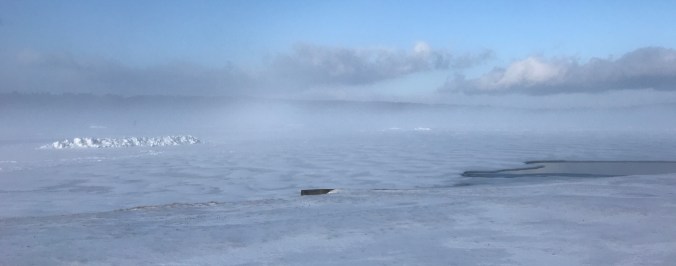
Caspian Lake, Greensboro, Vermont


Reprieve

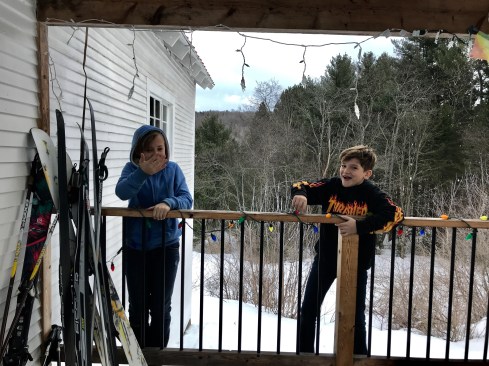
A sunstruck afternoon in February — I opened the windows and aired out the house. The kids jumped off the back deck, ate potato chips, planned building projects we needed to start right away.

A trustee signed off on an email to me, Happy sap run. These are the intimations of sugaring season, the beginning of the thaw and freeze, thaw and freeze. When we first began sugaring, twenty years ago, I believe the thaw would come in a rush and stay. Not so. Thaw and more thaw, studded with bursts of hard cold, slowly melts the frost down deep.

(I had) a revelation the first time I ever flew in an airplane as a kid: when you break through the cloud cover you realize that above the passing squalls and doldrums there is a realm of eternal sunlight, so keen and brilliant you have to squint against it, a vision to hold on to when you descend once again beneath the clouds, under the oppressive, petty jurisdiction of the local weather.

— Tim Kreider, We Learn Nothing: Essays

IMG_1135.jpg

Random February Late Afternoon

With the number of snow days this year, I imagine my daughter will be picking handfuls of peas from my garden when she walks to school in June. The lilac blossoms will hang limply by then, past their sweet prime, fading. No sense mentioning this to her, now.

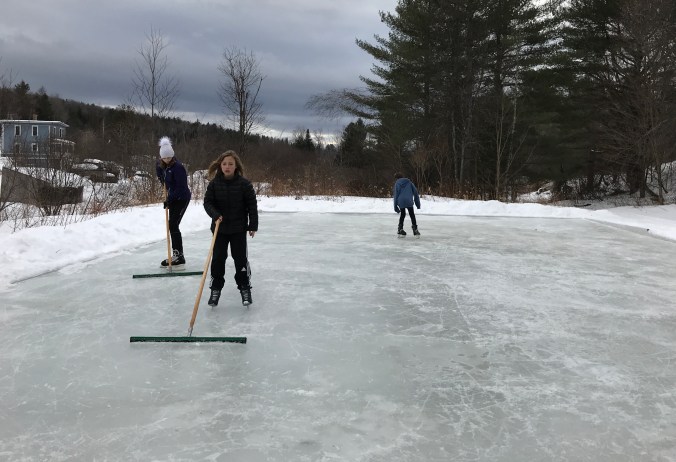
Ice skating at the end of the day, just before the beautiful February twilight began folding around us, the girls’ former bus driver appears from the snowmobile trail where he and his dog had been walking.

He stops to talk to us as I lace up my skates, and points out a nearby house where he grew up. I ask what it was like. He’s in his sixties, and I know he’s traveled, worked in Costa Rice, and returned to Hardwick again.

It was all kids. There were six kids in my family. Everyone had at least four kids. Sometimes a lot more. He stares at the house. Irish Catholic.

I wait. On a night of freezing rain a few years back, he came to the town’s bookstore when I read my from my new novel. Later, picking up my kids at the bottom of our driveway, he told me a particular character reminded him of his father, long dead.

He tells me where the ice skating rink was in those years, stares at the house a little longer, then wishes us a good skate and disappears.

No one else is around. The ice is perfect. Before we leave, we prop the three folding metal chairs and two chairs high in bank, so they won’t get lost in more snow.

Mount Fuji in winter
The sun and stars are big-hearted
and strict.

— Lida Dakotsu

IMG_1095.jpg

The Foul-Mouthed

We talk a lot in our house. I mean,  a lot. The mornings I work at home, I always close my laptop when my oldest comes downstairs, generally holding a cat. This daughter works late and stays up later, while I’m awake hours before January’s dawn appears. Even if only for a few minutes — often while I making more coffee or washing a few dishes — we talk, and much of it is simply my own curiosity. What’s up with you? What’s happening in your world?

What she gets from me is possibly not much, but one thing both daughters seem to be absorbing like osmosis is the interconnectedness of everything. This leads to that which prompts this… and so on. That the past is alive and real, and the future holds a myriad of possibilities.

So when my teenager mentions Trump’s denunciation of shithole countries and asked if I could believe it, part of me said God, yes, I believe it, while another part of me is perpetually shocked by such a fatuous fool as commander-in-chief.

I forwarded her this Chris Hedges’s essay my father sent me, in hopes of widening the thinness of a public high school education. Hedges begins, “I covered the war in El Salvador for five years. It was a peasant uprising by the dispossessed against the 14 ruling families and the handful of American corporations that ran El Salvador as if it was a plantation.”

IMG_0984

Sunday, when we’re lucky to live in Vermont.

Hill Farms

A drawback to easy-access tech is a proliferation of images, everywhere.

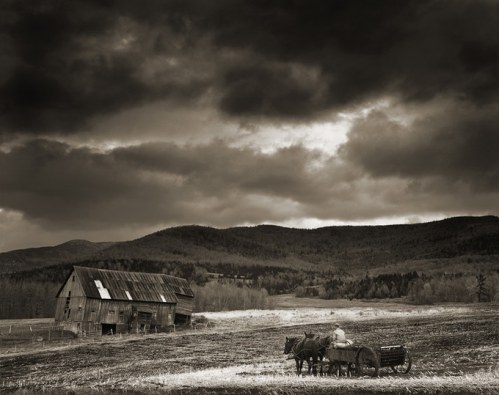
And then, this. From the library, I picked up Richard W. Brown’s The Last of the Hill Farms: Echoes of Vermont’s Past, a stunning book published by Godine, with the most amazing black and white photographs of rural farming Vermont.

Check out page 95, with the moon sailing over a barn’s cupola, righteously high with a cow weathervane, intimating great height over farm fields. Broken-paned, paint peeling,

There it is: that elegant, perpetual juxtaposition of human endeavor and the lasting beauty of our landscape.

A neglected landscape silently gathered the patina of the passing years. Weather stained the unpainted barns and farmhouses the color of tarnished silver and gently bowed their rooflines with the weight of one hundred winters’ snow. Seemingly forgotten by the rush of progress, they aged with a poignant grace: spare, worn, yet, to my eye, hauntingly beautiful.

— Richard W. Brown, The Last of the Hill Farms

IMG_0902