Lilacs!

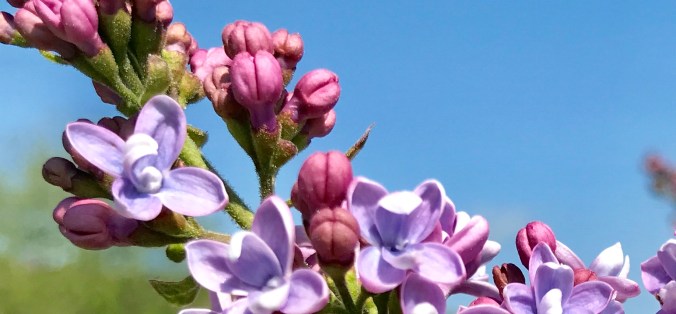
Every morning these days, my daughter and I look to see if the lilacs have opened. Today, today.

Their scent reminds me of some of the best things: early childhood, summertime dinners on the grass, the return of spring.

a scrap of iron–
without fail, menfolk
stop to look

— Uda Kiyoko

IMG_1968


Sweet Sowing

Merry, merry month of May.

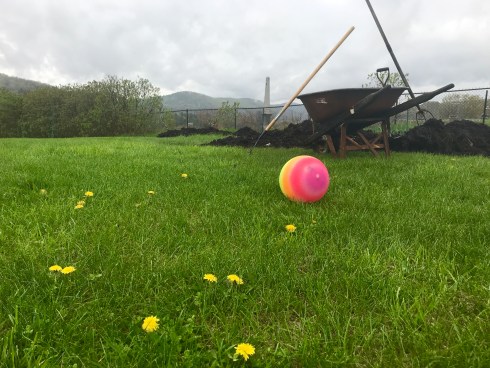
In the middle of the day, I fold my laptop closed and dig in my garden, shoveling away a long rectangular swath of lawn and pitchforking in manure. In May, the grass is emerald with gold coins of dandelions, and the earth is opened-up black, all wiggling worm and grub, potential for a season’s growth. The chickens investigate my wheelbarrow.

Over the cemetery I can see the valley with its greening mountains and the blue trapezoid of the lake held at the far end, glistening.

While I shovel, I think of a line from the movie The Darjeeling Limited my daughter and I have repeated back and forth: We were supposed to be on a spiritual journey, but that didn’t pan out.

How I laughed when I heard that line, thinking it summed up my marriage, and yet the journey spins on. In May, in Vermont, the icy snow that covers my garden has long since melted. The lilacs are near to blooming. A sweet spot at the moment: savor this.

I love the way this country smells. I’ll never forget it. It’s kind of spicy.

— The Darjeeling Limited


IMG_1860


Evening Meet-up

With two 12-year-olds and a giant dog cage in my small Toyota, I drove along the dirt roads in Woodbury, in search of the woman who said she had chickens. Ignore the no trespassing sign at the foot of the driveway, she told me, a warning for burglars. That part of the Woodbury is mountainous in the small, Vermont way, with curved hillsides cupping homes, and lots of clear running streams and glacier-carved ponds.

It was nearly dusk, and she was outside, waiting for us. The girls eyed the chickens, who were not yet in their houses. Waiting, the woman showed the girls her fluffy chicks, and then we went inside. Her house had an amazing floor made from stones on the property. While the girls waited quietly, the woman and I talked about her relatives who had been in the area since before the Revolutionary War. She showed us a photograph on the wall of her distant relative in a Civil War uniform with his wife, who must have native blood.

The woman’s house was filled with dusky light. She was one of my people, a small woman, and, standing, we were eye-to-eye. I could feel the girls getting antsy for the chickens, but they were quiet, saying nothing. This woman had raised three sons alone in a mobile home on this property, and then built a house about the time the boys moved on and began their own families, cutting a deal with her ex-husband’s child support arrears for more land instead of the  money he owed.

The girls petted her lovely black lab. I stood listening to the unexpected bends of her life, to an autoimmune disease and the loss of a job, and then, she said, the chickens saved her life. Began her on a new track. In the descending gloaming, we walked behind the coops and visited her new bees. For a moment I guessed she would offer to take us further, up that steep hillside I admired where she and her son cleared a field.

But the girls edged toward the chickens. The hens muttered, stepping slowly into their houses for the night. We took four, driving out through the sound of the clattering peepers.

Morning glories
enough thatching
for this hut.

— Issa

IMG_1877

Egg

A steady May rain turns up the most beautiful things: bits of green leaves on our two pear trees, the slender stems of lily-of-the-valley, gold coins of bright yellow dandelions in the greenest of green grass. Inimitable green.

Years ago, I drove through hayfields rich in dandelions to take my daughter to preschool. She was four when she first called me on the telephone, her tiny voice over those black lines.

Yesterday, while I was at work, my youngest texts me, just a single line: We have an egg.

I stand there for a moment. I’ve propped the door wide open in the library and opened all the windows. A breeze blows through, sweet with spring air, with that mixture of grass that’s both freshly cut and growing, the way May in Vermont flings itself headlong toward full leaf and blossom.

While two little brothers in the library are chatting at me about Goosebumps books — companionably and nicely — I’m thinking of my daughter in our dim barn, with her four chickens clucking and muttering around her, holding an egg in her left hand.

The Pasture

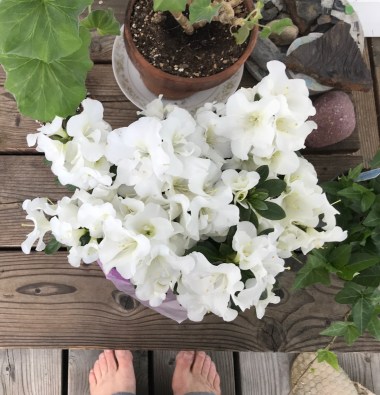
I’m going out to clean the pasture spring;
I’ll only stop to rake the leaves away
(And wait to watch the water clear, I may):
I sha’n’t be gone long.—You come too.
I’m going out to fetch the little calf
That’s standing by the mother. It’s so young,
It totters when she licks it with her tongue.
I sha’n’t be gone long.—You come too.
— Robert Frost
IMG_1869.jpg

Metaphors

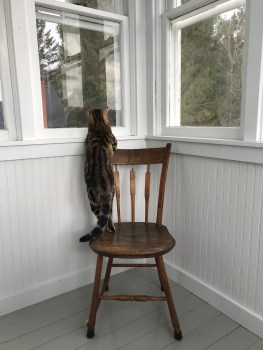
The front of our house has two small glassed-in porches, one on the first floor and one on the second. Since the windows are single-paned, we closed them off for the winter, leaving them as darn cold storage.

Our last house reminded me of a clipper ship, especially under the stars at night, with its tall and windowed cupola. This house, instead, on a hill, reminds me a lighthouse, its windows a beacon we can see all the way down into town.

The cats are happy to have the doors open to other rooms, coffee and laptop a portable office.

Aristotle, on the other hand, saw poetry as having a positive value: “It is a great thing, indeed, to make proper use of the poetic forms, . . . But the greatest thing by far is to be a master of metaphor” (Poetics 1459a); “ordinary words convey only what we know already; it is from metaphor that we can best get hold of something fresh.” (Rhetoric 1410b)

— George Lakoff, from Metaphors We Live By

IMG_1776

Acer on chair courtesy of Ben Hewitt

Separate Travels

When I was a new parent, I mistakenly searched for our family life to even out. Oh, so this is what being a mother is like —  as if our family would steady into evenness. Maybe family life does work that way for some people, but I doubt it. Our life kept changing, because the infants grew into round-kneed babies, who grew into curious toddlers, then little girls who made houses from blankets, and teenagers who rode bikes and shared secrets with friends. Because the very heart of life is change.

And yet, we’re still us, who like to play card games and take walks at night. My daughters are on a trip to the southwest, the two of them on cusps in their own lives, one beginning young womanhood, the other her adolescent years. In the intensity of young motherhood, I never imagined our lives would not so much diverge but widen.

Someone asked my younger daughter if she was afraid to go so far alone. She answered, I’m not alone. I’m with my sister. 

Here’s a (perhaps unrelated) few lines from Tod Olson’s terrific kid’s book, Lost in the Amazon:

Even the naturalists, who spent years studying the plants and animals of the Amazon, never understood the jungle as well as the men who paddled their boats. Richard Spence, the Englishman who marveled at the size of the rainforest, once overhead a native man talking about him behind his back. “This man knows nothing,” he scoffed. “I doubt he can even shoot a bird with an arrow.”

IMG_1709.JPG

Burlington, Vermont