First Train Tickets

My daughter entered nursery school at three-and-a-half, in a sunlit-filled Waldorf school, with a teacher she had known her entire life. Her teacher tied an apron around her back, and she happily sat at a table, with a wide brush and bright yellow paint. She looked up at me and said, probably very nicely, Mommy, you can go now.

I must have looked bereft, because the teacher laughed and told me I could go around the school and look through the window. I considered this. I actually wondered how deep the weeds grew there, if I was tall enough to look in, and if the children might see me.

I ended up sitting in the school’s courtyard that morning.

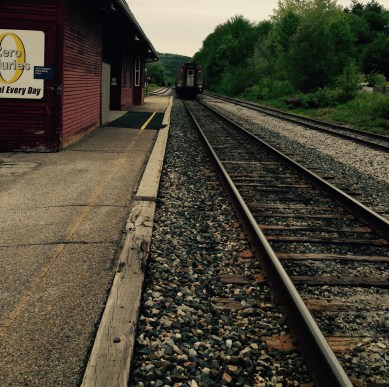
Yesterday, I was at the Montpelier train station with my daughter just about all grown up now, with her boyfriend and their luggage, and we were laughing and joking, as she sat there eating watermelon. In the companionable train-traveling way, a woman joined in with our conversation. On the open-air platform, listening to red-winged blackbirds, the morning was all green Vermont May and enthusiasm for their trip. Then the great silver train rushed into the station, they got on, and I was alone on the platform, watching the receding back of the train with its two lights, the horn sounding at the next road crossing.

I was quite sure they were still laughing in the swaying train.

In my youth, I took so many trips, packed up an old black VW Rabbit and traveled west, and probably thought little of my parents. But standing on that train station platform before heading off to work, already missing my daughter, I thought of my parents, too.

The secret source of humor itself is not joy but sorrow. There is no humor in heaven.

– Mark Twain
FullSizeRender

Montpelier Junction, Vermont


Living the Dream

My friend’s mother has a phrase we repeated when we dwelled in the Realm of Raising Toddlers: after happiness comes tears.

After playing with sand, a spat over ownership of a small red shovel – as if the earth’s continued rotation depended on who held that plastic scoop.

Yesterday morning, I passed my friend’s once-upon-a-toddler driving his Toyota with two bicycles strapped on the roof, while my once-upon-a-toddler drove the opposite way in her Toyota, heading to her final days of high school.

We are long past the short, declarative sentences of small children, deeply into the lyricalness of years upon years unfolding. Punctuation is an illusion – toss it out and let the days and nights unspool….. happiness… tears… a stuffed toy rabbit worn down through affection… mason jars of crimson and gold tomatoes with fat emerald handfuls of basil… children lying on sparse grass beneath a maple tree, staring up at breeze-trembling leaves, wondering….

We’ll never mow the grass, hardly ever
rake the leaves. Adopt a goat for the lawnmowing
and squirt her milk into strong tea….
moonlight clothes snap
out on the line, extended
under stars.

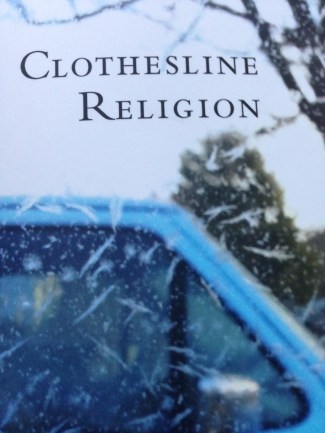
– Megan Buchanan, from “Dreamlife” in Clothesline Religion

FullSizeRender

Stretching Beyond Kidhood

At dinner, my nearly-12-year-old daughter laughs with her friend, dirt smeared in patches on her face – under one eye, at her forehead’s crest – possibly where she’s swatted at black flies, or where she’s lain on the earth this summery Sunday, looking at something I’ll never know.

Over their bowls of rice, the girls plot a run and ice cream, our kitchen where the light filters through the apple tree tinged chlorophyll-green, dappled with shadow.

These girls are in the growing-nearly-by-the-moment phase, long legs, budding breasts. And more – their curiosity digging to matters of the heart, parsing apart their actions and their friends’, trying to unraveling the complexities of human relations. In our conversations, we circle around and around, and I can feel swimming beneath the surface of our talk these two girls grabbing those age-old themes of justice, happiness, heartache.

As I’m cleaning through drawers, discarding what I no longer need or want, her friend gathers a chunky handful of assorted keys and knots them together on a piece of wire. She ties them beneath the seat of her bicycle.

I ask what her plans are, and she answers she’s making wind chimes. The keys clink as the girls pedal away, merry.

I wish it would slow…
I want it all
to last, the chimney falling
back to bricks,
the orchard on its way to bud…

Laura Foley, from “The Orchard on Its Way” in Roads Taken: Contemporary Vermont Poetry

IMG_0854

Elmore, Vermont

Wedding Dress

As little girls, my sister and I played pretend in a pink polyester dress and musty-smelling man’s dinner jacket and clomped around the house in my mother’s high heeled wedding shoes, with the implicit expectation someday our small feet would fit into those shiny and coveted heels.

For my feet, not so. My grown-up women’s feet are size five, my older daughter’s size eleven.

Growing up in the ’70s and ’80s, I believed in a 1950s-framework of a long marriage, two or three children primarily reared by myself as mother, a college education, and a stable and possibly sedate life. It was a vision of life I was doomed to abysmally fail.

While those values lay deeply in my culture, they weren’t particularly in my own childhood home. Unlike every other family in the small New Hampshire town I grew up in, my parents were happiest packing up our old green Jeep and camping all summer on the cheap in national parks west of the Mississippi River. We spent our best hours cooking on a Coleman stove with our kitchen stuff in cardboard boxes, playing Hearts by lantern light and reading used books at the picnic table. “Leave It to Beaver” is a concept I culturally grasp, but I’ve never watched an episode, and I’m willing to bet my siblings haven’t, either.

So when my daughters discovered my wedding dress while cleaning a closet the other day, marveling that its size will never fit either of them, I laughed and told them it was just as well. Each of them can stitch or discover their own attire.

It may be that when we no longer know what to do we have come to our real work and that when we no longer know which way to go we have begun our real journey. The mind that is not baffled is not employed. The impeded stream is one that sings.

– Wendell Berry, “Poetry and Marriage”

IMG_0849

On our way to a performance of “Little Women,” we took a detour. Hardwick, Vermont


Lounging on the Lawn of the Loony Bin

When my older daughter was a babe-in-arms and all through her toddlerhood and young childhood, she and I delivered tiny bottles of maple syrup for wedding favors, usually tied up with ribbon or raffia, with a small slip of colored paper with the couple’s names and wedding date, and a cheery phrase, like Eat, drink & be merry! Or A Sweet Beginning.

With my little kid, goldfish crackers and the Vermont Gazetteer, we met people in  Price Chopper’s parking lot, tony lakeside resorts, or – one of my favorites – outside the Vermont State Asylum for the Insane in Waterbury. The hospital then had locked wards, and the purchaser of maple syrup bottles came down and met us on the grass. She was on her lunch break and had time to chat. I offered that my mother is a RN, and had amused us as children with her nursing school stories of the woman in the state asylum who swallowed spoons.

My daughter, who was four, looked up at me, completely puzzled. Why?

The woman and I laughed.

Of all the people who bought my wedding favors, this woman is the one I wonder about. We lingered on the grass that day, the sheer expanse of tended lawn a novelty for my child and I. This woman was happily getting married in a few days, and I took my child to a playground that afternoon. There were not enough playground trips in that girl’s childhood. Maybe that’s one of my few pieces of advice to young parents: more playgrounds. Linger barefoot on the grass. The strangeness of people who devour spoons doesn’t disappear.

The American way of life has failed – to make people happier or to make them better. We do not want to admit this, and we do not admit it. We persist in believing that the empty and criminal among our children are the result of some miscalculation in the formula (which can be corrected), that the bottomless and aimless hostility which makes our cities among the most dangerous in the world is created, and felt, by a handful of aberrants, that the lack, yawning everywhere in this country, of passionate conviction, of personal authority, proves only our rather appealing tendency to be gregarious and democratic. We are very cruelly trapped between what we would like to be, and what we actually are. And we cannot possibly become what we would like to be until we are willing to ask ourselves just why the lives we lead on this continent are mainly so empty, so tame and so ugly.

– James Baldwin

FullSizeRender

Waterbury, Vermont

Kid Chat

The May my younger daughter was born, rain fell every day, from May 1 to May 31. At the beginning of June, cornfields sprouted shoots of green, and the summer turned sweltering. We are yet in the rainy phase. Everyday, my daughter, now nearly 12, claims the apple tree leaves unfold their leaves noticeably wider. Fragrant blossoms and pollination are imminent. This girl changes, too, on the tender cusp of childhood and adolescence, past the why stage of toddlerhood and wondering at the pieces and people in her life.

The other morning, she asked about a church’s billboard sign: Jesus was a low-wage worker. She asked what Jesus did; I answered he was a carpenter, not a low-wage job in our town. Then what does the sign-writer mean? We wonder, who’s telling this story, anyway? The story of Jesus? The story of our town?

Then we were at her tiny school, the handful of graduating sixth graders wild about their trip to Maine, nearly trembling with excitement. On my way to work, I stopped again at that sign, pondering its existential statement. Rain fell lightly, and I sank my fingers into the church lawn’s soil, glad to see grass for the first time this year, long as my fingers.

….art and ideas come out of the passion and torment of experience; it is impossible to have a real relationship to the first if one’s aim is to be protected from the second.

– James Baldwin

FullSizeRender

Hardwick, Vermont