Heart in the Hand

When my husband and I bought our first house, I intended to live there forever, unpack my two cast iron skillets, have a couple of kids, dig a vast garden, and stay. Then there’s that Robert Burns’ line John Steinbeck retooled, and maybe I should have reflected that line might encompass the lives of women, too…. The best laid schemes of mice and men…. and so on.

Luckily, what I perceived as plans awry has evened out – at least for now. Intrepidly exploring the terrain of where we’re living, I realize, again, just how corporal our lives are, how the angle of light through the kitchen window – whether wide open or filtered through mist  – shapes the kernels of our days. Walking through the dusky forest with three girls last night, the muddy path surrounded by August’s copious greenery was all alive, alive: pencil-thin snakes, slugs, a darting rabbit, Cooper Brook running over its pebbles, shallow and clean. As we entered a field of goldenrod and chicory, crickets sang wildly, lusty in the heat of summer.

Simultaneously, I’m re-entering the landscape of the heart through my own daughter stepping into her young adulthood. What a bodily world is love. Those well-made schemes? Perhaps that’s what makes our lives so fascinating – our clever designs, and the universe’s unfolding and rearranging of our blueprints.

A summer river being crossed
how pleasing
with sandals in my hands!

– Buson

FullSizeRender

Mason-Dixon

The summer my nephew was 10, my daughters and I spent a long piece of the summer with his family in Charlottesville, Virginia. We were visiting because of family illness, and so it was me and the kids and a palpable uncertainty and unhappiness, and sweltering days and nights – and, since we are this kind of family, we laughed a lot, even at things that may not have been hugely funny. The four kids and myself explored the surrounding woods and the downtown, and my nephew – a boy hungry for history and stories – offered a near nonstop commentary about his hometown’s past. My own daughters, who’ve lived in woodsy Vermont all their lives, were mystified by the sprawling historic mansions, the prolific Civil War statues, the presence of the past.

In one long ramble, my nephew mentioned the War of Northern Aggression –  a name never mentioned in my New Hampshire public schooling. He was stunned I’d never heard the term.

Really? he asked.

Really. Like that, I was ashamed, suddenly seeing this sticky and different place more foreign and infinitely more complex than I’d imagined. The statues, the big houses, my nephew’s intricate stories were but keyholes, tiny slits into a titanic past.

And one day we must ask the question, “Why are there forty million poor people in America?” And when you begin to ask that question, you are raising questions about the economic system, about a broader distribution of wealth. When you ask that question, you begin to question the capitalistic economy.

– Martin Luther King, Letter From Birmingham Jail, 1963

FullSizeRender.jpg

First Star I See Tonight

Dislike of burning fossil fuels notwithstanding, I love driving through the White Mountains, this journey from my brother’s house to mine. Last night in the crepuscular light, my feet wet in sandals from kayaking, my 12-year-old daughter quiet beside me, we wound through the granite mountains as dusk fattened into dark.

Just before we left, my brother and I walked through his house, talking, feeding his dogs leftover bits of dinner. My brother remarked how much he remembered this one particular hike we took as kids on countless Saturdays: in black-fly spring, humid summer, autumn’s splendor. We saw a snowy owl, an opossum in a tree hanging by its tail, scads of wildflowers, a few other hikers.

Driving through that gorgeous sprawl of granite and forest, white-clapboard towns and curvaceous river, with the sky morphing from blue to onyx by our evening’s end, my daughter and I talked about little things, her hands around glass my brother had given her from his brewery. Playing music from her teenage sister, she asked if I knew a particular song she didn’t: AC/DC’s Highway to Hell. Sure, I knew that one.

Through all the other junk in my head, I realized about the time we saw the first single star poised over a St. Johnsbury steeple that the infinity of childhood hiking – through days laughingly glorious and those heartless ones when we bickered and were terribly out of sorts – braided in one long inseparable whole, as sacred as I’d ever get in this earthly realm.

Will my daughters, looking back on their childhoods filled with both love and grief – as we all come to, in some variation of measure or another – see the same? Perhaps that actually may not matter. Maybe the journey together will be sufficient.

that midsummer night…
the cold moon
fills my whiskey glass

– Chenou Liu

FullSizeRender

Sacco River, New Hampshire


Hey, Kid!

The other evening I walked by a kid in shorts and a t-shirt crouched down in the mess of road construction on Main Street. What the heck? He was about seven-years-old or so, his hands on a thick stake with a blue triangle flag hammered into the bulldozed dirt.

The little boy was so serious that I stopped and looked back at him. Evening, the workers had long since quit, and no one was around except for cars and pickups on the road. The boy snapped off the stake, immediately put it over his shoulder, and walked down the road quickly.

Slow-thinking perhaps, I didn’t realize what the child was up to, until I saw his yet-serious face glance over his shoulder at the blue flag, and then his fingers came back and brushed the triangle, lightly, without lessening his speed.

The kid was working, doing serious stuff, holding up the veritable imaginative life of the village. So intent he never smiled, he hurried across the street and disappeared around a building, out of my sight.

When we are mired in the relative world, never lifting our gaze to the mystery, our life is stunted, incomplete; we are filled with yearning for that paradise that is lost when, as young children, we replace it with words and ideas and abstractions – such as merit, such as past, present, and future – our direct, spontaneous experience of the thing itself, in the beauty and precision of this present moment.

– Peter Matthiessen

FullSizeRender.jpg

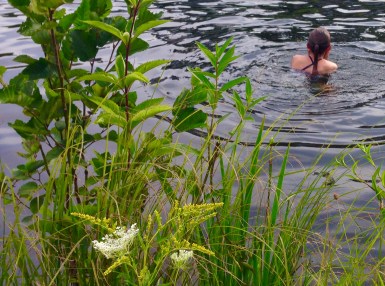
Summer girl

Far Travels

Here’s something I never told my daughters: the summer I was 19, the hitchhiking tour of New England my then-boyfriend and I took ended in a convertible ride from Springfield, MA, up I-91 to Brattleboro. The car was an enormous old beauty from the 1950s, and the boyfriend sat up front and talked nonstop with the driver, an ebullient pilot of his darn cool car. I sprawled in the back, the wind wildly noisy, holding my hair out of my face with both hands.

I was 19, in lust but not in love with the boyfriend, and I knew I wouldn’t marry him, as he doubtlessly knew he would never marry me. But we were both at that age of no longer child but not really adult, and we were madly in love with the world, with just the sheer possibility of living.

Every now and then, I think back to my younger self, flying up that interstate in a stranger’s car, my legs stretched out on the red leather seat, with no seatbelt tethering me in, admiring all that sky gradually darkening into a bloody July sunset.

I wear seatbelts now. I never hitchhike. My daughters sleep under a solid roof, in a well-built and deeply insulated house. My older daughter is 18, and I think of this story sometimes when she’s headed off with her friends. I say the same things my parents said intently to me, Drive safely. Keep your eyes open. Come home.

I stand in the doorway, watching her leave. What are you doing? she asks. And when I say, humor me, humor me, she’s gracious enough to do so.

It’s lovely to live on a raft. We had the sky, up there, all speckled with stars, and we used to lay on our backs and look up at them, and discuss about whether they was made, or only just happened…

– Mark Twain, The Adventures of Huckleberry Finn

FullSizeRender.jpg

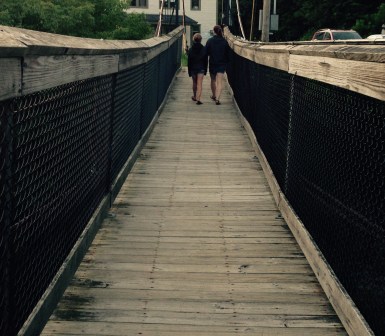
Sisters.


Crossing Open Water

My canoeing experience, while somewhat lengthy, has always been confined to summery, pleasurable afternoons, on Vermont’s still lakes and ponds, often with swimming and almost always with kids. Only once, on my honeymoon, did I worry our canoe might flip.

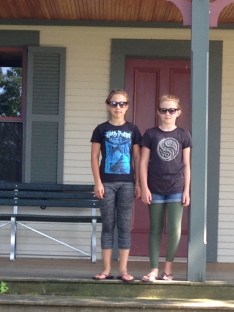
Oddly, I found myself on nearly those same waters in Lake Champlain this weekend, worrying again if I might roll the canoe. While the two cheerful and sunglasses-wearing 12-year-old girls waited for the ferry, I headed out to an island with a canoe loaded low with camping gear, not looking closely at the lake – a very large lake – rough with wind, torn up with the furled wakes of motorboats.

After I spun around, I gave myself a rapid crash course in reading the water washing near the low sides of my canoe, keeping my prow headed into the waves – those long curls might have delighted me swimming near the shore but frightened me with all this water around. The silver ferry passed by with my smiling girls, waving merrily in the sunlight.

On the return leg of the journey, after a few days of bicycling and card playing on an island magical with fiery sumac and twining vines, the water lay invitingly still, just me and the ducks and few gulls cavorting overhead.

It was then, on that crossing, that I remembered the children’s father and I had paddled in a rainstorm to this same stretch of beach, from an island further out, in a canoe we had borrowed from his parents that had no lifejackets. In a different version of my life story, I would have taken the ferry with the girls and he would have rowed the canoe – much stronger than myself and far savvier at reading wind. He would not have gotten stuck on the far side of the island as I did, and struggled against the current to round the rocky edge.

As I rowed, the lake lifted against my old red fiberglass boat, all that deep blue water, stretching far further than I could imagine, filled with darting fish and frond-waving plants, the shale-splintery islands, boats with white sparkling sails, sunlight profuse, with sunken ships and ancient fossils. I had been reading David Hinton’s The Wilds of Poetry, filled with narrative and a collection of stunning poems, from Rexroth to Robinson Jeffers, a stonemason apprentice who built his house at Carmel-by-the-Sea, all about motion and change. Kismet reading for sleeping on an island. I imagined how the gulls might see me, a small woman with a braid and a wooden oar with a broken handle, rowing home with a basket of dirty clothes, crumbles of crackers, softening cheese, a coffee pot and an unfinished sweater on knitting needles. I could not have wished to be anywhere else than there.

On the mainland again, I unloaded the canoe and walked along the high bluffs, waiting for the ferry. The wind was picking up then, and the day, the first of August, was bright with promise. The grass could not have been greener. I read the heartbreaking memorial marked for the boys who had died in the Second World War and then leaned against a bent cedar tree, one small woman in a landscape beyond time, myself just one living piece of its infinity.

When I met the ferry, its captain asked if the two girls alone were mine. Yes, indeed, I said and walked onto the rattling gangplank to greet them.

I have tried to write Paradise

Do not move
Let the wind speak
that is paradise.

Ezra Pound, from Cantos in Hinton’s The Wilds of Poetry: Adventures in Mind and Landscapes
IMG_1490