Hardwick Postcard #7: Middle School

At the middle school concert’s intermission, my merry-eyed daughter sat behind me with a girl I didn’t know, so I turned around and introduced myself. Being 12, the girls laughed at this weirdly formal introduction, and then the couple beside me began laughing, too. I had been sitting beside the girl’s parents.

It’s a little world we live in.

I chatted with the new friend’s parents. Quickly, the girl’s mother and I realized we had both served on an elementary school board. The lights dimmed just as we started a conversation that could have launched into a very long conversation about school consolidation.

For all its myriad faults, public education — at least in Vermont — is still all about the local community. Chances are, at a middle school concert, you’ll sit beside people you like, and, equally possibly, besides people you don’t.

But you’re all still there.

My father sent me this Wendell Berry essay. Read it.

In 1936, moreover, only a handful of people were thinking about sustainability. Now, reasonably, many of us are thinking about it. The problem of sustainability is simple enough to state. It requires that the fertility cycle of birth, growth, maturity, death, and decay—what Albert Howard called “the Wheel of Life”—should turn continuously in place, so that the law of return is kept and nothing is wasted. For this to happen in the stewardship of humans, there must be a cultural cycle, in harmony with the fertility cycle, also continuously turning in place. The cultural cycle is an unending conversation between old people and young people, assuring the survival of local memory, which has, as long as it remains local, the greatest practical urgency and value. This is what is meant, and is all that is meant, by “sustainability.” The fertility cycle turns by the law of nature. The cultural cycle turns on affection.

Wendell Berry

IMG_0622.jpg

Main Street, Hardwick, Vermont

Hardwick Postcard #1: Start Here

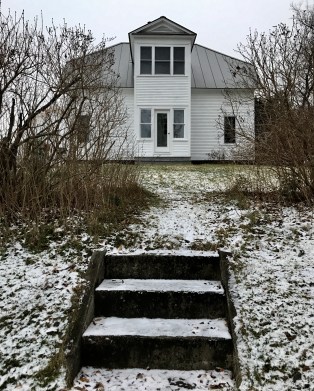
The front steps from our yard to the street reflect a time when people walked more. These days, the walkers in town are mainly kids and adults who, for one reason or another, don’t drive.

When I closed on the house, my older daughter was a high school senior who hardly seemed to attend school, so she came, too, on a hot and sunny June day. We’d known the sellers for years, and, as the closing was slightly delayed, we had some time to laugh. The electric company was switching out the poles in front of the attorney’s office, and the power was going to be shut off. We had a back-up plan to move across town, as modern closings need electricity, and  we tossed around the idea of using the library’s wifi on their front stone steps.

Afterwards, my daughter and I walked around the empty and freshly-painted house. Roses bloomed under the front windows that somehow, in all my examination, I had failed to see.

We hadn’t moved one thing in, still walking around barefoot in the sunny rooms, when a car pulled into the driveway. The woman, who was about my age, had grown up in the house. She was with her husband and their teenage daughter, and they had driven a very far distance for a relative’s graduation from the local high school. When she was a teenager, she told me, her future husband came and sat on the front steps with her, courting. From those steps, there’s a view down into the valley of the village and a trapezoid of the reservoir between the curves of mountains.

We walked through the house. She took pictures and told me stories. They live now in the middle of this huge country, and they wouldn’t return to Hardwick for many years. In the driveway, we shook hands, and then they drove away.

Sometimes the stars align. What a piece of luck to begin living in this house with the stories of a family who had lived here for over thirty years and loved this house and this place. In the few minutes I spent with this couple, I knew they had their own share of misfortune – and love and goodwill.

For a writer – and maybe for everyone, really – stories are manna. That afternoon, my daughter and I were no rush to move in. We opened all the windows and let in the June breeze, suffused with the scent of roses.

We shall not cease from exploration, and the end of all our exploring will be to arrive where we started and know the place for the first time.

– T. S. Eliot

IMG_0526.jpg

Bit of Breeze

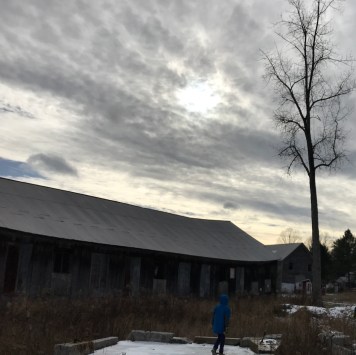
I stood on my back deck last night, leaning against the house and watching my friend get out of her Subaru with a bowl of meatballs. My daughters had strung white Christmas lights all over the barn’s front side that afternoon. The white clapboard had that classic New England winter festiveness, complete with a red-bow wreath someone gave my daughter.

I stood there thinking how in my twenties I would have believed I would live here forever. Forever was part of my twenties’ worldview. In my forties – like just about everyone else I know – the erosion of loss (marriage, business, house) has altered the landscape of my worldview. I stood there thinking that, at some point (God willing, many years hence), someone will live here, and maybe paint that barn cotton-candy pink. For that moment, though, in early December, I leaned against the solid house in the cool afternoon, thinking how fine it was to have guests for dinner and my daughters inside, baking cookies.

I don’t knit, but when I watch someone who does, I think that they must have found some of the same inner peace that I discovered during my expeditions (for example, the South Pole)…. A great many of us have a desire to return to something basic, authentic, and to find peace, to experience a small, quiet alternative to the din….The results that you achieve – firewood to warm you, a sweater you have poured yourself into – are not things that can be printed out. The fruit of your labor is a tangible product. A result that you and others can enjoy over a period of time.

– Erling Kagge, Silence in the Age of Noise

IMG_0448.jpg

Bright Spot

There’s nothing like a carful of laughing girls to whisk away despair. While the girls skied, I walked down to Big Hosmer Lake and sunk my hand in its cold water, thinking of my older daughter at 12 and how much she loved the rope swing on this lake. With an hour left, I sat in the touring center and sunk into my work.

Bringing in the cold and snow, the rosy-cheeked girls found me, chattering, hungry for the crackers in the car. All the way down the narrow valley from Craftsbury to Hardwick, I watched the remnants of daylight dwindle into pale rose, so glad we were headed to our warm house and leftover posole and the cats who would be mewling for their dinner.

12-year-old girls, laughing about falling on skis, listening to Christmas carols, exuberantly happy. I drove, listening, the girls’ merriment like a cloak around us, keeping night terrors away.

IMG_0414.jpg

Last Week of November

My female friends, thinking of middle school, cringe – like me, too – as though we’re all reliving those years.

Just months into middle school with my second daughter, it seems to me the heart-wrenching agony is driven by a burgeoning and raging sense of injustice. Sometimes I wonder if the adult world ever escapes middle school, or merely wears down and accepts bad behavior.

November, November, I remind myself. Afternoons of lake swimming will return.

The girls and I cook dinner and wash the dishes and – because it’s dark – take an evening walk in the dark. White sparkling lights are strung on the footbridge suspended over the river, and even the closed stores on Main Street are lit. Around us, the lights hang low on the mountains stretching up into the black sky. A crescent moon cups its white-gold place in the sky. Walking, I think of Martin Luther King’s long arc of the moral universe, bending back towards injustice, imperceptibly and, yet, making its gradual way.

December, season of falling snow and good cheer, isn’t far.

If ever God’s heart was drowning
in fifty gallons of despair, I would mention
the anatomy of birds as a flashlight
to shine through His heavy grief.
Avian Pallium, I would say….
… the kindness
of this gentle bone, how it protects Cerebral Cortex
like hands wrapped around
a small snowball.

– From “The Anatomy of Birds” by Steven Coughlin

IMG_0406.jpg

Good and Evil

When the holiday is finished, the dishes washed and floor swept, guests departed, the teenager headed to her nursing home job, the 12-year-old and I walk down to the post office in the dark, to drop a letter in the mailbox.

Everything but the empty laundromat and the diner with not a single soul visible is closed. Although dark, the evening is warmer than our walk that morning; a few cars rush through the village, but that’s about it. The laundromat glows overly florescent bright, empty.

We stop where we often do, at the thrift store window, and peer into the shadowy space.

As we walk, I’m thinking of a line my brother said, sprawled on our couch with two sleeping kittens – that the universe may hold good and the absence of good, and what we name evil might merely be that absence. Knitting a hat for my daughter, I paused and asked if he believed that possibility. What, really, would that mean?

We let my question lie between us. Finally, my daughter lifted a card and asked if we might try to answer a question about salamanders.

State 14 generously ran a rewrite of one of my posts. Check out their Vermont writers and photographers.

When I was a boy, when there were wolves in Wales, and birds the color of red-flannel petticoats whisked past the harp-shaped hills, when we sang and wallowed all night and day in caves that smelt like Sunday afternoons in damp front farmhouse parlors, and we chased, with the jawbones of deacons, the English and the bears, before the motor car, before the wheel, before the duchess-faced horse, when we rode the daft and happy hills bareback, it snowed and it snowed.

– Dylan Thomas

IMG_0397.jpg

Hardwick, Vermont, Thanksgiving morning