Who Shows Up

What’s for dinner and politics fill a chunk of our household conversation these days. My Facebook-loving teenager keeps me abreast of the social media world, while I’m in the world of Democracy Now.

As we hurtle towards this contentious presidency, I keep remembering Gandhi’s insistence that politics begins in the house, among the most intimate of relationships. I see that in the wider circle of my own world as well. At school meetings, who doesn’t show up is as important as who does, and tips the balance of those conversations in uneven ways.

As we head into these uncertain times – times that are bound to get even more dicey – I want my daughters to understand both their actions and non-actions make a difference and that passivity does not equal patience. More than anything else, I pose this as a challenge for myself. And to remind myself that even in the bleakest of times – personal or politics, or where the two mix – that we live in a world of laughter, too.

Washing one’s hands of the conflict between the powerful and the powerless means to side with the powerful, not to be neutral.

– Paulo Friere, Pedagogy of the Oppressed
fullsizerender

This Day

Sensible advice from my dad arrived via email this morning.

Two days after I was born, Dr. King was assassinated, when my mother was still in the hospital. I imagine my father returning home in his blue Volkswagen beetle to his two-year-old and his babysitting mother-in-law, switching on the evening news and drinking bourbon in the brilliant Albuquerque light.

48 years later, a mother myself, I intend to walk with my two daughters next weekend in the Women’s March on Montpelier.

Why? my daughters ask. I begin by answering, Because we must.

My dad’s advice was to read Dr. King’s two greatest essays, “Letter from Birmingham Jail” and “Beyond Vietnam — A Time to Break Silence.”

We must rapidly begin the shift from a thing-oriented society to a person-oriented society. When machines and computers, profit motives, and property rights are considered more important than people, the giant triplets of racism, extreme materialism, and militarism are incapable of being conquered.

– Martin Luther King, “A Beyond Vietnam – A Time to Break Silence”

img_9098

Photo by Molly S./Woodbury, Vermont

Keeping the Roof Intact

The other night, my daughters began shouting in the other room. In what I can best describe as my attitude of what fresh hell now? I asked what was up.

A raccoon was climbing up our cedar-shingled house in the dark. Which might fairly well explaining living with kids. Expect what you could never expect. Say you’re deep into an Elena Ferrante novel and you realize a mole has scurried out from behind a kitchen cabinet and is now in the sink, checking out an unwashed dinner skillet. Where is that on a day’s plan?

We trapped the mole and released it down the road (at the neighbors’ driveway), and the girls determined the raccoon tracks led into the sugarhouse and didn’t come out (fine).

The younger daughter and her friend ran into the house yesterday and grabbed ice skates. The roadside ditches were frozen perfectly for ice skating.

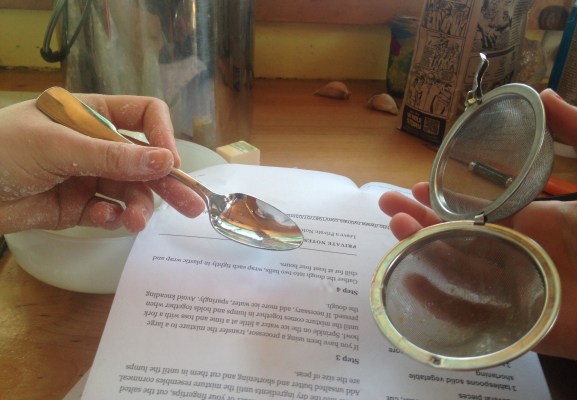
This afternoon is filled with sunlight and lemon meringue pie baking. How’s that for poetry?

There is only one way to happiness and that is to cease worrying about things which are beyond the power or our will.

– Epictetus

FullSizeRender.jpg


Put on Sunglasses

Thaw. The wind screamed all night, breaking the deep cold’s back, strewing broken branches around our house, and even shattering a storm window. In return, we have a reprieve from the deep cold, and the earth – still buried beneath snow – exudes the fragrance of spring’s promise, albeit months yet in the coming.

That there’s promise in scent is remarkable in these monochrome winter days, when much of the talk seems about politics and what the future might bring. None of us know.

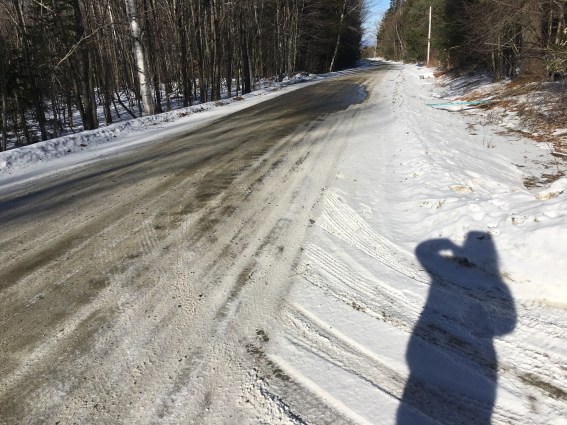
My teenager insisted on driving to school this morning on an icy road. I gave her two pieces of advice and let her go. How could I keep her now, at nearly 18-years-old? It’s been overcast for months in Vermont, and perhaps all over the country, and yet she and her friends insist on wearing sunglasses, these young women, so full of giddy promise.

Old man’s love affair;
in trying to forget it,
a winter rainfall.

– Buson

FullSizeRender.jpg

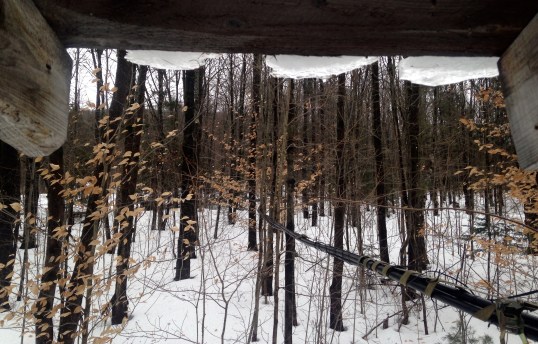
Sap line

Talented Kid

Ever since the holidays, I’ve noticed the same boy riding a unicycle to the Main Street Middle School as I drive through Montpelier on my way to work in the mornings. The cycle is fat-wheeled, sensibly built for Vermont’s rugged terrain. I can see concentration tight on the boy’s face, as he cycles down the steep hill, wearing a helmet and a winter coat, pack on his back.

The boy is maybe eleven or twelve.

Although I don’t know this boy at all, I find myself looking for him on the sidewalk, admiring his tenacity as – at five degrees fahrenheit the other morning! – he pedals down that uneven, icy incline. I imagine him arriving at school, triumphantly cherry-cheeked, hoisting his one-wheeled steed over his shoulder. As I go into my own day, I wonder what kind of man he will become, this hearty, focused, child unicyclist.

The bicycle is the noblest invention of mankind. 

– William Saroyan

img_3116


A Fierce Heart

Years ago, the house we lived in had an enormous King stove, about as ugly as could be with a rust-colored shield. When that stove threw off BTUs, its damper clicked like a mouse in a live trap, rattling.

I once owned a terrible round coal stove I used for wood. Its damper sometimes slipped loose, and I feared that stove would burn down the house. Eventually, that stove was donated to the scrap yard.

Now, cold as my house is around the edges, with too many doors, recycled and unweatherized windows, far-from-well-done insulation, my stove burns its mighty heart, truly keeping my girls and myself alive in these wintry nights. Of the few objects I hold most dear – my cast-iron skillet, laptop, garden shovel, knitting needles – this stove, its brass-handled door so familiar in my hand, is my dearest companion these days, place of succor.

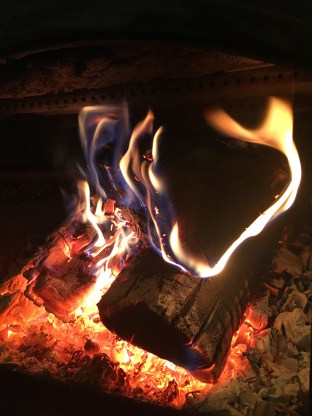
Around our house lies sugary white, sprinkled with a wavering trail of black ash, but inside is glowing red and yellow, flames laced at the edges with blue.

….Oh, now I sing praises to a wood fire,
to the heat this smoky burning liberates,
the heat that keeps us warm all winter.
Oh, praise this primordial fire, praise heat
in its most basic form:
the blessed warmth that comes from
our old, wood burning, Round Oak stove.

– David Budbill, “Ode to Fire, Ode to Heat”

IMG_9064.JPG

Photo by Molly S.