Flipping the Question

The summer I had my second daughter in 2005, the term “peak oil” surfaced in my world, first from a neighbor who came to see the baby. The term itself wasn’t so disturbing, but the potential social unrest was mightily so.

I’m sure Vermont has more than its share of the country’s population battening down the root cellar hatches and stocking the ammo cabinet to bursting. While I’ve been joking for years that my garden isn’t merely spiritual succor but also our homeland security project, I sometimes wonder if these hard-core survivalists just might be right, and I should be mapping a route out. What’s my reluctance? Laziness? Immersion in magical thinking?  Lack of ready cash to invest in an underground bunker equipped with a five-year supply of Spam? Or just, where the heck would we go? 

Evan Osnos writes in the recent New Yorker about ultra-rich disaster preppers, then winds up chatting with Stewart Brand, hippie cult creator of the “Whole Earth Catalog.” Osnos writes:

At seventy-seven, living on a tugboat in Sausalito, Brand is less impressed by signs of fragility than by examples of resilience. In the past decade, the world survived, without violence, the worst financial crisis since the Great Depression; Ebola, without cataclysm; and, in Japan, a tsunami and nuclear meltdown, after which the country has persevered. He sees risks in escapism. As Americans withdraw into smaller circles of experience, we jeopardize the “larger circle of empathy,” he said, the search for solutions to shared problems. “The easy question is, How do I protect me and mine? The more interesting question is, What if civilization actually manages continuity as well as it has managed it for the past few centuries? What do we do if it just keeps on chugging?”

fullsizerender

Morning commute, West Woodbury, VT
Young Women

My younger daughter collided with a basketball in practice the other day and returned home with a swollen lip. Her older sister, a tiger by nature, immediately asked if she should provide restitution. (It was an accident.)

Today, in her high school guidance counselor’s office, my teenager is all long legs, a combination of gawky and ravishing in her black parka and dark eyes. Like sparks, she emanates loyalty, desire, heartache, anger, joy. Yes, all this.

I’m reading the new biography of Emma Jung, and I can’t help but wince that this talented woman, like so many others, was under the “vaulting ambition” of her famous husband. As a society, we haven’t made it all that far from those days. How much I want for both my daughters not to bend under their future partners’ ambitions, and to expect with impunity equality in parenting and in creative fulfillment, to know that before we can demand justice anywhere else on the planet, our own relationships must at least be threaded with decency.

My fierce tiger, my mighty one.

If only we lived in a culture that made ambition compatible with motherhood and family life, that presented models of women who were integrated and whole: strong, sexual, ambitious, cued into their own varied appetites and demands, and equipped with the freedom and resources to explore all of them. If only women felt less isolated in their frustration and fatigue, less torn between competing hungers, less compelled to keep nine balls in the air at once, and less prone to blame themselves when those balls come crashing to the floor. If only we exercised our own power, which is considerable but woefully underused; if only we defined desire on our own terms.

– Carolien Knapp, Appetites: Why Women Want (Put this book on the required reading list.)

fullsizerender

Greensboro, Vermont

Winter Travels Near to Home

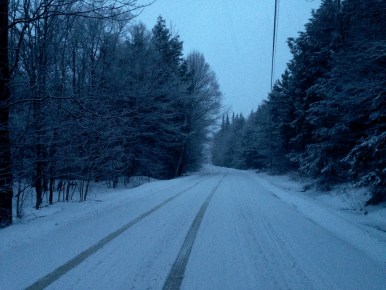
We drove home through falling snow tonight – real snow – not ice, not grapple, not nerve-wracking freezing rain. As my kid and I wound up our steep dirt road, the visibility diminished to just a blue twilight, white flakes and road, and my windshield wipers.

That narrow vision mimicked my day – both parenting and working. In my twenties, I would have raged; now in my forties, I still rage, but at least I’ve figured out the value of endurance.

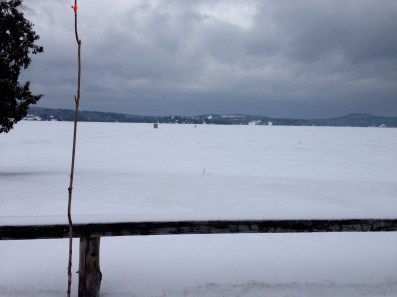
Working in Greensboro today, I stopped by Caspian Lake, scene of so many swims, beach chat, peppermint ice cream cones. On camp stools, three ice fishermen sat in the lake’s middle, beneath the open sky.

Winter solitude —
In a world of one color
the sound of wind.

– Basho

FullSizeRender.jpg

A New Compact?

Snowed and iced in today; no school. My teenager, lying on the couch, reads the news aloud, then shows her sister and me image after image. Although I’m hardly ancient, photos were never so prolific in my childhood. In her hand, she scrawled through the nations. It’s mesmerizing.

And yet.

Lying on the rug before the wood stove, listening, I thought of the Mayflower Compact, when those pilgrims, faced with starvation and illness, in a foreign and bitterly cold country, pledged to hold together for their survival. One of the aspects of small town Vermont politics I like best is coming together on metal folding chairs, looking directly at each other, and determining the course of our future, face to face. In these little towns, open meeting laws rule – not email and certainly not Facebook.

Don’t we need a contemporary version of the Mayflower Compact? Here’s a single mighty sentence.

Having undertaken, for the glory of God, and advancement of the Christian faith, and honor of our King and Country, a voyage to plant the first colony in the northern parts of Virginia, do by these presents solemnly and mutually, in the presence of God, and one of another, covenant and combine our selves together into a civil body politic, for our better ordering and preservation and furtherance of the ends aforesaid; and by virtue hereof to enact, constitute, and frame such just and equal laws, ordinances, acts, constitutions and offices, from time to time, as shall be thought most meet and convenient for the general good of the Colony, unto which we promise all due submission and obedience.

– Mayflower Compact, 1620

FullSizeRender.jpg

Vermont

The summer I had my second baby was particularly hot, and I frequently nursed my baby beneath one of the enormous sugar maples on the Montpelier state house lawn. My six-year-old played on the capital steps, and ran up and down the granite walkway, admiring the blooming flowerbeds.

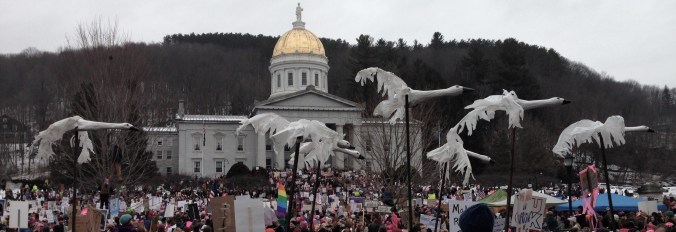
Yesterday, with my kid contingent, we stood somewhat elevated on the DMV steps. Readers, the people kept coming and coming. This place we know so well was filled to bursting and more – with an odd kind of quiet and extremely polite tension, which was then dissipated by a full-throated roar of collective energy.

My teenager, walking and driving all over town with her friend, relayed that the interstates were backed up and the exits closed. Vehicles were abandoned on the roadsides and mediums, and people walked in.

That’s the Vermont I’m proud of. Resilient and smartly dressed in winter footwear. The Vermont who shows up – traffic jams be damned – when needed. If there’s hope for democracy’s survival anywhere in this country, it’s here.

I stood beside two older women who had set up their folding chairs and were prepared to stay as long as needed. One woman held a lavender homemade sign, with a sunflower and a single word: RESPECT.

Here’s a few lines from the library book I was reading last night while the children slept.

For a long time I have hesitated to write a book on woman, is how de Beauvoir starts one of the most famous books on women ever written…. The wounded woman gets called a stereotype and sometimes she is. But sometimes she’s just true…. Pain turned trite is still pain. I think the charges of cliché and performance offer our closed hearts too many alibis, and I want our hearts to be open. I just wrote that. I want our hearts to be open. I mean it.

– Leslie James, The Empathy Exams

fullsizerender

Montpelier, Vermont

January 20, 2017

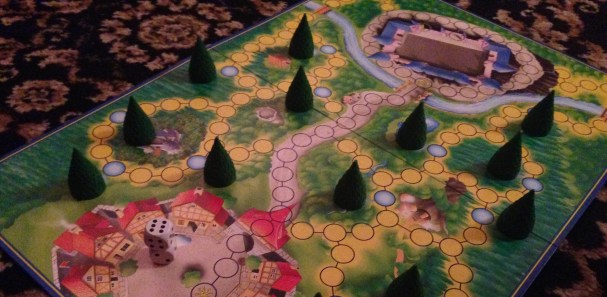
Since the holidays, my 11-year-old daughter and I have played The Enchanted Forest just about every night. Each round of the game is different, involving only a few things: a  journey and remembering what’s beneath each tree. A red cap. A glass slipper. A gold star. Who wins or doesn’t hardly matters in this game; it’s just fun.

On the not-so-fun spectrum, when my marriage broke up, I knew this was not a matter of winning or losing, but there was an enormous gray area I wanted to emerge from in a way I’ll describe as “least soulfully damaged.” Perhaps one of the few things I’ve learned is that there are no winners in this life at all, either in our intimate realms or the political world. That knife of mortality cuts across all of us, from Trump Towers to Rio’s dump dwellers. But it does seem to me that there are better ways than others to emerge from the firestorm of life we all come to, at certain points in our lives.

In our world, the threads of discontent are so manifest, and the threat of widespread societal violence and misery so palpably real. We may be entering the lightless trek of our forested journey, and yet, I myself know, through my own hard-earned experience, that our reserves of faith and empathy are far, far mightier than we might ever envision. I’d like to believe that’s a spring we may draw from, without cease.

Here’s a few lines from one of my favorite poems.

This is the season of mud and thrash, broken limbs and crushed briers
from the winter storms, wetness and rust,
the season of differences, articulable differences that signify
deeper and inarticulable and almost paleolithic
perplexities in our lives, and still
we love one another. We love this house
and this hillside by the highway in upstate New York.
I am too old to write love songs now. I no longer
assert that I love you, but that you love me,
confident in my amazement. The spring
will come soon. We will have more birthdays
with cakes and wine. This valley
will be full of flowers and birds.

Hayden Carruth, “Birthday Cake”

fullsizerender